
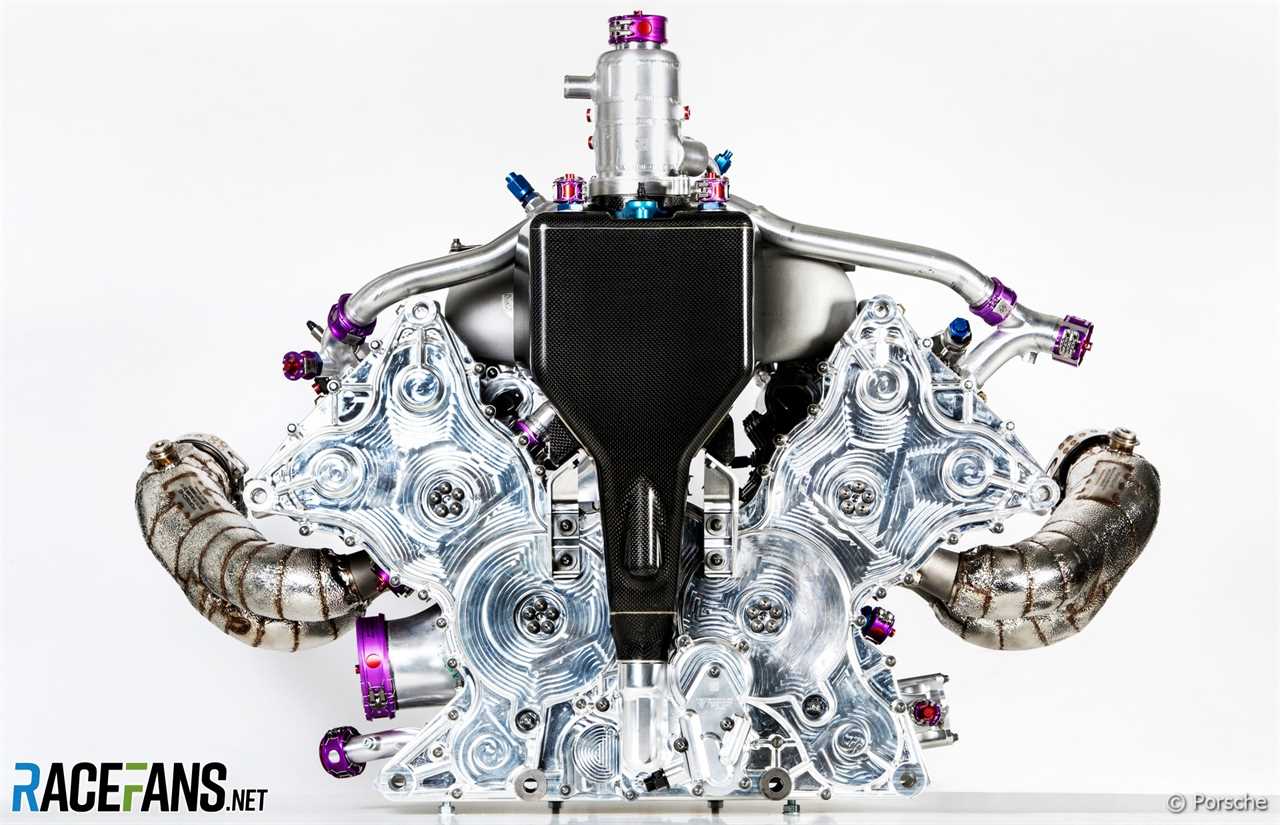
There were high hopes in the Austrian Grand Prix paddock that Saturday’s engine meeting at the five-star Hotel Steirerschlössl, a mini castle-like establishment situated in, as the name implies, the picturesque Styrian highlands surrounding the Red Bull Ring, would magically deliver definitive 2025-onwards powertrain regulations, but that was never the intention behind the meeting.
For proof of this statement consider one simple factor: team principals and technical directors were not invited (of which more later, for there was an exceptional case), so any deductions that regulations (or even binding decisions beyond agreement to meet again) would be agreed were not only premature but based on false premises.
The mere fact that, apart from F1 and FIA executive and senior officials, only CEOs of currently committed and potential engine suppliers were invited to the meeting in the boutique hotel owned by Red Bull proprietor Dietrich Mateschitz suggests the primary criterion was return on investment of future power units – not number of cylinders, cubic capacity or hybrid capabilities (although these were broadly discussed).
According to sources with knowledge of the meeting – a ‘gentlemen’s agreement’ to maintain confidentiality was struck amongst the delegates – Red Bull proprietor Mateschitz delegated his authority to his F1 leadership due of Christian Horner and Helmut Marko. Mercedes F1 Toto Wolff was not present, but then he is not a director of engine company Mercedes High Performance Powertrains Ltd, of which the team is effectively a customer.
The purpose of the summit was to establish a top-down direction, one that determines what the current spectrum of suppliers – Mercedes, Ferrari, Renault and Honda (Red Bull from 2022-onwards) – is prepared to spend on F1 power units versus their market expectations, and to establish the terms and conditions under which brands such as Porsche and Audi are prepared to join F1 as engine suppliers, or even as team owners.
Porsche VP Fritz Enzinger was in the F1 paddock in Austria…This approach differs markedly from that used before, where ambitious engineers – mostly with little grasp of marketing or economics – trotted wish-lists, which they submitted to the governing body at the time (2009) presided over by the regime. These items were then combined into a set of regulations that delivered the most complex and efficient engines in automotive history – at eye-watering prices.
Although costing methods vary, consider: In 1968 a Ford Cosworth V8 DFV, at the time the gold standard, cost around $10,000, translating to $80,000 at present values. True, that was for an outright purchase, and rebuilds – around four per season – were required, but most teams got by on engine budgets of $50,000 ($400,000 at current values) for two cars, so $25,000 ($200,000) per car per season. And they owned the units, rather than lease them.
Now consider that in 2019 – the last year on record – Mercedes High Performance Powertrains (the F1 engine division) reported a turnover of around $270m. According to sources around 65% of that was F1-related, the rest spent on internal and sporting projects, so $180m. While exact production figures are confidential, it is doubtful HPP produced more than 100 complete units across three teams, including for test purposes.
Advert | Become a RaceFans supporter and
That pans out at $1.8m per unit annually, or an average of $60m per team, yet FIA regulations permit suppliers to recover $20m per season in lease and servicing fees, meaning that in broad terms HPP subsidises F1 engine supply to the tune of $40m per team.
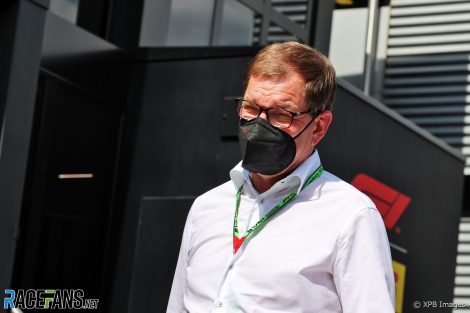
…as was Audi CEO Markus DuesmannCosts are unlikely to have reduced since. Furthermore, Mercedes now supplies four teams, making for subsidies of around $160m, give or take $10m. No wonder Daimler chairman and head of Mercedes Ola Källenius – a former CEO of HPP – was an active participant on Saturday!
“I think it was a constructive dialogue,” said Horner on Sunday. “It’s important we find the right solution both in cost and products, for the future of Formula 1. I think the right stakeholders are involved in the discussion, and it’s important to work collectively for the benefit of the sport.
“I think we see that costs of the current engine are extremely prohibitive. It was not thought of when this engine was conceived, and I think there’s a fantastic opportunity for what could arguably be the engine for 10 years [after introduction] to do something a little bit different.
“It’s to address the emotion, the sounds, it has to tick the sustainability boxes, but I think it still needs to be entertaining otherwise we should all go and do Formula E. Hopefully the collective minds can come up with something attractive for 2025 or what would be more sensible is to do the job properly for 2026.”
Note: Where previous talk had been about 2025 introduction, already there are attempts to push the introduction back by a year.
The challenge facing F1 engine suppliers is that they all have different agendas: On one hand Renault uses F1 as a flagship for a range of (largely) mass-produced econo-box cars; on the other Red Bull aims to be self-sufficient across its two teams, hence its decision to produce its own units based on Honda’s design. Sitting between these extremes are Mercedes and Ferrari. Try slotting Porsche and Audi into that lot, yet F1 desperately needs more than four suppliers…
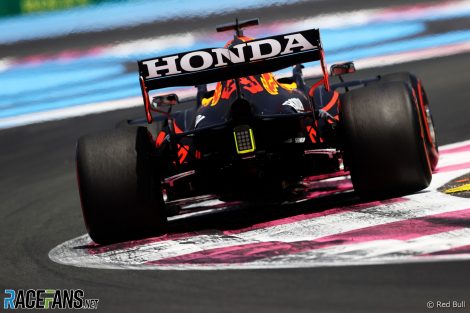
Red Bull will rebrand its Honda power units next yearComplicating the matter further are the unknown ecological and political factors: That the automotive world, including F1, needs to be carbon zero is absolutely clear, yet politicians cannot even agree on a simple set of emission standards, let alone provide a roadmap for the future. This topic opened the second day of the FIA’s combined mobility and sport conference, held this week in Monaco. Fittingly, the theme is: ‘PurposeDriven’.
Motorsport Industries Association CEO Chris Aylett likened the topic to space exploration, saying, “Zero carbon is our ‘man on the moon’,” adding that when US president JF Kennedy set the objective of landing a human on the moon he didn’t tell the engineers how to go about it. By implication politicians are doing precisely the opposite with emissions legislation – yet are clearly far from being qualified to do so.
One thing was clear from the session: Speakers believe that electricity is not the only global alternative for the automotive industry and that the internal combustion engine will be around for decades to come, regardless of what ecologists and politicians preach, if for no reason other than the world simply cannot generate sufficient affordable electricity and deliver it sufficient quantities to charging points.
Advert | Become a RaceFans supporter and
Per chance, the headline feature in Tuesday’s edition of (the daily) Automotive News industry publication made the point that, while around 15% of current new car sales are electrified vehicles, 50% of those are what are known as plug-in hybrid electric vehicles (PHEV), which are, of course, powered by ICE units, whether diesel or petrol-powered.
Thus, 92.5% of the 85m cars the global automotive motor industry will this year add to roads this year will be fuel-powered to some degree or other. With a life expectancy of 15 years it is clear the 1bn-strong global vehicle park will increase in the medium term (at least), making it imperative that zero-carbon combustible fuels are developed as rapidly as possible. As production ramps up, so costs should progressively reduce.
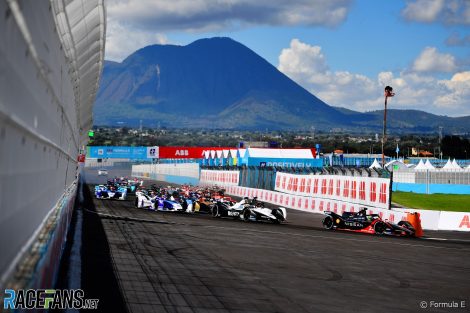
Horner isn’t impressed by Formula E’s electric motorsDisciples of electric vehicles predict enormous strides in battery technology over the next few years, citing mass power density advances which reduce weight, cut costs and extend range. However, they seldom (if ever) acknowledge that such technologies apply equally to PHEVs; indeed, many deny that PHEVs could play a pivotal role in accelerating the development of batteries, thus serving PHEVs and EVs equally.
During the conference Burkhard Goeschel, president of the FIA Manufacturers Commission, former technical head of BMW and long-standing alternate energy proponent embraced made the point that the motor industry is building “giga-factory upon giga-factory upon giga-factory”, but that global reserves of lithium, nickel and copper – primary ingredients in the production of lithium-ion cells – are depleting rapidly.
Dr Goeschel believes that solid state batteries will be the next big thing across the industry. F1 proved its reaction abilities by designing and developing ventilators during the COVID pandemic; imagine how rapidly motorsport could develop solid state batteries if pushed to do so, even if they are also deployed in EVs. Indeed, Renault CEO Luca de Meo justifies his company’s F1 engagement in the face of a push to electrification on that basis.
The primary difference between the two is that Li-ion uses liquid electrolytic solutions to regulate current flow, while solid-state cells, which pack up to thrice the energy density, rely on solid electrolytes. These are also less combustible and rely on less toxic materials, although they do present manufacturing and scaling challenges. However, ongoing research could resolve these sooner rather than later.
“We have a lot of electric motor sport series and we should put a lot of purpose on pushing battery technology,” said Goeschel.
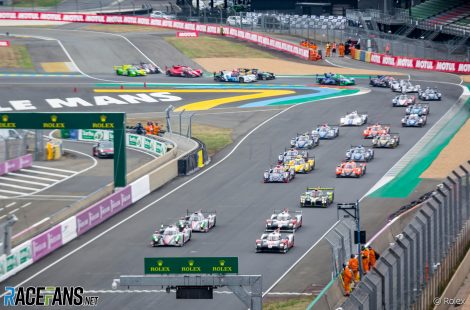
Hydrogen could be the future fuel of the Le Mans 24 Hours“I know the costs could ramp up but we have to push. If we go to solid state batteries and it fulfils the performance which has been discussed, it could outperform hydrogen fuel cells.
“The other area is sustainable e-fuels,” he said. “We have existing infrastructure for liquid fuels and we have a very weak infrastructure for electric vehicles. We cannot neglect that.”
Intriguingly, though, during his session Pierre Fillon, CEO of the Le Mans 24 classic, stated WEC’s top racing class could be hydrogen-powered within 10 years, such is progress made by fuel cell technologies. Thus, by the turn of the decade global motorsport could be powered by three distinctly different energy sources: e-fuels, electricity and hydrogen, each with obvious cross-over potential for road car applications.
However, the major issue is that motorsport does not carry the highest priority for politicians, yet motorsport could provide the solutions to low- or zero-carbon mobility solutions. Thus, it is incumbent upon the FIA, which carries global responsibility for both disciplines, to formulate technologies that drive mobility solutions forward via motorsport.
F1 is the FIA’s standard bearer in this regard both through its hi-tech capabilities and global reach, which brings us neatly to the point of Saturday’s summit: to formulate F1’s 2025-onward engine regulations that tick the following boxes with an indelible marker pen: similar power levels to current, lower costs, run on zero-carbon fuels, and increased hybridisation. A simple list, yet all the desired characteristics are mutually exclusive.
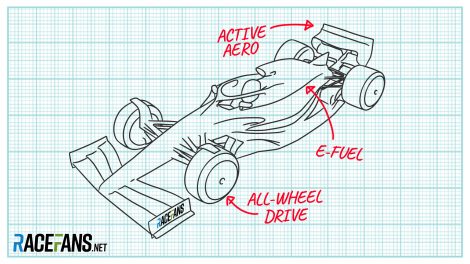
Analysis: Radical changes on the drawing board for F1’s next rules revolution in 2025Various options were (allegedly) discussed in broad terms, including a switch from V6s to downsized four-cylinder inline units as per road car trends, and the scrapping of the horrifically complex and expensive MGU-H units which sap engine noise, then compensate for energy recovery loss via all-wheel drive, as originally revealed by RaceFans.
There is, though, a flipside: Unless Porsche and/or Audi (or any other incoming brand) commits wholeheartedly to a new power unit formula there is little rationale in change, for dumping the current formula for the sake of change makes little sense unless F1 benefits via increased participation from motor manufacturers. If not, why incur these costs?
“The discussion was ‘what are we doing in the future in terms of engine’, because we want to save costs, so we don’t want to reinvent the wheel,” Wolff, who did not attend the summit but is clearly protecting vested interests, told the FIA conference on Monday.
“We also want to have an engine that is relevant from 2025 to 2030, and we can’t be old petrol heads with screaming engines when everybody expects us to be going electric.
“So these engines are still going to be fuelled [by zero-carbon fuels]. We are staying with the current V6 format, but the electric component is going to massively increase.”
Thus, it is not inconceivable that F1 sticks to the current V6 architecture by converting the tried and tested engines to run on e-fuels or ‘drop-in’ fuels that require little modification. The MGU-H technology has, after all, been fully paid for, while the reliability of the units is no longer a major concern. Such a decision will be by far the cheapest, but, equally, ticks fewer boxes and is unlikely to attract incoming brands.
F1 has been here before: In July 2018 a summit was called shortly before the British Grand Prix weekend and a full slate of options presented to interested manufacturers, including Porsche. When suits in Stuttgart refused to commit to F1 a wholesale change of engine regulations were scrapped and the lifespan of current units extended to the end of 2025, subsequently shorted by a year and their specifications frozen for the duration.
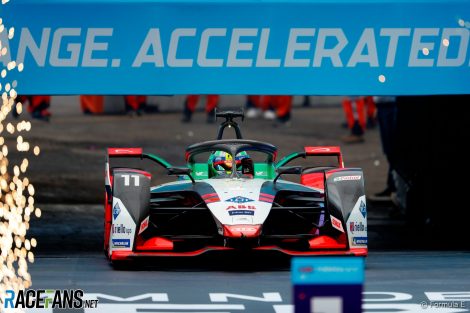
Porsche is saying in Formula E, but Audi is leavingThe next step in the current process is for Saturday’s attendees to confer internally before another summit called in the near future – likely in the run-up to Silverstone – to ascertain the appetite of the VW Group companies and whatever follow-up points are raised by the current suppliers. That meeting will provide the acid test for F1’s commitment to long-term sustainability.
That F1 needs to change its ways is clear, that the ICE is far from dead equally so. The trick facing the FIA, F1 and all engine suppliers – present and potential – is to manage the switch-over in such a way that the decisions find lasting favour amongst fans, sponsors, promoters, broadcasters, all of whom will base their medium- to long-term decisions upon the engine formula.
The ultimate irony is, though, that after years of criticism of the current engine formula it is delivering the best racing for many a year, yet its demise is being widely debated due to external factors, not all of which are within the sport’s control.
RacingLines
Browse all RacingLines columns





