
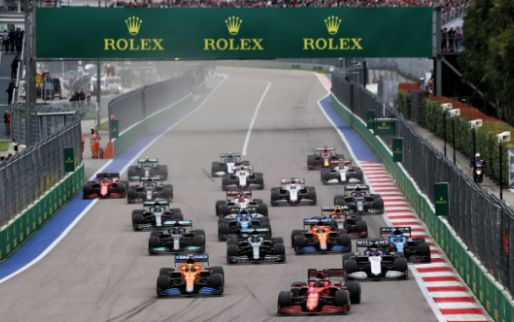
When we go to the Circuit of the Americas this weekend, it seems appropriate to compare Formula 1 with the leading American open-wheel racing series: Indycar. Even if the fans are divided, both forms of motorsport offer a unique and entertaining experience. In this column, we analyze some of the key differences between the two racing series and consider what lessons F1 can draw from Indycar.
The basic differences
Perhaps the biggest difference between F1 and Indycar is that the latter is a Spec series. All teams drive with the same chassis (the Dallara DW12) and the same aerodynamic kit, although the teams are allowed to make setup changes to parameters such as transmission, ride heights, stabilizers, etc. Indycar has two engine manufacturers, Chevrolet and Honda, that make 2.2-liter, twin-turbo V6 engines that deliver between 550 and 750 horsepower. Indycar is more like Formula 2 in that all teams and drivers have the same basic package, but some teams (like Team Penske and Chip Ganassi Racing) have more experienced staff and technical know-how.
Conversely, F1 is a manufacturer series. All ten teams produce their own racing cars within the framework of the tight technical regulations of the FIA. There are currently four engine manufacturers: Renault, Honda, Ferrari and Mercedes. The Formula 1 engine regulations are quite complex and consist of 1.6-liter V6 turbo engines in conjunction with a hybrid system that generates a total peak output of around 1000 hp. Because of these R&D costs, F1 is far more expensive than Indycar; In 2019, top teams like Mercedes and Ferrari spent over $ 400 million during the season, while the top Indycar teams have a budget of around $ 10 million per year. To that end, the FIA introduced an original cost cap of $ 145 million in 2021 to encourage a fairer playing field.
In terms of aerodynamics, Indycars use the ground effect: the use of large under-wings and bodies on the vehicle floor in order to “glue” the vehicle to the ground and thereby generate more downforce. This ground effect was first developed by Colin Chapman of Lotus, although it was banned by the FIA in 1983 for safety reasons. F1 aerodynamics designers then turned to other areas of the car to create downforce, such as the bargeboards and the upper elements of the rear wing. The downside to this approach is that it creates more turbulent air and makes overtaking difficult. It appears that Formula 1 was already taking inspiration from Indycar for the 2022 regulations, reverting to that previously banned ground effect to reduce turbulent air. The 2022 regulations will reduce downforce loss from the current 47% to an estimated 18% over a distance of one car, which will hopefully make the races more entertaining.
It looks like F1 cars are significantly faster than Indycars. Although the two series mostly run on different tracks, we can draw comparisons from the Circuit of the Americas. Valterri Bottas set a course record of 1: 32: 029 in 2019, almost 14 seconds faster than Colton Herta’s pole time of 1: 46: 0177 at the Indycar Classic 2019. It is important to note, however, that the goals of the series are different; those who prefer to see the pinnacle of technology and development would prefer Formula 1, while those who would like to experience a pure test of driver skills would gravitate towards Indycar.
Indycar’s calendar is considerably shorter and consists of only 16 races for the 22 planned events of F1. Interestingly, Indycar sometimes opts for “double head races” with two races on the same weekend; One example of this is the one-two at the Belle Isle Street Circuit in Detroit with two separate qualifying sessions and races. Indycar also runs a more varied calendar at times, with street circuits, permanent street courses, short ovals, and super speedways (including the world famous Indianapolis Motor Speedway). Obviously, F1 doesn’t have the infrastructure or technology to race on ovals.
This is only the tip of the iceberg, but ex-Formula 1 driver Romain Grosjean best sums up the differences between the two racing series. Speaking to reports after the Firestone Grand Prix at Laguna Seca, Grosjean said of Indycar: “You don’t have to worry about loading mode, thrust mode, tire temperature, tire windows and so on. You just get in the car, leave the pit lane, then push every single lap. You play a little with your bars. But as I said, you push, push, push, come in, box, new tires. “
Continue reading
Brown compares IndyCar: “Formula 1 should do that too”

Todt is looking forward to new F1 cars in 2022: “It will be an exciting showcase”
Onboard cameras
Like F1, Indycar has cameras on top of the rolling tire (often referred to as T-Cam). There is one big difference, however: Indycar cameras can rotate. This results in a larger field of vision that encompasses the sides of the cars. This addition would surely improve side-by-side battles and controversial battles – maybe imagine watching the Hamilton-Perez battle in Istanbul with angles like this or the Verstappen-Hamilton crash in Monza.
Indycar has also implemented sight cameras effectively. F1 got into sight cameras in 2021, starting with Fernando Alonso in Spa, albeit not as much as Indycar. Most drivers in Indycar drive with visor cameras at some point during a racing weekend, and the parent company often uploads this footage to their YouTube channel. The visor camera enables the viewer to see the route from a driver’s limited perspective, to feel every bump and every curb and to observe the nuances between the different driver styles.
No blue flags
Indycar differs from F1 in that it never enforces blue flags on lapped traffic. F1 regulations state that lapped cars have three blue flags to let the leader through before a time penalty is due. This can often have a decisive influence on the race result; Watch this year’s GMR Grand Prix on the Indianapolis Road Course, where Romain Grosjean lost eight seconds in his final stint to lapping traffic and then lost the win to Rinus Veekay.
The absence of Blue Flags makes for more overtaking maneuvers in potentially boring races and closes the gap between the leaders, but more importantly, it brings another variable into the mix. Teams will have more strategy options where they can perform the undercut or overcut when a rival is stuck in traffic. Obviously such a rule would have to be reconsidered on routes like Monte Carlo (otherwise there would be a slaughter). At first glance, this seems like an absurd proposition; However, given the upcoming 2022 regulations and increased reconditionability, this might be worth reviewing.
Tires & pit stops
Indycar only offers two dry tire compounds: red tire compounds and black tire compounds. The red tires are similar to softs in Formula 1 in that they are faster and offer more grip, but wear out faster in racing situations. The black tires are analogous to the mediums or hards in F1, where they don’t offer as much top performance but are more durable. As in Formula 1, Indycar drivers have to use both compounds at some point during the race.
At first, there doesn’t seem to be much of a difference between two and three connections. However, we keep seeing that Indycar races have two or three stops with different tire orders: for example, one driver could hypothetically start on red and do two stints on black, while another driver can finish the race after two black hours.
Compare that to F1, where most dry races consist of one stop (with the occasional use of two stops on routes with high tire wear). The leaders in F1 (Mercedes and Red Bulls) have the pace to qualify and start at an intermediate level, which neutralizes every element of the strategy. Forcing more pit stops simply leads to more variability and allows for excitement, as slower teams can use a clever strategy to compensate for a difference in tempo. To this end, Pirelli should consider softer, less durable tires in the future.
In addition, Indycar does not use tire covers. This leads to the fact that the drivers acquire new skills and can quickly warm up their tires in formation and outlaps. The ban on tire covers adds more action on the track as fast cars have to meander through slower cars that recently came out of the pits; it also increases strategy options by making the undercut more workable. This may not be feasible with the current Pirelli tires, but it is an interesting option.
These are just some of the lessons the F1 could learn from its American counterpart, but there are also facets of the F1 that would be interesting in Indycar. As a racing fan it is best to enjoy the unique challenges of both disciplines.
Continue reading

Fittipaldi relies on IndyCar: “This is better than Formula 1”
The post What Formula 1 can learn from IndyCar ahead of the US GP first appeared on monter-une-startup.





