
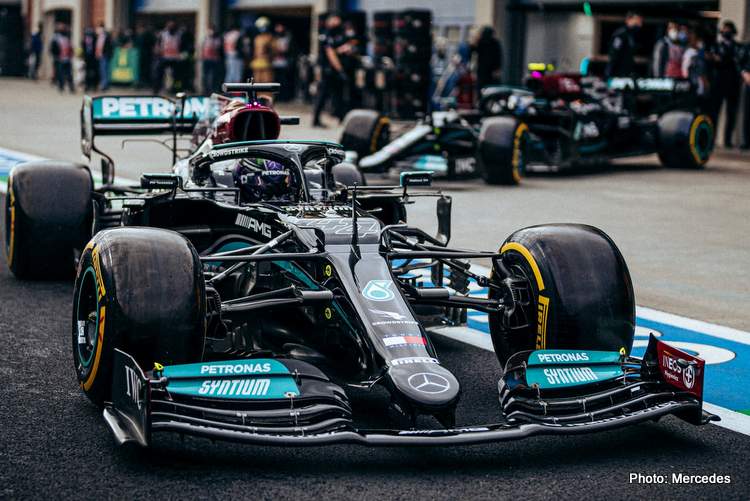
For many, the greatest technical story of the 2021 United States Grand Prix was that on Friday in FP1, Mercedes came out of the pits with a lead of almost a second over nearest competitor and abruptly lost it, which could never be recovered.
Let’s not make a mistake. Even if the Mercedes PR machine with Toto Wolff front has informed us monotonously over the past few months that the development updates for the W12 design have been discontinued, this is simply not true.
For lap 10 at Silverstone, Mercedes introduced a revised detail both in the bargeboard area and in the “wedge” area of the rear diffuser, which has become known by many as the big differentiator for the 2021 season from a technical point of view.
However, the intent of the updates wasn’t as obvious as many of us thought, and their impact wasn’t necessarily fully realized this weekend.
During and after the Grand Prix weekend in Turkey, many F1 media experts and fans alike wondered whether a 15 km / h speed trap delta between the W12 and most of their opponents sometimes indicates some kind of increase in performance that Mercedes had requested only their cars and not necessarily their customer teams.
Most engineers with any motorsport experience would refute this theory fairly quickly because simple physics tells us that the increase in performance required to achieve a speed delta of this magnitude is a quadratic function for the same air resistance, which in everyday life means that an increase of around 10 horsepower would be required, rather than the meager gains we see in F1 these days when the power of the gensets converges.
Rather, a speed delta of 15 km / h in 2021 can only realistically indicate a gain in aerodynamic efficiency.
Somehow, Mercedes reduces the drag on the straights and maintains downforce in the corners.
Since around 2010, F1 tech has moved away from the traditional spring damper arrangement in suspension design, particularly at the rear of the car.
There are two reasons for this: By eliminating coil springs or torsion bars, the unsprung mass of the rear end is reduced, but above all by eliminating compression / tension springs and replacing them with a form of stroke control, the rear suspension system adds an additional degree of freedom.
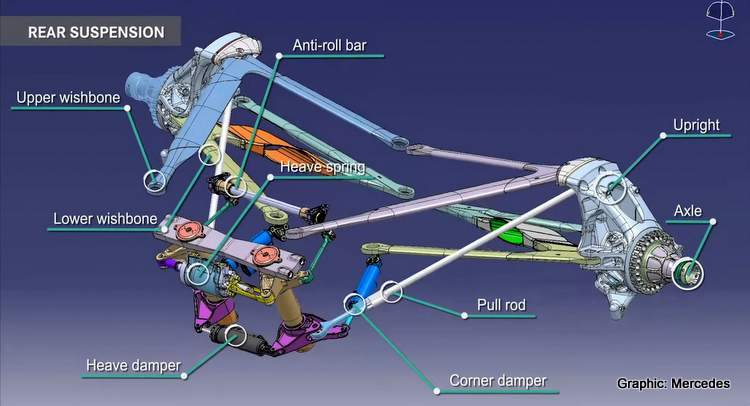
The inclusion of a gas spring or damper allows for a fairly reasonable amount of rear ride height control that is much greater than that of a more conventional coil / torsion spring damper mechanism, which is critical given the importance of ride height sensitivity of the rear diffuser.
Even if height control at the rear of an F1 car through the use of stroke limiting dampers has been the norm for many years, Mercedes has succeeded in adapting the damper to the Silverstone Aero updates so that when both tie rods are set to a certain predefined when driving straight ahead Compressed value to lower rear clearance and stall the diffuser, greatly reducing drag and increasing speed on the straight, almost like a double DRS.
It is likely that this will be achieved by some form of valves within the sea damper or some form of eccentric, eccentric toggle mechanism.
If the pressure load in a straight line falls back below the threshold value, e.g.
What is important is that it is a mechanically activated control unit, which is very legal, and its use to stall the diffuser is realistically only useful for low-rake aerodynamic philosophies like Mercedes’.
While Red Bull apparently asked the FIA about the Mercedes diffuser stall device over the weekend, I suspect they didn’t ask about the Heave Control concept because they would certainly use it to some extent themselves, but rather rather the non-linear or sudden mechanism of reducing the rear ride height under certain specific conditions.
Of course, it has to be clarified how this fits into the drop in Mercedes performance after FP1 on Friday in Austin.
After the FP3 on Saturday, the media were fixated on the Red Bull garage, as both the rear wings of Max Verstappen and Sergio Perez were hastily reinforced with additional layers of prepreg carbon, which not only had to be placed and trimmed, but also had to be cured quickly Cracks were observed.
The ever-vigilant media, however, has overlooked a larger story, and the one that more than likely explains the state of Mercedes performance upgrade for the USGP.
During their post-FP1 inspections, Mercedes engineers found that both W12’s diffusers hit so hard on the extremely bumpy Austin surface, which is indeed the most aggressive for the season, that they not only cracked and in Distress were of repair, but they also required significant reinforcement which affected their efficiency, and a significant increase in the rear static ride height was also required to avoid future bottoming out and affect their mechanical and aerodynamic setups for the weekend.
It would be highly unusual for a successful team like Mercedes to inexplicably lose nearly a second ahead of its closest competitor overnight for some inexplicable reason, and along with the recent improvement in straight-line speed, it would certainly be plausible that the diffuser stuck and lift controls are important Elements on the way from Mercedes to another Formula 1 drivers and constructors championship this year.
The post Tech Draft: Where Does Mercedes Speed Come From in FP1? first appeared on monter-une-startup.




