

Much has changed since the first Grand Prix of the Formula 1 World Championship in 1950 at Silverstone, Great Britain. Today, Formula 1 is without a doubt the most technologically advanced motor sport in the world.
A kind of arms race has been going on since 1950, not between the drivers on the track, but between the engineers who build F1 cars and the technicians who build them. Below are just a few of the technological developments that have taken place in Formula 1 since 1950:
- 1952 – Hard shell helmets for drivers have been made compulsory
- 1955 – Engines were moved behind the driver
- 1961 – The first four-wheel drive car was presented
- 1962 – the first full monocoque vehicle; Monocoque is a French term that means “single shell”. It means a structural skin in which the chassis is integrated into the body and the loads are carried by the outer skin of the vehicle, similar to an eggshell
- 1963 – Fire retardant overalls were required
- 1968 – Full-face helmets were made compulsory, and integrated aerodynamic wings and separate wing wings were also introduced
- 1971 – Slick tires used for the first time; These tires, also known as “racing slicks”, have a smooth profile
- 1972 – Seat belts were made compulsory first
- 1977 – the first car with turbocharger and the first car with ground effect; A turbocharger is a turbine-powered forced induction device that increases the performance of an internal combustion engine by forcing additional compressed air into the combustion chamber. The ground effect refers to the increase in downforce
- 1981 – first monocoque chassis made of carbon fiber composite material
- 1989 – Introduction of the semi-automatic transmission
- 1990 – Introduction of traction control
- 1992 – The active suspension has been introduced
- 1993 – Introduction of the anti-lock braking system
- 1997 – Introduction of a wheel-specific second brake pedal
- 2003 – Introduction of the HANS device (Head and Neck Support)
- 2009 – Introduction of the kinetic energy recovery system (KERS), including the double diffuser
- 2010 – F-channel, burnt-out diffuser introduced
- 2011 – The Drag Reduction System (DRS) is introduced
- 2012 – The innovative Coanda exhaust is presented, also blown front axles
- 2014 – Introduction of turbo hybrid engines
- 2018 – The Halo cockpit protection system is introduced
- 2020 – Introduction of two-axis steering (DAS)
2011 to 2021
There have been enormous changes in Formula 1 vehicles in the last decade alone. In 2011, F1 vehicles were 4,800 mm long, today they are over 5,000 mm long. The cars have also gotten wider. Today’s are 2,000 mm wide, compared to 1,800 mm in 2011.
Clay Regazzoni drives for Ferrari at the 1976 German Grand Prix Source: Lothar Spurzem / Wikimedia Commons
2021 Formula 1 vehicles are heavier than 2011, partly due to the weight of the Hybrid Power Units (HPUs). In 2011 F1 cars weighed at least 640 kg, in 2020 746 kg and the minimum was increased to 752 kg in 2021 and to 790 kg in 2022 (all weights include the driver but not the fuel). Between 2020 and 2021, the minimum weight of the unit increased from 145 kg to 150 kg. This weight test was an attempt to improve the playing field as well-funded teams had access to expensive weight loss materials.
In 2014, 1.6-liter V6 turbo hybrid engines were introduced, replacing the 2.4-liter V8 of the last decade, the V10 before 2006, and the V12 before that. The V6 weigh a minimum of 145 kilograms and run at an astonishing 15,000 revolutions per minute (rpm).
The V6 engines use a sophisticated hybrid system consisting of the energy storage (ES), the control electronics (CE) and two additional power sources, the Motor Generator Unit Kinetic (MGU-K) and the Motor Generator Unit Heat (MGU-) H) . The MGU-K generates electricity from braking energy and the MGU-H generates electricity from the engine’s exhaust gases.
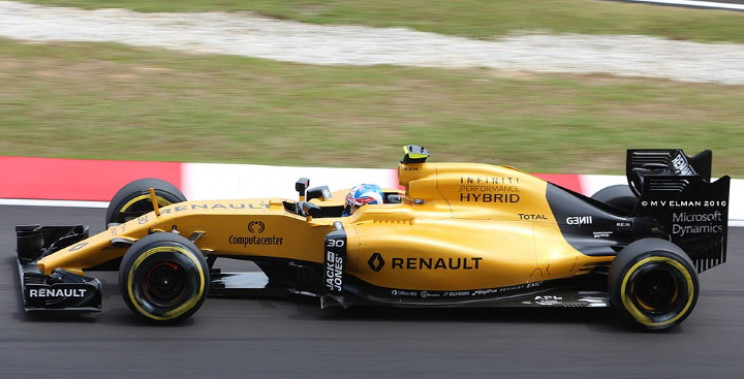
2016 Renault Source: lmankram7 / Wikimedia Commons
Another change since 2011 is the number of engines available to racing teams. In 2011, every car had eight engines for the 19 races of the season. Today the teams are limited to three combustion engines, turbochargers and MGU-H units, as well as two MGU-K, ES and CE units.
In 2020, Lewis Hamilton of the Mercedes Petronas team set a record for the fastest lap in Monza, the venue for the Italian Grand Prix, with an average speed of 264.362 km / h.
Today’s cars also generate much higher downforce. At 160 km / h the aerodynamically generated downforce corresponds roughly to the weight of the car, which leads to the claim that Formula 1 cars could “drive on the ceiling”. At full speed, a downforce of more than 2.5 times the vehicle weight is achieved, which generates a side force of up to 3.5 g or 3.5 times the force of gravity when cornering. These high side forces make it difficult for the driver to breathe, who has to be physically in top shape to cope with it.
Due to the high downforce, the load on the tires has increased. The front and rear tires of the 2021 F1 vehicles are about 50 percent more stressed than in 2011, and in order to cope with this increased stress, the tires have changed dramatically compared to the tires used in 2011. Today’s tires are 25 percent wider than those used in 2011, which gives them more contact with the ground and creates more grip, resulting in faster lap times.
First introduced in 2011, the Drag Reduction System (DRS) is an adjustable rear wing that moves in response to driver commands. It moves the mushroom-shaped “dirty” air that follows a leading car over a trailing car that is within a car length of the first car. The purpose of the DRS is to reduce drag to increase top speed and encourage overtaking. The DRS cannot be used at all points on a route, but only at certain sections.
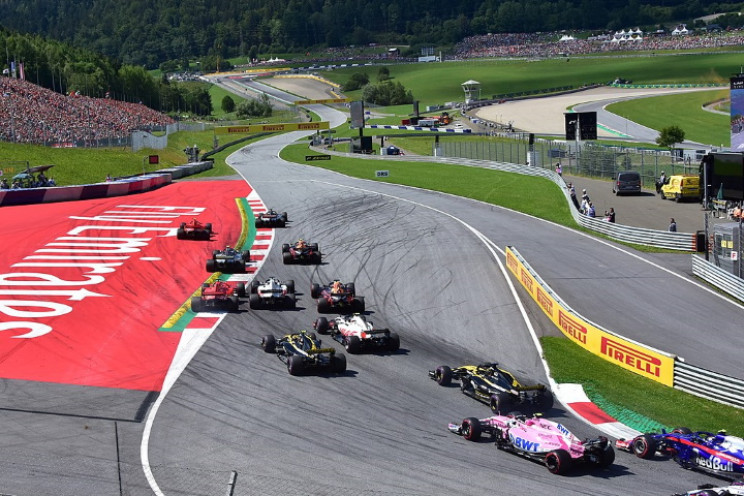
Austrian Grand Prix 2018 Source: pedrik / Wikimedia Commons
Today’s F1 drivers are held in place with a six-point racing harness. In 2003, drivers started wearing a head and neck support system (HANS). Introduced in 2018, halos are the three-pronged poles above drivers ‘heads designed to stop or distract large pieces of debris that can fall off trackside barriers or other cars’ tires and wheels.
Pit stops in 1950 were a leisurely affair. It took around four people between 25 and 30 seconds to service a car. Today’s pit crews have up to 20 people and take less than three seconds. Red Bull Racing holds the current pit stop time record. At the 2019 Brazilian Grand Prix, the Red Bull pit crew changed all four of Max Verstappen’s tires in a record of 1.82 seconds.
Data is king
Probably the biggest change in Formula 1 vehicles since 2011 is data collection. In 2011, F1 vehicles were able to log around 500 data channels, while today’s vehicles have around 1,500 high-speed data channels. This means that on a typical racing weekend, a single car collects around 70 GB of data, while in 2011 only 18 GB of data would have been collected.
2021 F1 vehicles have hundreds of small, wireless sensor nodes positioned throughout the vehicle. Each of these data collects data and transmits it back to a central data logger. In 2011, data sensors were bulky and were transmitted in the 400 MHz range. Today’s sensor nodes are tiny and transmit at much higher frequencies.
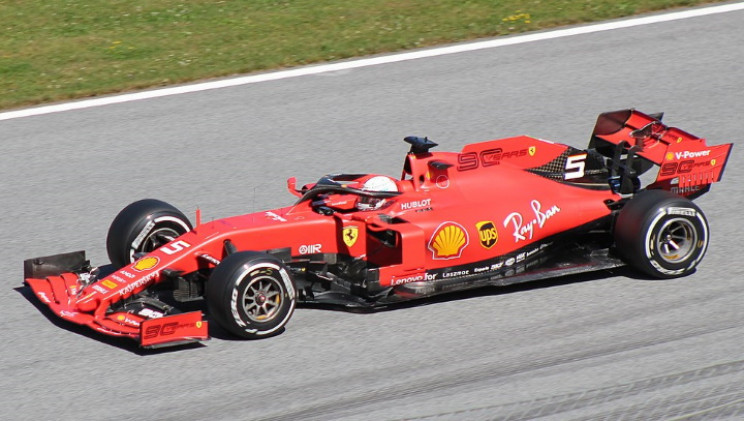
2019 Sebastian Vettel drives for Ferrari Source: Lukas Raich / Wikimedia Commons
Some of these sensors monitor tire pressure and temperature, while in 2011 the tire temperature was determined by looking through an infrared camera while the car was driving past. Today’s F1 vehicles have a warning system that warns if a crash creates a side force of more than 15 g or a vertical force of more than 20 g for longer than five milliseconds.
The 2021 F1 season
The map below shows the countries in which the F1 Grand Prix is currently taking place in dark green.

Grand Prix sites of the 2021 F1 season Source: Cherkash / Wikimedia Commons
In the 2020 season, Racing Point’s RP20 car caused a sensation, which was a very close copy of the Mercedes W10. This led to a new rule prohibiting teams from using images Reverse engineering of large parts of competing cars, although individual components can still be copied. Another rule change was that the use of 3D cameras was prohibited. This was so that teams couldn’t reverse engineer another team’s car. The new regulations also prohibit teams from sharing their intellectual property or information that enables a team to reverse engineer competing parts, which are marked as listed parts.
As early as 1950, Dr. Giuseppe Farina the first Grand Prix with Pirelli tires. Today’s teams also use Pirelli 18-inch tires, but they are made up of compounds that were unknown in 1950. The 2020 season recorded some of the highest cornering forces in F1 history, and Pirelli said these played a role in the three tire failures at the 2020 British Grand Prix.
For 2021, a change in regulations means teams will receive two sets of hard tires, three sets of media, and eight sets of softs for each race weekend.
The biggest change in the 2021 F1 season has to be a budget cap of $ 145 million (£ 103 million) per season. This means that the number of employees will be limited to around 550 employees. This is the number of employees that smaller teams like McLaren, Williams and Renault currently have. Larger teams like Mercedes, Red Bull and Ferrari have to downsize and lose up to 40 percent of their workforce.
At the time of this writing, there have been four F1 races so far in the 2021 season and the battle between top three Mercedes Lewis Lewis and Valtteri Bottas plus Red Bull’s Max Verstappen seems as fierce as anything the sport has seen. Hold on to your hats, the 2021 season is going to be a nail biter.
The post Formula 1: How much has changed since 1950? first appeared on monter-une-startup.




