
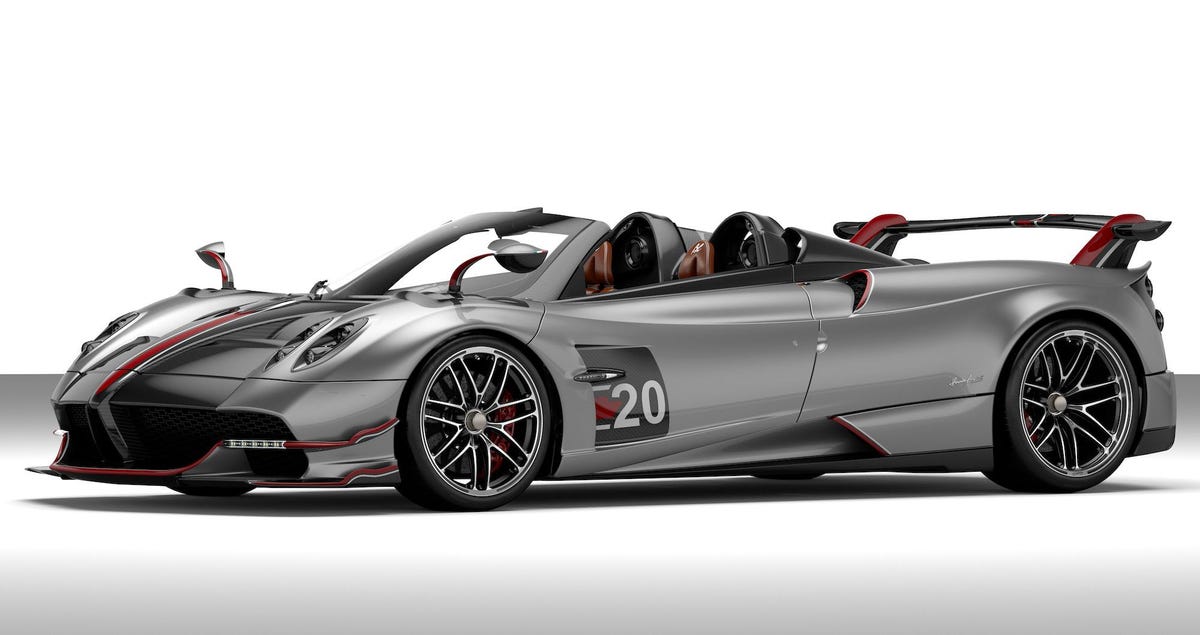
The Pagani Huayra Roadster BC is the company’s newest hypercar
Pagani
Hypercar is a term that was understood or used by a few people 10 years ago, even in automotive enthusiastic circles. Sure, hypercars existed before 2010, but there were very few of them and very few people who fully understood what a real hypercar was all about. I suspect a lot of people still don’t understand exactly what the term “hypercar” means and I’ll provide an explanation before we get into how this market has evolved over the past few years.
The Huayra Roadster BC’s V12 engine develops 791 hp
Pagani
A hypercar is essentially a vehicle that combines extreme performance with extreme styling, extremely low production numbers, and an extremely high price point. If you notice a topic here, you are on the right track. Hypercars are a step above supercars that offer their own impressive performance metrics, styling cues, and their own price tag. But where supercars reach the top, hypercars are only just beginning.
The Lamborghini Huracan is a very powerful super sports car, but not a hyper sports car
Karl Brewer
As an example, a (relatively) large-volume Ferrari or McLaren could cost $ 300,000, produce 630 horsepower, accelerate from zero to 60 in 3 seconds, have a top speed of 205 mph, and have worldwide production in the 1,000 to 4,000 range. As I said, these are impressive numbers. But today’s hypercars cost well over $ 1 million, offer more than 800 horsepower, accelerate to 60 mph in about 2.5 seconds (or less), have a top speed of over 220 mph, and have a total production count of fewer than 500 cars, often far fewer.
Koenigsegg is another hypercar brand that has hit the market over the past 15 years
Karl Brewer
Why are “rare” hypercars suddenly no longer so rare?
Those numbers may seem ridiculous for a street legal car, but it is precisely this level of ridiculous performance and cost that drives consumer passion for hypercars. Brett David, CEO of Prestige Imports in Miami, confirmed that the market for these cars has multiplied in a relatively short period of time. “The exotic car market has changed in recent years,” says Brett. “Lamborghini was a single model brand for a large part of its history, now it offers 3 separate volume models as well as limited hypercars such as the Sian FKP 37. We used to sell 3 Lamborghinis a month. Now we are selling 20. “
The brand new Lamborghini Countach is limited to 112 units
Karl Brewer
While most of those 20 Lamborghini sold are the brand’s “volume” models, such as the Aventador, Huracan and Urus, Brett recognizes the branding power of hypercar models like the Sian or the new limited-edition Lamborghini Countach recently unveiled in Monterey. Only 82 Sians will be produced, while new Countach production is limited to 112 units and both models will cost over $ 2 million. Brett David had been in the exotic car business all his life and took over Prestige Imports after the death of his father. And he quickly realized: “The McLaren F1 was the only million dollar car for years. Now multi-brand million dollar automobiles are regularly introduced. “
The McLaren F1 was a hypercar before the term existed
Karl Brewer
Hypercars in transition: hybrid
This McLaren F1, a hypercar before the term existed, was produced between 1992 and 1998. It had a full carbon chassis and was powered by a 618 hp BMW V12 that was mounted behind the passenger cell. With a top speed of 240 mph, a victory in the 24 Hours of Le Mans and only 106 units produced, the McLaren F1 is one of the most desirable performance cars ever produced, which is reflected in the price tag of US $ 20 million -Dollars paid for an F1 in a recent auction.
The 2013 McLaren P1 was one of the first hybrid hypercars
Karl Brewer
Modern hypercars use a large part of the Formula 1 recipe – a lightweight carbon fiber chassis, a mid-engine V12 and well over 600 hp. However, two new ingredients have been added to almost every newer hypercar that have never been seen on the original McLaren F1: an electric motor and a battery. This trend started with the Ferrari LaFerrari, McLaren P1 and Porsche 918, all hypercars produced between 2013 and 2015.
Pagani’s first car was the Zonda, which was introduced in 1999
Pagani
Not every hypercar has become a hybrid
While the majority of hypercars today incorporate some level of electrical motivation, some have stuck with the old-fashioned internal combustion engine. Pagani is a hypercar brand that introduced its first model, the Zonda C12, in 1999. Powered by a V12 supplied by Mercedes-Benz, the Zonda started at around 400 hp in 1999 and grew to 789 hp for the final version, the Zonda HP Barchetta, produced in 2017. The top speed of the first Zonda was 185 mph, the last HP Barchetta reached 221 mph. That number includes a total production of 140 units, including coupes, roadsters and at least 25 bespoke or “one-off” versions.
Only 3 Pagani Zonda HP Barchettas were produced
Karl Brewer
The successor to the Zonda, the Pagani Huarya, was first presented in 2011 as a completely new model. Compared to the Zonda, the Huarya has a lower weight and higher horsepower output from its twin-turbo Mercedes-AMG V12, but still relies on combustion – there is no electrification component for the powertrain.
Only about 300 Pagani Huayras have been produced in the last 10 years
Pagani
Christopher Pagani, son of the founder Horacio Pagani, spoke to us about the hypercar concept and where Pagani sees itself in this unique market. “The appetite for hypercars is great. We see other premium brands responding by offering limited edition vehicles like the LaFerrari to wealthy individuals. But Pagani keeps all of its models limited, not just some, which helps the brand remain unique. “
All Pagani cars have so far got stuck with internal combustion engines
Pagani
When asked about electrification, Christopher told us: “We are about to start our third chapter in vehicle development, but the next car will not use electrification or hybrid technology. Pagani wants to continue to develop cars that are simple, powerful, and designed for high performance. We recognize the shift towards electrification and asked our dealers a few years ago if they would like to go this route, but the dealers said, ‘No, don’t do it’. ”
The successor to the Huayra will debut soon, but it will continue to be powered only by an internal combustion engine
Pagani
Christopher told us that Pagani is developing a fully electric car, even though it has no inquiries from customers or dealers because they don’t want to be late for that shift. “The problem with electric cars is that they are very heavy. If we develop an electric vehicle, it still has to be light, the lightest electric vehicle that doesn’t lose the essence of a nice ride in a car and at the same time offers Pagani fun. “
As non-hybrid supercars, the Ford GT and Ferrari 812 Superfast represent an extinct race
Karl Brewer
Hypercars vs. Hybrid Hypercars vs. Pandemic
Brett David of Prestige Imports notes the impact of hybrid hypercars on non-hybrid models. “We are looking to move towards hybrid and electric vehicles, which will make the traditional ICE versions more valuable because this is really the cutting edge of the old school ICE world. People want to park their money in high-end cars, not just the super rare cars, but even the mainstream cars that are still powered by internal combustion engines. Investors become collectors and the auto business flies. “
The upcoming Hennessey Venom F5 will stick to pure combustion
Dean Smith / Hennessey
Brett told us that the pandemic had an impact on the high-end auto market as well. “The only thing that was recognized after COVID is the flexibility and mobility that people can practice with their personal car. You can get in your car and drive if you want. Plus cars are a known factor, not speculation like crypto and bitcoin. And with EV push, investors feel like older internal combustion engine vehicles are a familiar resource that is tangible and can be touched and viewed in their garage. It’s more than just owning the car, it’s the culture and community that comes with owning these types of cars. The COVID situation has made people really reassess their lives, similar to September 11th. “
The post What is driving the explosive growth in this rare automotive sector? first appeared on monter-une-startup.