
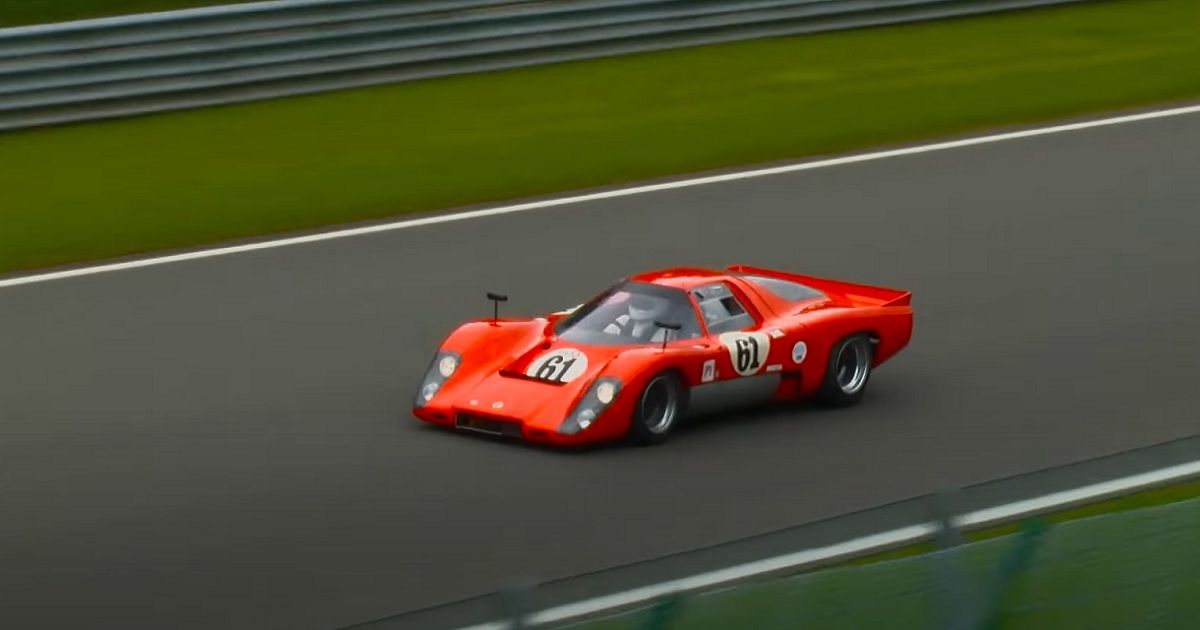
Few people know that F1 driver Bruce McLaren was the driver of the victorious Ford GT40. His experience at Le Mans convinced McLaren that a heavy racing car like the Ford GT40 could make a great road car. McLaren realized his idea three years later in the Mclaren M6 GT from 1969.
Bruce McLaren’s M6 GT concept is the foundation for all McLaren road cars. Thanks to the latest racing technology, the M6 GT was super light, incredibly fast, trustworthy and safe.
McLaren’s original plans in 1969 were to compete in Group 4 GT competitions, which included Ferrari, Porsche and Alfa Romeo. McLaren had to develop a coupe body suitable for endurance racing as the M6A chassis was already on the market and McLaren had won a crucial Can-Am championship.
In early 1969, it made its debut on the stage at the London Auto Show. Shortly thereafter, McLaren sold the M6 GT to private driver David Prophet and found that Group 4 races were out of the question for the vehicle.
Let’s take a closer look at the 1969 McLaren M6 GT
How the M6 GT came about
Via: Netcarshow
The McLaren M6 GT has its roots in the golden era of the Can-Am series, when McLaren was almost unbeatable with cars like the M1B and M6A. It all started with the McLaren M6A racing car that Bruce McLaren and his team built for the 1967 Can-Am season.
The M6A was McLaren’s first monocoque chassis and an integral part of the company’s design concept. It was ultimately to serve as the basis for the M6 GT.
The M6A, backed by a Chevrolet V8 engine, would continue to dominate the season, sporting an intense McLaren orange livery that has become synonymous with Bruce McLaren and the McLaren brand.
The path to the later development of the McLaren M6 GT began even before the glory days of the M6A, at least on paper, as Bruce McLaren had long tried to design a mid-engined racing car based on his Can-Am experience.
The plan was to make the M6 GT the fastest vehicle of its kind in the world and then compete in Group 4 of the World Sports Car Championship against big names such as Ferrari and Porsche. The M6 GT would use the same engine as the M6A, but Bruce McLaren allowed the option to install a 7-liter Ford unit.
McLaren had to meet new FIA requirements for admission to the championship this year; one of the requirements is that at least 50 production samples were required to access, even though you were unable to meet these requirements.
The Mclaren team quickly put the M6 GT project on hold. However, McLaren and Trojan-Tauranac produced some prototypes. Mclaren later converted two of these cars into street legal versions, one of which was Bruce McLaren’s private vehicle.
The design of the M6 GT
Via: Netcarshow
The M6 GT had rear-wheel drive, a mid-engine layout and a two-door coupe body. It has a 5.7 liter Chevrolet LT1 engine modified by Bartz that produces 370 horsepower at 5,800 rpm and 370 lb-ft of torque at 4,000 rpm. The power is transmitted to the drive wheels via a 5-speed manual transmission. The stated maximum speed is 266 km / h (165 mph).
The M6 GT is a street legal variant of the M6A Racer. The coupé body consists mainly of fiberglass, underneath the aluminum monocoque of the racing car. This made it very light at just over 800 kg and paved the way for the desired driving characteristics of the vehicle. Butterfly doors and manually operated pop-up lights were available as options on certain models.
A personal road vehicle
Via: Netcarshow
Every McLaren street car we see now can be traced back to the M6 GT. Bruce McLaren’s lack of homologation didn’t stop him from legally having an M6 GT on the road. While the vehicle’s real destiny is to hit the world’s race tracks, it may be faster than anything else with a license plate.
The cabin of the M6 GT is cramped and lacks any sense of use or functionality. The most notable feature, however, is the Bartz tuned Chevrolet engine, which can reach a top speed of 165 mph.
After the tragic death of Bruce McLaren in June 1970, the M6 GT was never mass-produced. Only four M6 GT were ever produced, two in red, one in yellow and the last in McLaren orange.
The legacy still lives on
Via: Netcarshow
The M6 GT has been featured at a number of auto shows, most recently at McLaren Newport Beach, California. It’s available now for just £ 250,000. To be honest, the price seems a bit low, especially given the importance of the vehicle to McLaren.
After Bruce McLaren’s death, his dream of developing a production-ready sports car was put on hold forever. Gordon Murray’s great McLaren F1 would ultimately realize McLaren’s road vehicle ambitions. This vehicle and all subsequent McLaren road vehicles owe their existence to the M6 GT.
Continue reading
About the author
Marcus Njuguna
(155 articles published)
Marcus has a lifelong interest in machines and worldly wisdom. When he’s not working on a blog article, you can find him working on his music in a recording studio.
More from Marcus Njuguna
The post That’s what we love about the 1969 McLaren M6 GT first appeared on monter-une-startup.Did you miss our previous article...
https://formulaone.news/mclaren/enttain-creates-oneofakind-experiences-and-content-for-f1-fans





