
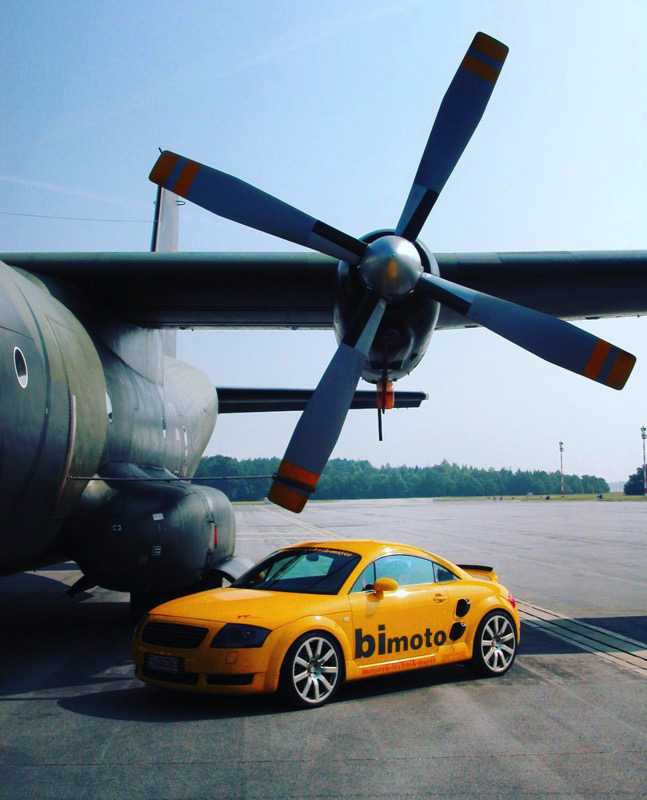
Motoren Technik Mayer (MTM) is a vehicle tuner based in Wettstetten, Germany, which was founded in 1990 by Mr. Roland Mayer, the head of the company. Their engineering competence is concentrated on brands such as Audi, Seat, Skoda, VW, Ferrari, Lamborghini, Porsche and Bentley. Their projects are mostly developed in-house, but occasionally they work with their affiliate development company called Wetec Engineering.
The company gained fame in the automotive industry after high-speed testing of its projects, but the most memorable of them all is the famous Audi TT Bimoto, which essentially broke speed records for a living. This remarkable project is still technically in progress, but its first public appearance dates back to 2003. It was then that it set its first official speed record of 232 mph (374 km / h) in tests carried out by Auto Motor und Sport magazine on the Nardo circuit in Italy. In the end, the MTM Bimoto was the fastest road vehicle they tested with road approval, an honorable achievement by a renowned specialist magazine. Later, in July 2007, the second version of this extraordinary rocket on wheels reached an even higher top speed of 393 km / h and was deployed with the pilot Florian. a new official speed record on a test track in Papenburg auf Gruber maneuvers the steering wheel confidently.
We must not forget that this level of performance was reserved exclusively for exclusive hypercars such as the Bugatti Veyron or the McLaren F1 in the mid-2000s. Imagine the buzz it caused among enthusiasts when, out of nowhere, a pimped up “barber’s car,” as Top Gear defined the first-generation TT, hit the headlines with its outrageous performance and left the supercars of the day dust. How did MTM manage to create such a beast?
What they did is amazing even now, many years later. Let’s start with the naming scheme. It wasn’t your usual Audi TT. Oh no, it was the MTM Bimoto. The last part gives some hints about the engine of this rocket. Or let’s say engines, because at the heart of this vehicle, to the surprise of all, had two engines, one in the front and one in the back, which stole the rear seats. MTM used two supercharged 1.8-liter engines, each driving an axle. In addition, each unit that came was connected to its own 6-speed gearbox, also one for each axle.
In total, two engines and two transmissions worked seamlessly together in absolute synchronization, producing around 700-800 hp in the first iteration and approaching the 1000 hp mark in the years that followed. Five hundred horsepower from each 1.8-liter four-cylinder was and is an impressive figure, even if one does not take into account the double architecture of the vehicle. The horsepower per liter ratio is still immense today, around the value of 277 hp / l and beats many modern performance machines.
The acceleration times were shocking for the time. The MTM Bimoto was able to get from standstill to 100 km / h in just 3.7 seconds in its original 2003 powertrain configuration and a claimed 3.1 and 3.3 second zero to 62 mph time for the 2007 version, during the Papenburg tests. By comparison, the now classic McLaren F1 reached 100 km / h in 3.2 seconds and drove up to a top speed of 240 mph (386 km / h), a few mph below the Bimoto’s top speed record of 244 mph (393 km / h) ).
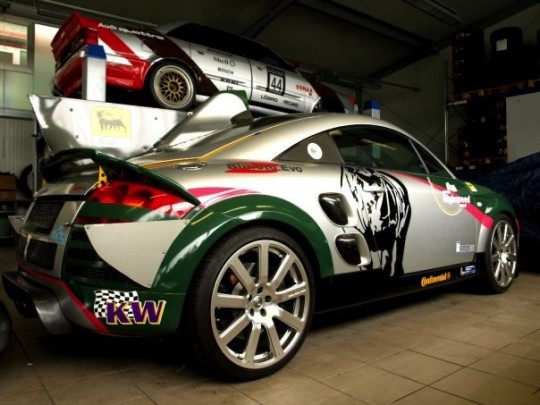
The external appearance of the Bimoto was still similar to the original shape of a standard TT. Some of the highlights were the side and top air scoops that fed the rear engine, the redesigned and lowered front and rear bumpers for added aerodynamic performance, and a large-area rear spoiler that increases stability at high speeds. In addition to the massive 19-inch wheels and the powerful Brembo disc brakes with 8-piston brake calipers, large flared fenders take up the widened track all around.
The estimated cost of this project was half a million dollars. When you consider how much research and development has to go into developing this speed legend, the cost seems justified. Allegedly, MTM planned to build a production run of ten Bimoto vehicles, but it is currently unknown if they ever sold a unit to the public.
Unfortunately, this incredible project has recently come under the radar, its last public appearances were many years ago. As one of the most complex performance automotive projects in recent history, the MTM Bimoto holds a special place in the hearts of enthusiasts who sincerely hope that the brand still has future plans for this seductive twin-engine, high-speed machine.
The post Remember the MTM Bimoto: record breaking twin-engine Audi TT that could take on a McLaren F1 first appeared on monter-une-startup.




