
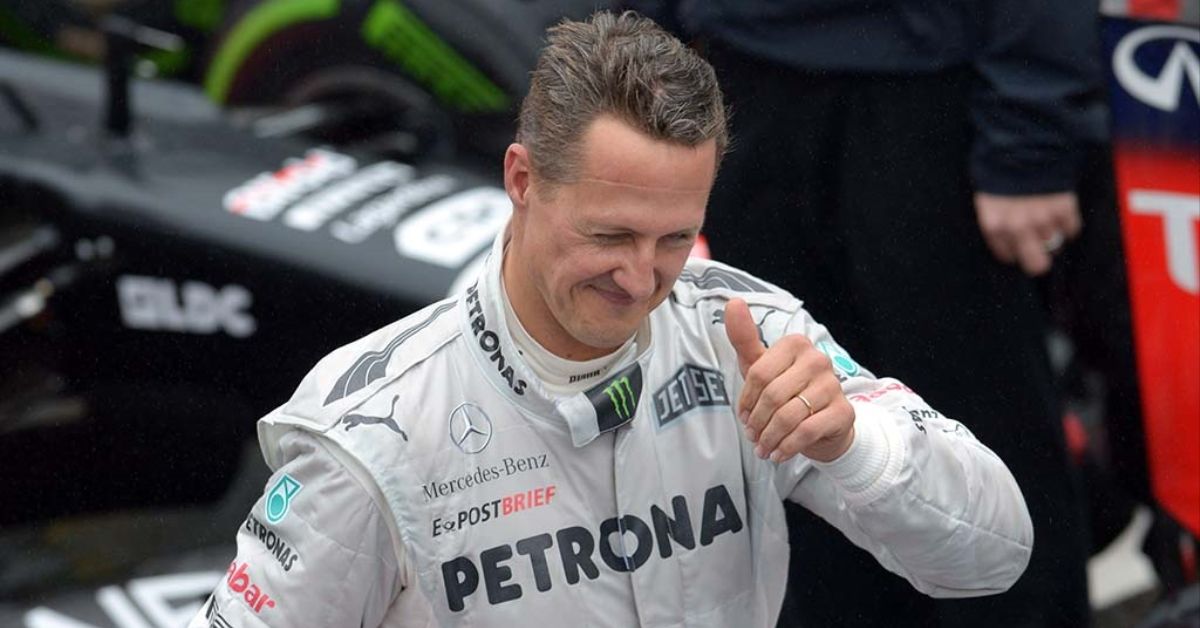
Michael Schumacher is certainly one of the greatest Formula 1 drivers of all time. Between 1991 and 2012, the German won seven world titles, 91 races and took 68 pole positions. He drove for Jordan, Benetton, Ferrari and Mercedes and became one of the greats in the sport. His career was also recently documented in the brilliant and emotional “Schumacher” documentary on Netflix, which shows his career from his first race with Jordan at Spa in 1991 to his first world title with Ferrari in 2000, through his career to the Mercedes days and recorded some of its more controversial moments.
The years at Mercedes formed his comeback years in sport, from 2010 to 2012. Schumacher retired from Formula 1 in 2006 while driving with Ferrari, but then returned in 2010 with the Mercedes team that had taken over the Brawn GP championship title , back to the sport squad at the end of 2009. Great things were expected of the team and drivers, Nico Rosberg was signed by Schumacher as a team-mate. But despite the high expectations, things did not go well and Schumacher was unable to win another race in the three years that he was with the Mercedes team.
A difficult first season
about auto evolution
The Mercedes F1 team project was born out of the 2009 Brawn GP championship team that won the constructors ‘and drivers’ titles with Jenson Button. Button moved to McLaren in 2010 as Schumacher replaced him and Rosberg replaced his teammate Rubens Barichello. However, the Mercedes team was facing a tough year. The Mercedes W01 was practically a 2009 B spec brawn, and Button said the car was really designed for it before moving to McLaren. The car had an inherent understeer that did not suit Schumacher’s driving style.
about fan pop
Beyond that, however, Mercedes had entered the sport in what appeared to be a cost-covering era and had budgeted accordingly. However, this cost cap never came. The team couldn’t develop their car much further than they did earlier in the year, and it had suffered layoffs from Brawn in early 2009 to survive. When you consider how good Mercedes would be in later years, it was the case “right place, wrong time” for Schumacher, who in 2010 at the Spanish and Turkish Grand Prix achieved the best result of the season with fourth place of the season “While Rosberg took a trio off the podium.
Badly developed cars
via Speedsport Magazine
The fundamental theme behind Schumacher’s tenure at Mercedes was the equipment that was made available to him. While the 2010 car could be forgiven as a midfielder, the next two seasons were almost worse due to their underperformance. The 2011 car was a modest step forward, but Schumacher failed to even make it onto the podium again as he finished fourth in the Canadian Grand Prix after finishing second for much of the final stages of the race. Mercedes started the 2012 season with a great car. Schumacher started from the front row at the Chinese Grand Prix and was fastest in qualifying for Monaco.
via Reuters
However, a loose wheel nut on his first pit stop ruined Schumacher’s Chinese Grand Prix when team-mate Rosberg dominated. In Monaco he had to accept a fifth starting place penalty due to a collision in the previous race and thus only started sixth. The 2012 car soon began to fall behind in the competition order. It ate the tires more than its rivals and other teams like McLaren, Red Bull and Ferrari started developing them. At the European Grand Prix 2012, however, Schumacher took a podium, which turned out to be his last podium in Formula 1.
Launched against Rosberg
about Max F1
However, there was something positive to take home from Schumacher’s comeback. With each season at Mercedes, Schumacher came closer and closer to Rosberg’s pace, and more and more people realized that it seemed to be the car that left Schumacher in the lurch. When Rosberg competed against Lewis Hamilton at Mercedes and presented himself so well that he took him to the title in 2016, more and more people became aware that Schumacher had put more money on his comeback than many had given him credit for. It also showed how good Rosberg was.
What could have been
via Goodfon
It’s hard to imagine what would have happened if Schumacher hadn’t had his skiing accident in 2013 and had stayed in Formula 1 beyond 2012. Because if he’d signed the same three-year deal that Lewis Hamilton signed, we could very well be talking about a man with another world title or two on his name, given how dominant Mercedes was in the early days of the hybrid era. Unfortunately, Schumacher was at the right time at the wrong time on his own comeback in Formula 1, but he laid the foundation for one of the most dominant teams in the sport in its history.
Sources: Auto Evolution, Fan Pop, Speedsport Magazine, Reuters, Max F1, Goodfon, Planet F1
Continue reading
About the author
Henry Kelsall
(1524 articles published)
From JDM cars to WWII machines. Has worked at HotCars since autumn 2018.
More from Henry Kelsall
The post Why Schumacher’s Mercedes comeback didn’t work out first appeared on monter-une-startup.




