
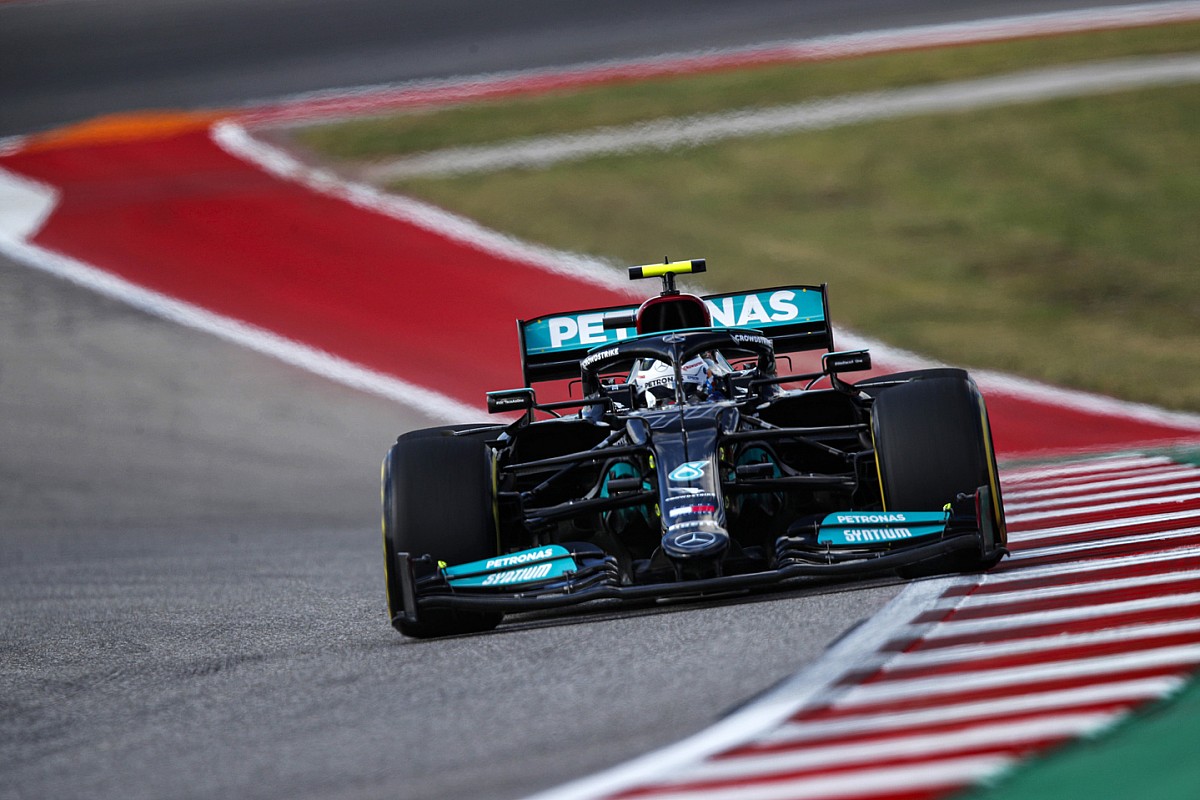
After Mercedes had shown excellent speed on the straights in the last few laps, especially at the Turkish Grand Prix, Mercedes came under fire from Red Bull team principal Christian Horner – who suggested that the team “obviously had a device for straight driving” for Sky F1 optimized.
These claims have been refuted by Mercedes CEO Toto Wolff, who said the team’s performance on the straights was a culmination of “all the small wins, small wins that were added and performed”.
However, video footage of the Mercedes W12 shows a slight crouching of the rear during the high-speed sections of the track, with ride height increasing as the car brakes for a curve.
Mercedes already has a low-rake package, which means that the rear is raised significantly less than the front compared to cars like the Red Bull, which drive with very high rake.
In the turns, where the airflow accelerates under the floor and the effective diffuser chamber can be opened to reduce the pressure under the car, a higher incline is an advantage, but a hindrance on the straight.
The reason for this is the higher air resistance, as the air from the ground is processed more strongly – and the frontal area of the car increases with the rear section.
If a team can reduce the rear height, it can reduce the drag and thus free up a higher straight-ahead speed.
It seems like Mercedes has come up with a setup that allows the rear end to be lowered when accelerating, thus achieving the effect of reduced drag that increases the car’s maximum speed.
Although it is not currently known how the car creates this effect, one way to operate a passive system is to install a spring adjuster that allows the rear of the car to compress as the rear downforce increases and then give way when the downforce decreases.
Using a softer spring will also handle the differences in elevation on the Istanbul Park circuit, so it will come in handy for getting consistent grip on the bumpy Circuit of the Americas.
It can also result in a stall in the diffuser, which teams often try to use above a certain speed due to its lower position to improve acceleration.
Also read:
One difficulty to consider is that when the car returns to its natural position in the braking zones, the airflow needs to pull in enough again to ensure that the diffuser is generating the downforce needed to corner.
It appears that after releasing the accelerator pedal, the W12 will gradually return to its normal rake to ensure that the airflow has ample opportunity to take its desired position.
Mercedes seems incredibly confident in its setup changes, and given the pressure put on the team by introducing new engines over the last few laps, it seems the straight line is in line with the team’s claims that it has a ” sweet “found spot” with its suspension configuration instead of drawing additional power from the drive train.
Lewis Hamilton, Mercedes W12
Photo by: Zak Mauger / Motorsport Images
The post What is behind the performance improvements in Formula 1 from Mercedes? first appeared on monter-une-startup.




