
F1 will unveil its 2022 calendar next week, with a record 23 races over a period of just over eight months.
While the move was welcomed by some for the regular action it offers fans and the opportunity to race in more markets, concerns have been raised about the personal costs of those who work in Formula 1.
The four-time world champion Sebastian Vettel warned that Formula 1 must not “neglect” its responsibility towards the people who work in the paddock and that the series “must be very careful where we want to place our interests”.
In an interview with Autosport on the occasion of World Mental Health Day on October 10th, Mercedes F1 boss Wolff said that the human costs and the effects of a 23-race season on mental health are “something we have to address”.
ANALYSIS: How F1 teams take care of their mental health
“I think as much as we want to race around the globe and put on a great show in really good destinations and make sure the sport grows in terms of viewers, exposure and commercial revenue, we have to see too.” what tribute it takes from the people, “said Wolff.
“Twenty-three races with triple headers is something that takes a toll.
“Now you can take the old-style mentality and say, ‘Well, be glad you’re in Formula 1 and if you can’t handle it, do something different,’ which is completely opposite to the way I work.
“We have to create an environment in which it becomes sustainable. We don’t want to reduce races, I’m absolutely with Stefano [Domenicali] there.”
Wolff considered it necessary to ensure the rotation of employees so that not every team member competes in every single race. As more and more teams in some departments have switched employees over the past few years, he believed this could be included in the regulations to ensure that this happens.
“To be able to take five out of 23 races makes a big difference for every individual who is in the sport,” said Wolff.
“We have to create some kind of regulatory environment and say how many races someone can participate in and have a rotation rate.”
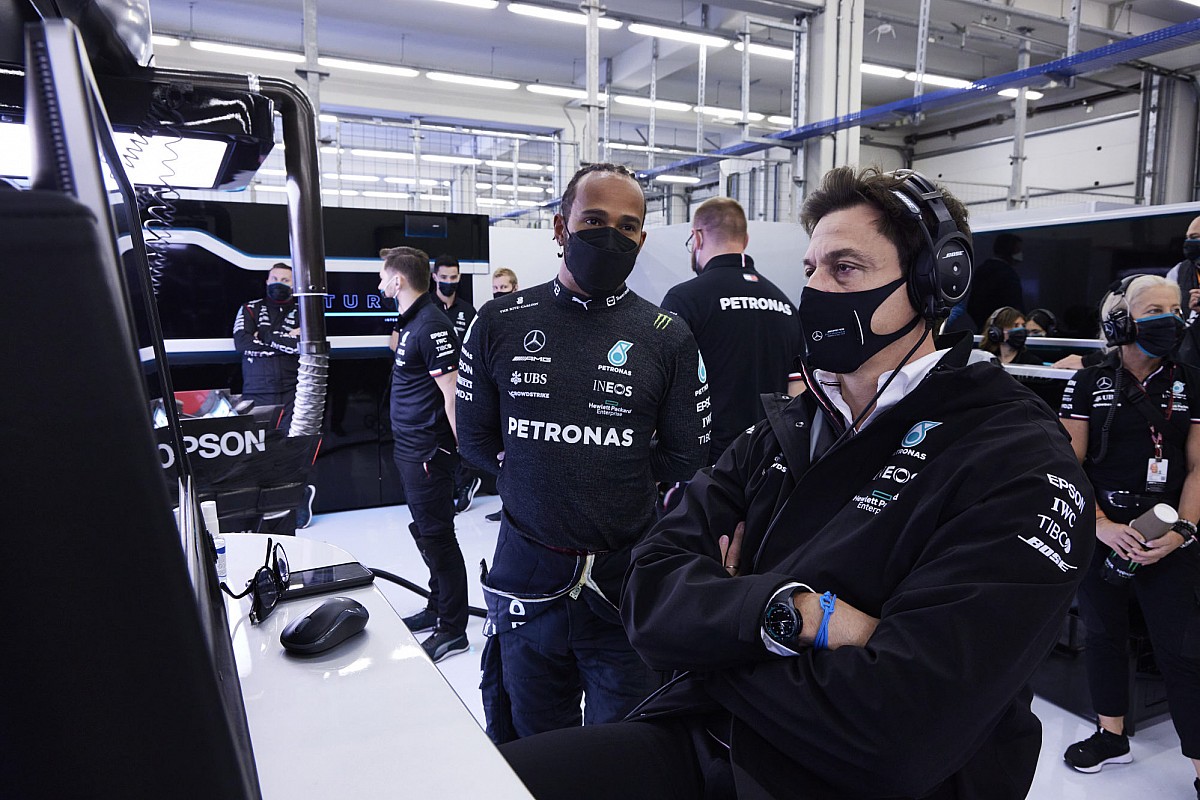
Lewis Hamilton, Mercedes, celebrates pole on arrival at Parc Ferme
Photo by: Steve Etherington / Motorsport Images
Wolff also believed that increased rotation would help teams give more opportunities to young talent coming through their ranks.
“We all have trainees in the organizations we raise who may not have been on the front line or on the hot seat,” said Wolff.
“If it’s the same for everyone, it will also help keep people in the field exposed to the high-pressure environment of the race track instead of just working in the background.
“When you know that everyone has to do it and everyone has to develop the younger ones, I think it’s a great initiative.”
Wolff admitted that he and other executives in Formula 1 did not belong to the “target group” for a possible rotation, but saw having a say in the design of the rules as a responsibility to make work in the series more sustainable for their employees.
“You have to look at the hard-working people out there,” said Wolff. “These are the mechanics and the technicians from FOM and the FIA, they arrive three days earlier, travel and accommodation are not always up to management standards.
“And they have high pressure jobs. Mistakes can mean a DNF or pit stops that don’t go well. It depends on the individual.
“We have to offer all these people a more sustainable environment. We sit at the table and can influence that. We have to do it to their advantage.”
The post The F1 rules should ensure staff rotation to reduce calendar pressure first appeared on monter-une-startup.




