
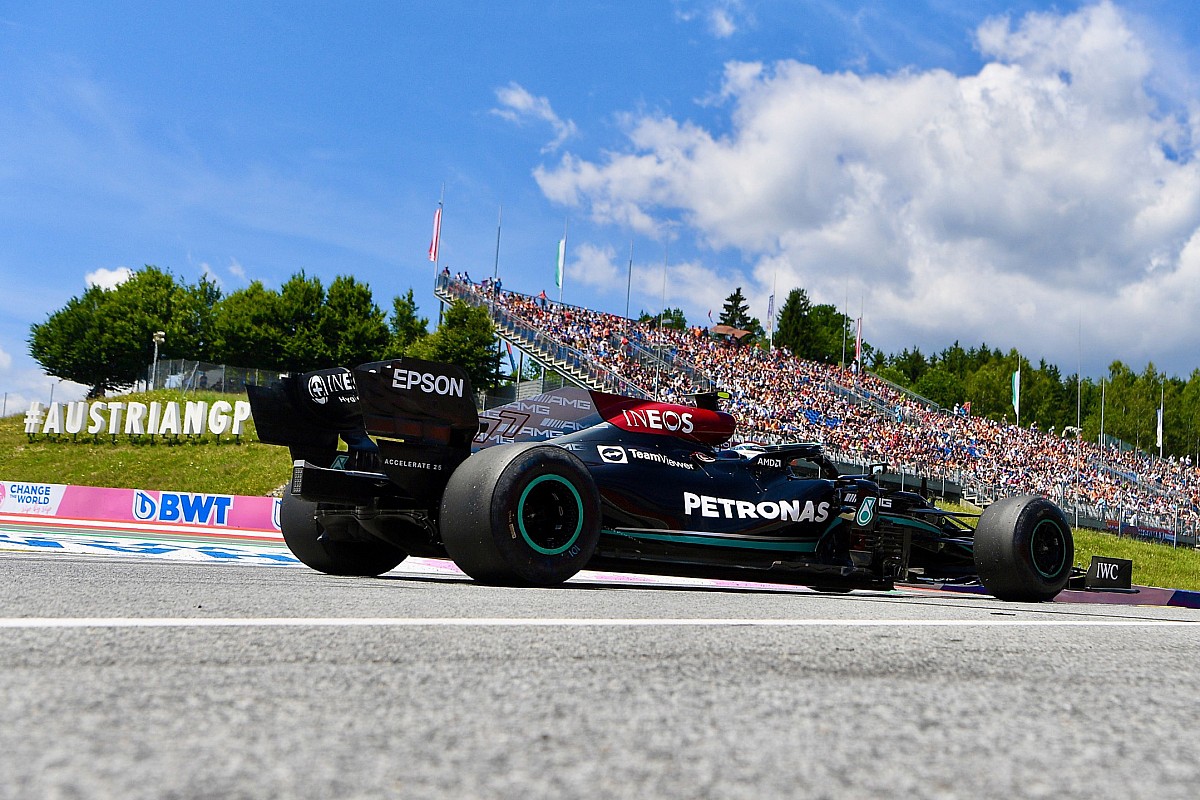
After a summit of major manufacturers – including Mercedes, Ferrari, Renault, Audi and Porsche – at the Austrian Grand Prix last weekend to discuss the new rules, a design concept for the F1 was discussed.
And while the details will take many months to formulate, Wolff says the F1 is doing the right thing in sticking to turbo-hybrid powertrains that run on completely sustainable fuel.
At the FIA conference in Monaco on Monday, Wolff said there was consensus that the F1 could not use noisy internal combustion engines.
“The discussion was ‘What will we do with motors in the future?’ Because we want to save costs, so don’t want to reinvent the wheel,” he said.
“But we also want an engine that is relevant from 2025 to 2030, and we can’t be old gasoline heads with screeching engines when everyone expects us to be electric.
“So these engines are still being refueled. We are sticking to the current V6 format, but the electric share will increase massively. “
The F1’s current engines have both MGU-K and MGU-H, but there are suggestions that the sport might ditch the MGU-H due to its cost and complexity. That would then open the door to the use of a stronger kinetic component.
One of the core components of the new generation of hybrid engines will be operation with sustainable fuels, which is of enormous importance to automobile manufacturers in view of the fact that internal combustion engines will continue to be used for many years.
Wolff adds: “We are sticking with the combustion engine because we believe that fuel will be with us for a long time to come.
“In Europe we may have ambitious goals to have electric mobility as part of our daily life by 2030 and I see how ambitious the goals are at Mercedes, but in the rest of the world we will have millions of vehicles that would do that” still drive on fuel.
“For Mercedes cars, we assume that we will have several million vehicles around the world that will still run on fuel. So what we can do with our innovation is to help them develop sustainable fuels: be it biofuels or synthetic fuels.
“Our cars will run 100 percent on sustainable fuels by 2025, so we will help reduce the world’s CO2 emissions.”
Also read:
Wolff said there is growing evidence that Formula 1 innovation is appealing to the younger generation of fans in finding sustainable solutions and advancing technology.
“If you look at F1 today and the large audience that is following us, especially the younger crowd, our fastest growing group is 15-35 year olds,” he said.
“I was in Austria last weekend, it wasn’t that great on the track, but it was impressive to see a full house. We had 115,000 spectators. And what I’ve seen is a younger crowd like never before in Formula 1.
“And I think Formula 1 stands for this younger audience, and we did a survey, for innovation and high-tech. We may move away from gladiators a little.
“But the younger generation see it as flying fighter jets across the racetrack, so we must never forget that high-tech innovation is part of our DNA.”
The post New F1 engines in 2025 rely on “massively increased” electrical components first appeared on monter-une-startup.




