
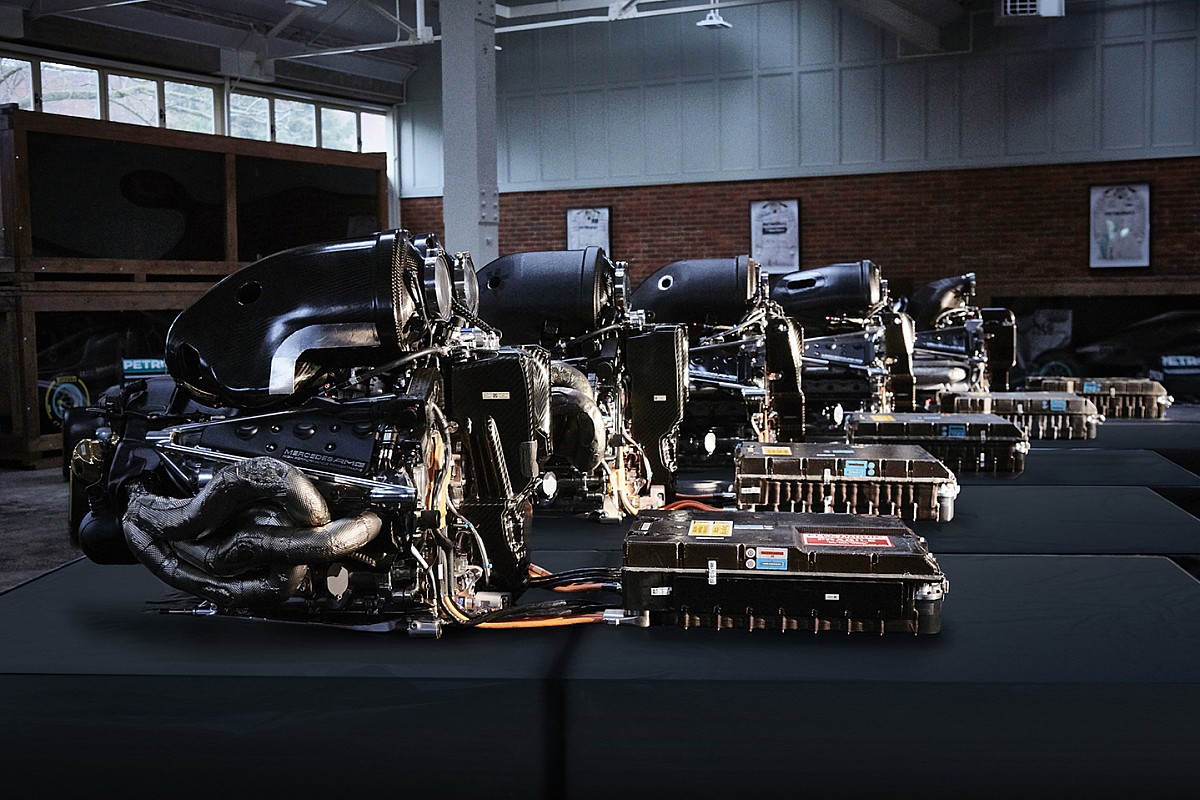
Do you know what power an F1 engine has, how the energy recovery works and which parts the teams can replace and when? You can find out more about this and more here …
Formula 1 is at the cutting edge of engine technology and its newest power plant is one of the most complex in the sport.
In fact, the current engines are so complicated that they have to go through a pre-start routine of laptops, remote operations, and a slew of clever engineers before they can be brought to life.
Winning in F1 is about executing a highly coordinated plan. The same goes for poker. See where your game plan can take you. Click here to start your schedule.
18+, new UK players only, £ 10 minimum deposit, full T & Cs apply, begambleaware.org, play responsibly
What’s in an F1 power plant?
First things first, a modern F1 engine is no longer called that, but rather “power unit” – and that’s because it’s a hybrid. It consists of a gasoline internal combustion engine and electric motors that are powered by an energy recovery system. (HE).
When they were launched in 2014, they were criticized for their low noise level compared to the popular deafening V8 and V10 monsters of the past, but these are among the most powerful and efficient units in Grand Prix history.
Max Verstappen, Red Bull Racing RB16, Valtteri Bottas, Mercedes F1 W11, Lewis Hamilton, Mercedes F1 W11, Lando Norris, McLaren MCL35, Alex Albon, Red Bull Racing RB16 and the rest of the field at the start
Photo by: Steven Tee / Motorsport Images
How much horsepower does an F1 engine have?
The total output of the combined petrol and electrical elements is around 1,000 hp – significantly more than that of a normal road car. The gasoline engine runs at 15,000 rpm – again significantly more than a street car.
All of this means that an F1 car can cover 0-60 mph in about 2.6 seconds and top it at about 230 mph, depending on the amount of drag it is driving. When BAR (which eventually went on to become Mercedes via Honda and Brawn GP) pulled as much drag from its car as possible, it hit 246.9 mph on the Bonneville Salt Flats in 2006.
What type of gasoline engine does the unit use?
A 1.6-liter V6-V6 four-stroke engine is used. It is designed to a strict range of dimensions and material constraints, with the cylinders arranged in a 90 degree V configuration and two intake and exhaust valves per cylinder.
The turbocharger works with a compressor to charge the engine under pressure. It is powered by the flow of air from the car’s exhaust pipe through a turbine that is connected to the exhaust system.
For those who understand engines, the compression ratio for each cylinder cannot be higher than 18, the fuel pressure in the injectors is 500 barG or less, and the fuel mass flow is no more than 100 kg / h, at lower speeds.
This fuel mass flow is critical – because it basically means limiting the amount of gasoline that can flow into the engine, limiting the number of revolutions and power that can be produced, and encouraging teams to develop more efficient engines.
F1 fuel in the sign
Photo by: Andrew Hone / Motorsport Images
What fuel do you need?
The cars use fuel made from compounds normally found in commercial fuels, with no specific performance-enhancing chemical compounds. Nowadays, at least 10 percent of fuel must be made from advanced sustainable ethanol.
According to reports, the cars consume around 135 liters of fuel during a race, which is said to be a third less than the thirsty V8s of yore.
What does the energy recovery system (ERS) do?
The ERS recovers energy from the exhaust and brakes and converts it into electricity to either drive the electric motors directly or to be stored in a battery for later use as an additional boost in performance.
The MGU-K (Motor Generator Unit – Kinetic) is an electric motor that is connected to the crankshaft of the engine. In regenerative mode, it works as a generator, slows down the car by “engine braking” (reduces the use of conventional brakes) and generates electricity to charge the battery. When in ride mode, it becomes a motor that uses that electricity to drive the wheels for extra acceleration.
The system is only allowed to generate a certain amount of energy per lap – around 33 seconds of maximum power – but it can store twice that amount so that a team can act strategically and save and use energy at different times.
The MGU-H (Motor Generator Unit – Heat) is more complicated and is used in combination with the turbo, which itself works by using exhaust gases to turn a turbine that pressurizes the engine.
As a generator, the MGU-H offers a resistor that slows down the turbo spin – which prevents the turbo from generating too much thrust at high power – and converts this energy into electricity that is stored in the battery.
As a motor, it is used to keep the turbo running when the driver is not on the gas, reducing turbo lag and smoothing out the power output. This is more efficient than the fuel-powered alternatives.
Crucially, the power generated by the MGU-H can be used to power the MGU-K directly – so it can increase the 33 second limit that can be used each lap of stored energy. This means that the more electricity the teams can generate from the MGU-H, the longer they can use their electricity boost.
The entire system, including the various parts and ancillary units, must not weigh more than 150 kg, of which the bearing part makes up between 20 and 25 kg.
MGU-H
Photo by: Magneti Marelli
How much power do the electric motors generate?
The maximum output of the MGU-K is 120 kW – this corresponds to around 160 PS. In order to prevent electrically powered superstarts, however, the use is limited to 100 km / h at the beginning of the race.
The MGU-K does not have to weigh less than 7 kg and can rotate up to 50,000 rpm with a maximum torque of 200 Nm. The MGU-H can be 3 kg lighter and can spin up to a massive 125,000 rpm.
How is this power used?
Power is in the hands of the driver – and the on-board computer. The teams develop engine maps that provide the electrical power in different ways, and the drivers simply have to choose between them and leave the rest to the car.
Is the electric motor dangerous?
The ERS is a serious high voltage part. It works with up to 1000 V and can therefore give off a very dangerous electric shock.
To reduce the risk, high voltage cables are colored orange and have a voltage interruption when disconnected. The main energy storage housing MGU-H and MGU-K as well as all high-voltage junction boxes are marked with hazard warning signs.
The ERS can be switched off in various ways and is equipped with status lights on top of the airbox to display the operating and insulation status, which light up green in the safe state and red in the unsecured state.
In 2019, after retiring from the Bahrain Grand Prix, Daniel Ricciardo was told to “jump out of the car” without touching it after the red light came on and his Renault team declared it “electrically unsafe” explained. Fortunately, that doesn’t happen often.
How do they start the cars?
The team must attach an external starting device to the car in order to start the petrol engine in the garage, pit lane and on the starting grid. The engines are equipped with anti-stall systems to prevent the engine from failing if a driver loses control.
Haas F1 mechanics on the grid
Photo by: Andy Hone / Motorsport Images
How many Power Units can a team use in a season?
Years ago there were no engine usage restrictions, and teams spent millions producing special “qualifying spec” engines that were tuned to the max but would only last a handful of laps before setting themselves up.
In order to keep costs down, the number of units allowed in a season is limited, with each driver not exceeding …
- – three engines
- – three turbochargers
- – three MGU-H
- – three MGU-K
- – two energy stores
- – two control electronics
- – eight sets of engine exhaust systems
The teams are allowed to exceed their assigned number, but are penalized each time with starting place penalties – therefore the units are now being built to be more robust than in the past.
How does the FIA ensure that the engines are legal?
In order to minimize the risk of fraud, electrical direct current sensors from the suppliers named by the FIA are attached to various parts of the ERS, and a torque sensor is attached to the MGU-K.
All cars have the same high pressure fuel pump, manufactured by a single supplier appointed by the FIA World Motor Sport Council, and two fuel flow meters are positioned in the fuel tank to monitor the flow rate.
In order to control the operation of the gasoline engine, the output shaft and each drive shaft are equipped with a certified torque measuring system as well as pressure and temperature sensors for the injection valves.
Ferrari SF1000 engine detail
Photo by: Mark Sutton / Motorsport Images
What is the future
The current units won’t last forever – because F1 is already making plans for the next generation.
These designs are now “frozen” – which means teams are no longer allowed to develop them. That means freeing up time and budget to develop a new, different, more industry-relevant hybrid engine to be launched in 2025.
The new regulations will focus on high levels of environmental sustainability, with plans to use fully sustainable fuels and greatly simplifying design to reduce costs.
Did you miss our previous article...
https://formulaone.news/mercedes/ineos-britannia-moving-parts-james-allison-chief-technical-officer





