
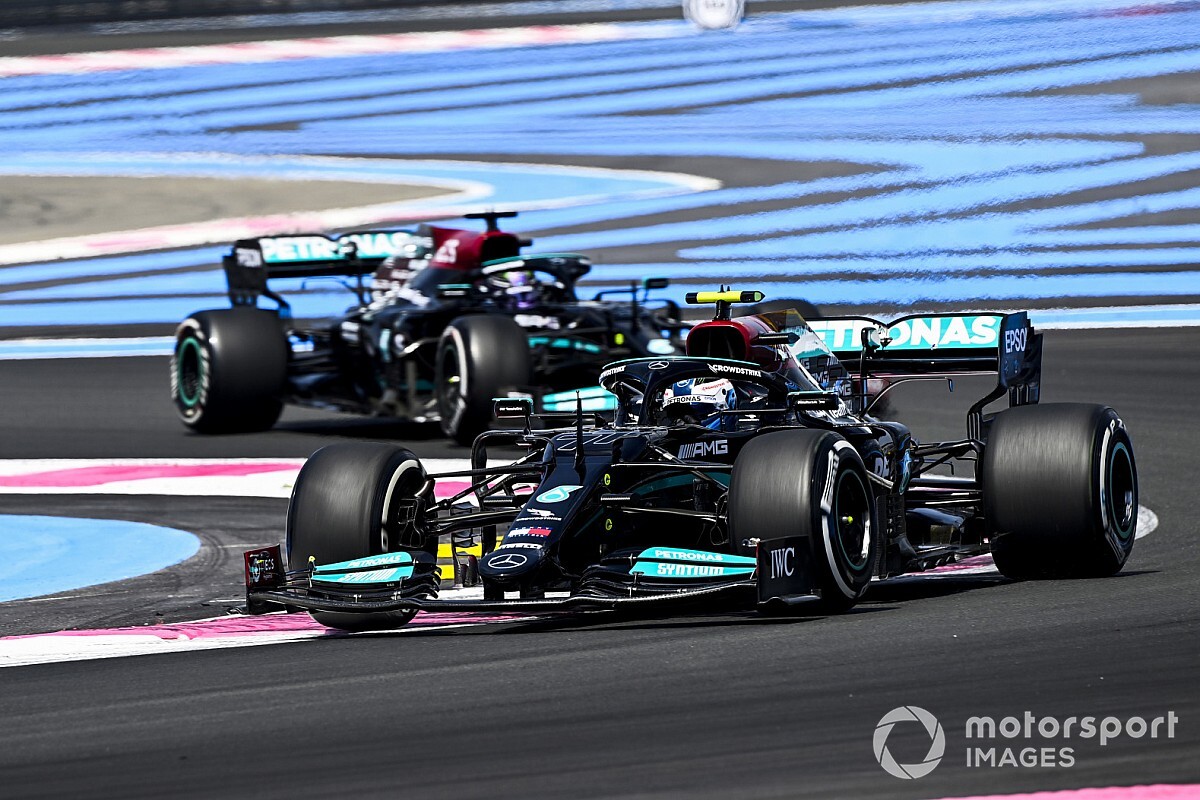
A planned change from the monocoque to the cars of Valtteri Bottas and Lewis Hamilton has become one of the biggest talking points of the race weekend. As is so often the case in modern Formula 1, the chase for controversy quickly exhausts the debate.
In short: it became a thing that is not a thing.
If you go back to Thursday, the news of the chassis replacement surfaced after Bottas’ appearance at the press conference. At the beginning of this year, the FIA expanded the format to include a fan questions area, in which children on site have the opportunity to ask the drivers questions. While they are entertaining and provide answers to favorite movies or superpowers, they have proven largely useless to journalists.
But not this time. When Bottas was asked by a young fan whether he always drives the same car, the Finn said: “Sometimes we can change the chassis. I think I’ll have a different chassis this weekend. So it’s not always the same car.”
That comment got the ball rolling. Bottas added that “it was always planned for me to switch to a different chassis at this point,” with Mercedes then adding details that it had swapped chassis with Hamilton, going from # 4 to # 6, which they did Mileage and lifespan of the cars. Bottas had driven chassis # 5 at the beginning of the year, but this is not yet to be put into circulation after the crash in Imola.
Valtteri Bottas, Mercedes in the press conference
Photo by: FIA Pool
Chassis swaps are common in Formula 1, but in the context of Bottas’ tough start to the year, and especially after his battles in Azerbaijan two weeks ago, it became a fascinating point. This was only encouraged when Bottas had the upper hand over Hamilton in training on Friday and was ahead in both sessions and over two tenths of a second in FP2. Hamilton once commented on team radio that “something is wrong with the car”. He later revealed that the team had “chased the tail” during the entire training session, and may explain his comment.
Bottas said after FP2 that it was “hard to tell” whether the chassis change helped him, but Hamilton quickly downplayed a role. “There are very seldom differences between the chassis,” said Hamilton. When asked whether he felt anything significantly different about his car compared to Baku, Hamilton said: “I don’t think so.”
But that didn’t stop the narrative in some corners. The fact that Hamilton was using the chassis that Bottas took to second place in Monaco was ignored. No, it was just the one that Bottas struggled with so much in Baku, which of course was why Hamilton was behind on Friday …
Toto Wolff noted that the chassis was “great” in Monaco during an interview with Sky Sports on Friday, but made it clear that Mercedes would of course make a change if there were serious concerns about the chassis.
The story was not released in the run-up to qualifying. Bottas overtook Hamilton by a few tenths again in FP3, which made it possible to reel up lazy observations. The fire was further stoked by former Mercedes driver Nico Rosberg, who was quoted on Sky Sports as saying that chassis replacement was not standard when he was on the team.
But Rosberg’s comment was quickly refuted. In a tweet from 2018, the official Mercedes account wrote about chassis # 1 of the 2015 Mercedes W06: “Lewis Hamilton drove this car in the first half of 2015 before it became Nico Rosberg in the second half.”
The debate was finally brought to an end in qualifying. Both Hamilton and Bottas were quick throughout the session and were consistently at the top. While Max Verstappen took pole for Red Bull, Hamilton secured second place on the grid and displaced Bottas in third with a little more than a tenth of a second.
“I was generally dissatisfied at the car weekend,” said Hamilton in an interview with Paul di Resta after qualifying. “I saw you make up a myth and so I was happy to prove the opposite – the quality of our engineering, you know, all cars are exactly the same.”
It was a strong statement from Hamilton that he was asked about in the post-qualifying press conference. “I think I heard Paul say something about the chassis yesterday,” said Hamilton. “I think he said there was a press release … I don’t know.” (Mercedes press release from Friday just listed the chassis number used, as is standard).
“And then the only question was whether our chassis was the same, and as you can see, I did a great job with the same car today, so it’s no different.”
Wolff was questioned again after qualifying at Sky Sports and asked to “clear it up”. He reiterated that this is a standard practice and that all chassis are rigorously tested to ensure that there are no major differences.
“The drivers were informed in the middle of the week or towards the end of the race that there was an option to swap, and there wasn’t even a comment,” said Wolff. “Of course, it is in the driver’s head if something suddenly doesn’t feel right, and that’s absolutely fair, and we also offered a suspension change overnight. But no, we stayed with what we have. ”Had it been a problem, Mercedes would have accepted a change for Hamilton, but the seven-time world champion saw no reason for it.
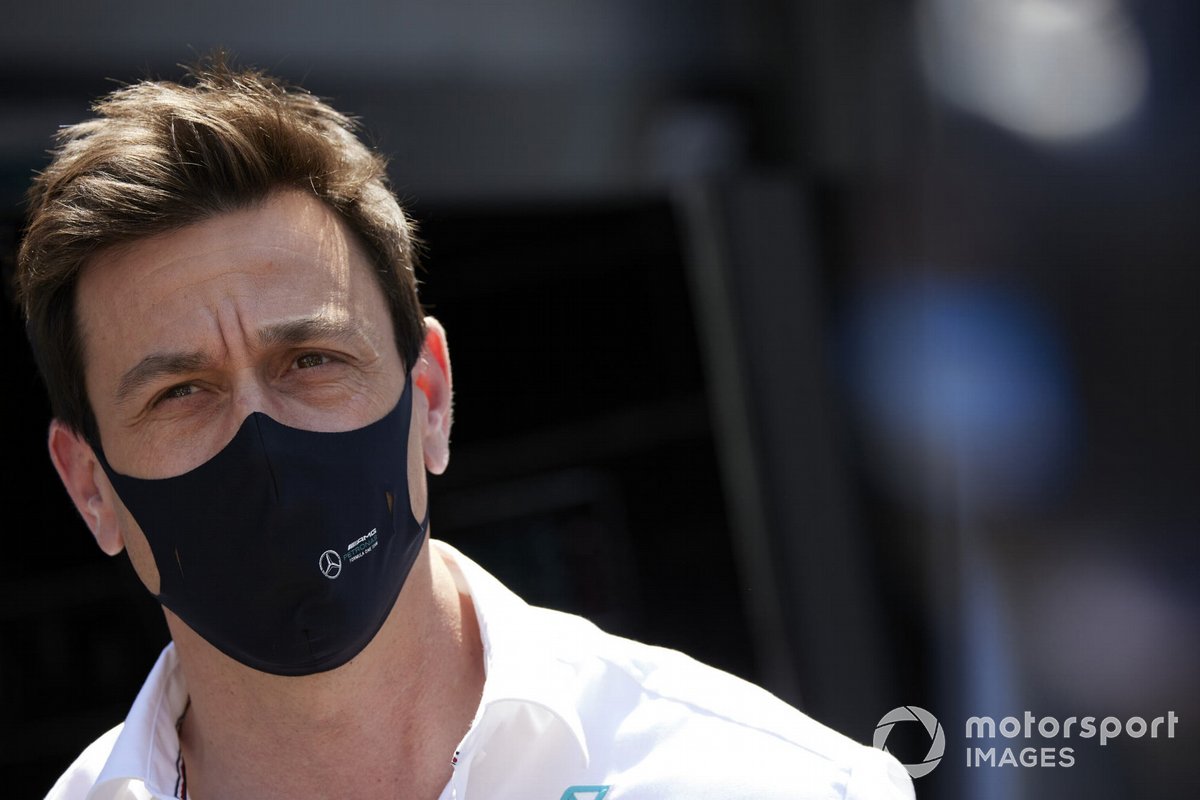
Toto Wolff, Team Principal and CEO, Mercedes AMG
Photo by: Steve Etherington / Motorsport Images
When Wolff came to conclude his last media visit of the day, the topic was dead. Mercedes even winked before the meeting warned that there would be a “penalty point” for journalists who said the words “chassis swap”, so the team got bored this matter. The first question then related – as predictable – to the chassis swap.
“So which camp are you?” asked Wolff. “The one who thinks Lewis is disadvantaged or the one who thinks Valtteri is disadvantaged?”
Our colleague said he was just trying to understand what happened and got Wolff to explain how Mercedes manages the chassis allocation. The team currently has four in action: # 3, which is currently in a box as a replacement chassis; # 4 used by Hamilton in France; # 5 to be fixed after Imola crashed; and # 6, which is used by Bottas. “
“We have four chassis, four carryover chassis, and if you are probably doing research with the other big teams, Ferrari and Red Bull, they should also have carryover chassis instead of producing a new one because the new one would be too expensive,” said Wolff.
“So we have four chassis with us. One had a little oops in Imola. These were all chassis that have won races in recent years and chassis that have been used by everyone, by both drivers.
“At the beginning of the season there is a plan of which chassis goes where, if there is one with the damage, when can we repair it? When does it come back in a box as a replacement chassis? There is no other thought behind it.
“Today these chassis are laser scanned when they return to the factory. They are checked for rigidity. And if there is the slightest deviation, the chassis is not used.”
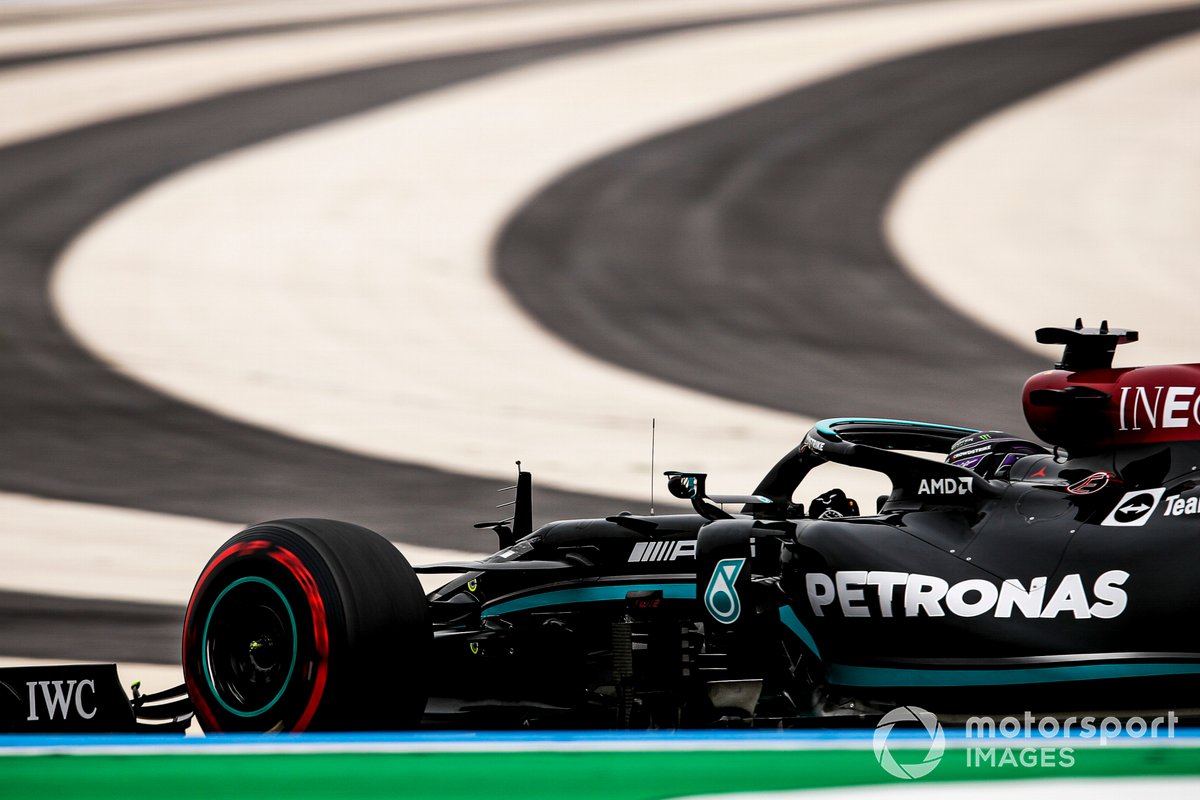
Lewis Hamilton, Mercedes W12
Photo by: Zak Mauger / Motorsport Images
Myth good and really blown up. But one last question: If two drivers are absolutely satisfied with their chassis, why should the team switch directly instead of leaving them in the same chassis for as long as possible?
A tweet sent yesterday by a Mercedes F1 composite designer offered an idea: “I think it’s just a business decision – chassis are worth more if Lewis wins in them!”
It makes sense. Being able to highlight the success of a chassis across two drivers would undoubtedly make it more valuable. The 2018 tweet about the W06 proves just that by setting the record for the most poles taken from a single chassis.
Should Hamilton not beat Bottas in the race today, it is possible that the chassis swap will be cited as the reason by those looking for a lazy explanation.
But if it were really an issue, with margins as good as in the title race, Hamilton would have already announced it and Mercedes would have acted quickly. Neither of them can afford to lose a bit of performance right now.
So let’s put the aluminum foil hats away and hopefully never give oxygen to this non-story again.
The post How the Mercedes chassis change sparked an unfounded F1 conspiracy theory first appeared on monter-une-startup.




