
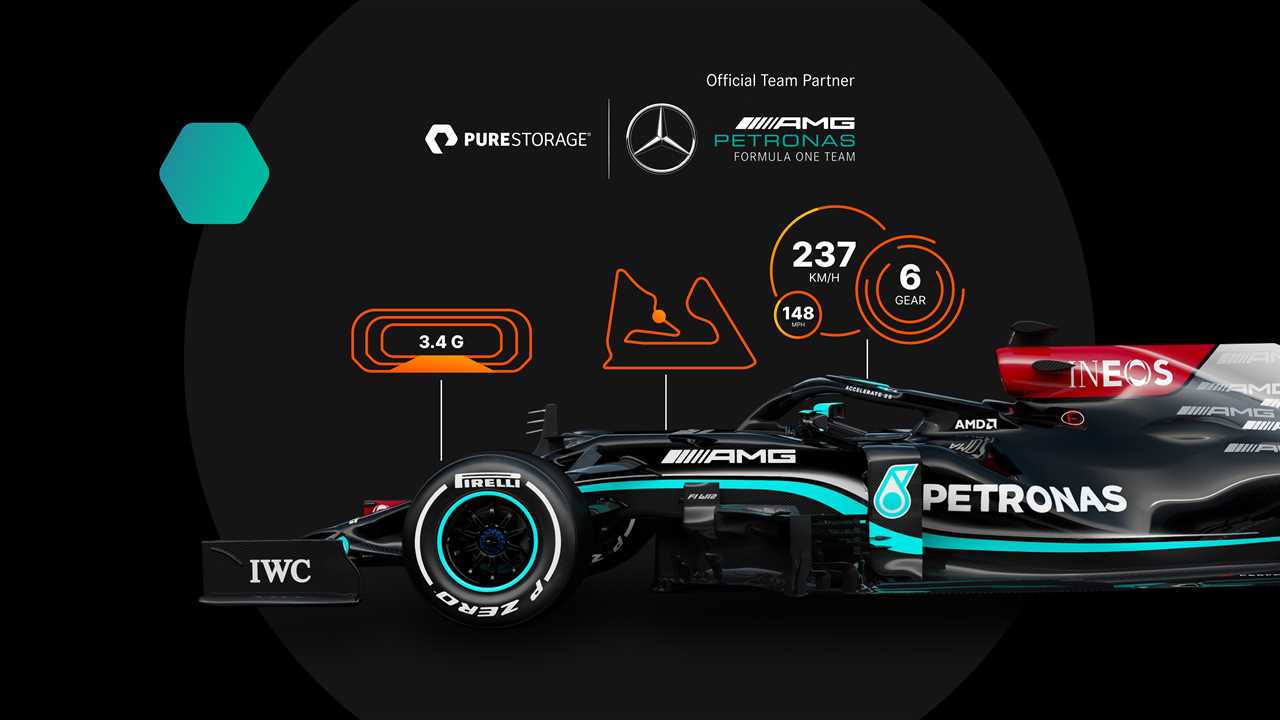
Modern F1 racing cars are connected, connected, intelligent machines that can contain hundreds of sensors and nearly a mile of wiring. These sensors provide billions of data points for analysis that help teams outperform the competition – such as when data from Mercedes-AMG Petronas’ Formula 1 car helped Lewis Hamilton achieve his dramatic victory at Silverstone this year.
Where are all these sensors, what data do they collect, and how is this data used by engineers and drivers? Here’s a closer look at the lean, mean data factories in modern F1 cars.
What sensors are in an F1 car and what data do they collect?
Without delving too deeply into the construction of cars, there are various systems – engine, exhaust system, transmission, differential and aerodynamics – that communicate with one another. The engine control unit (ECU) is the center of a car’s system, and the standard ECU (SECU) is a small, powerful computer within the ECU. The SECU was commissioned in 2008 and acts as the central data storage unit in the car, which is responsible for processing and transmitting the data from the car to the team.
There is also a Power Control Module (PCM), a Data Logger Master Control Unit (MCU) and the steering wheel, which also acts as a remote data interface for the driver.
Then sensors are placed in different places in the car. Sensors come in three different categories:
- Instrumentation sensors, such as pressure and fuel flow sensors.
- Monitoring sensors, send the channels with data on the state of the vehicle systems.
- Control sensors, convert driver inputs into car outputs (e.g. acceleration or ignition).
They can be magnetic, optical, and even laser powered. Some examples of specific sensors include:
- Temperature sensors, including engine and airbox temperature sensors and non-contact temperature sensors that measure the friction between parts using infrared energy. Thermal imaging cameras can also offer non-contact heat detection.
- Accelerometer, measure the g-forces generated during cornering or braking.
- Pressure sensor, Measure hydraulic systems.
- Biaxial sensors, Measure braking and steering.
- Tire sensors, Measure wear, grip, temperature and pressure to tell engineers how the tires are holding up or affecting the car’s balance.
- Pitot tubes, these are tiny tubes with sensors that measure airspeed – the same type of sensor used on commercial airplanes.
- Ultrasonic fluid flow sensors, that monitor fuel performance.
- Laser, which measure the distance of the car from the ground.
- Damper potentiometer, Measurement of the spring compression and the rolling behavior of the chassis.
And don’t forget the “black box” of the Formula 1 car – the accident data recorder (ADR), which also collects sensor data and alerts you immediately in the event of an accident.
How do sensor data get from the car to the team?
Sensors and other components on board the car transmit data to each other via a network built into the car, which is logged on an on-board server. This data is then encrypted and sent to the teams by radio from an antenna mounted on the car. All of this happens in a split second.
However, this is not just any radio frequency. On tracks in busier cities like Singapore, it can be difficult to block out the noise on race day. Formula One Management (FOM) has created a standardized communication network that uses fiber optic connections and shared access points that are distributed over a route and provide encrypted communication for each team between the car and the workshop. This sends small packets of real-time data, while cars can also send out a burst of microwave data if they are in range during a pit stop.
What happens to the sensor data that is collected from the car?
In an article about how Formula 1 teams get agile data at the edge, we looked at how data from the Mercedes F1 team is collected, processed and stored with mobile data centers powered by Pure Storage®. But what do engineers do with this data?
Back in the Race Support Room, the data is processed and mixed with audio and video data to draw a clearer picture for:
- Tests before the race. Much like an airline pilot completing a pre-flight checklist, pre-race sensor tests are performed by a data engineer, including calibration checks and tuning to the conditions of each route. Each track is unique, which is what makes these sensor values so crucial before and during the race. See, track by track, how data on the unique physics of each racetrack helps you develop racing strategies.
- Monitoring in the middle of the race. On race day, engineers can spot monitoring problems and allow the driver to make adjustments in a split second.
Two examples:
- A driver is hot on the heels of a competitor in an aggressive attempt to overtake. The exhaust of an F1 car – with temperatures between 950 and 1,000 degrees – can be like putting the car in an oven. If the engine temperature rises to dangerous levels, engineers can tell the driver to hold back until things cool down .¹
- Tire sensor data helped with a second pit stop strategy at this year’s Barcelona Grand Prix and gave Mercedes and Lewis Hamilton a victory advantage in no time at all.
- Legal compliance. The Fédération Internationale de l’Automobile (FIA), the umbrella organization of Formula 1, has strictly regulated which technologies are allowed on board and strictly monitors them using sensor data. Each team’s data center is directly linked to the FIA.
- Strategic intelligence. Data from the car is not only saved after a race. Data is added and processed over and over again, sometimes in future seasons. Competitive data also plays an important role in the overall picture of F1 analytics. Sensor data can be analyzed in isolation from a car or paired with data from competitors. For example, look at curves. This is a great use case for overlaying sensor data with competitive data to compare two lines on the same curve to see which apex is best.
- Driver behavior. Sensors generate telemetry and log data from the car itself, but also monitor driver behavior. This data is a great tool for teams to provide quantifiable feedback to drivers to improve their driving behavior. Driver metrics include what percentage of a lap a driver spends at full throttle, how he uses the brakes and how he turns.
Mercedes-AMG Petronas F1: Driven by data
Modern F1 cars are incredibly impressive, complex systems that have become more sophisticated over the years, giving engineers (and drivers) more responsibility, but also more insight. Today, winning is a successful marriage for the two – an instinct driven by data.
Explore more of the world of F1 and learn how the Mercedes-AMG Petronas F1 Team wins with data with the help of its official technology partner Pure Storage. Download the Breakthrough Guide to see how data can help you win your business.
- https://www.mclaren.com/racing/inside-the-mtc/f1s-fantastical-facts/#:~:text=4.,aluminium%20(660%C2%B0C).

Author: Carey Wodehouse
Carey Wodehouse is an IT / development content writer at Upwork who aims to make the complex world of web development a little easier. Based in Richmond, VA, Carey has worked for clients ranging from online retailers and global market research firms to financial companies. … Show complete profile >





