
Three cargo planes left Mexico City late due to fog problems, which meant the equipment reached São Paulo too late.
As a result, the teams were unable to carry out their usual sequential pre-race prep work on the regular schedule.
McLaren, Ferrari, Alfa Romeo and Haas were particularly hard hit by the late arrival of chassis and parts, while Mercedes and Aston Martin were among those who could prep their cars to a certain level but had to wait for their aggregates to arrive before they did arrived could finish the work.
The FIA agreed to waive the usual Thursday evening / Friday morning curfew, and Race Director Michael Masi sent out sporting regulations for that weekend with curfews cleared. The usual deadline for acceptance was also waived.
The last of the trucks from Sao Paulo Airport reached Interlagos on Thursday lunchtime, and the teams were able to complete their preparations for the FP1 meeting on Friday.
“What happened was that Mexico City airport was closed for five or six hours because of fog, which obviously messes up the whole schedule,” Nielsen told Autosport. “Some flights couldn’t get on and those that are already there couldn’t get off.
“Flights are then diverted, and those that have been diverted could not come here directly. And then it happens that you run out of crew hours.
“Freight flights have their crew on the plane, they are not airlines where you can simply call another crew from a certain airport, you have to bring staff from elsewhere.
“So a combination of diverted flights and dwindling crew hours meant there was about a 24 hour delay. You can’t short out some of this stuff when the airport is closed and the crew hours are what they are.”
Nielsen explained that all teams have received the first shipment of priority cargo and that it is up to the teams to decide what to put in this category.
“Everyone has their priority cargo,” he said. “I think it’s three pallets each. You can choose what to put in it. I’m sure most people put their chassis in there, things that they need right away.
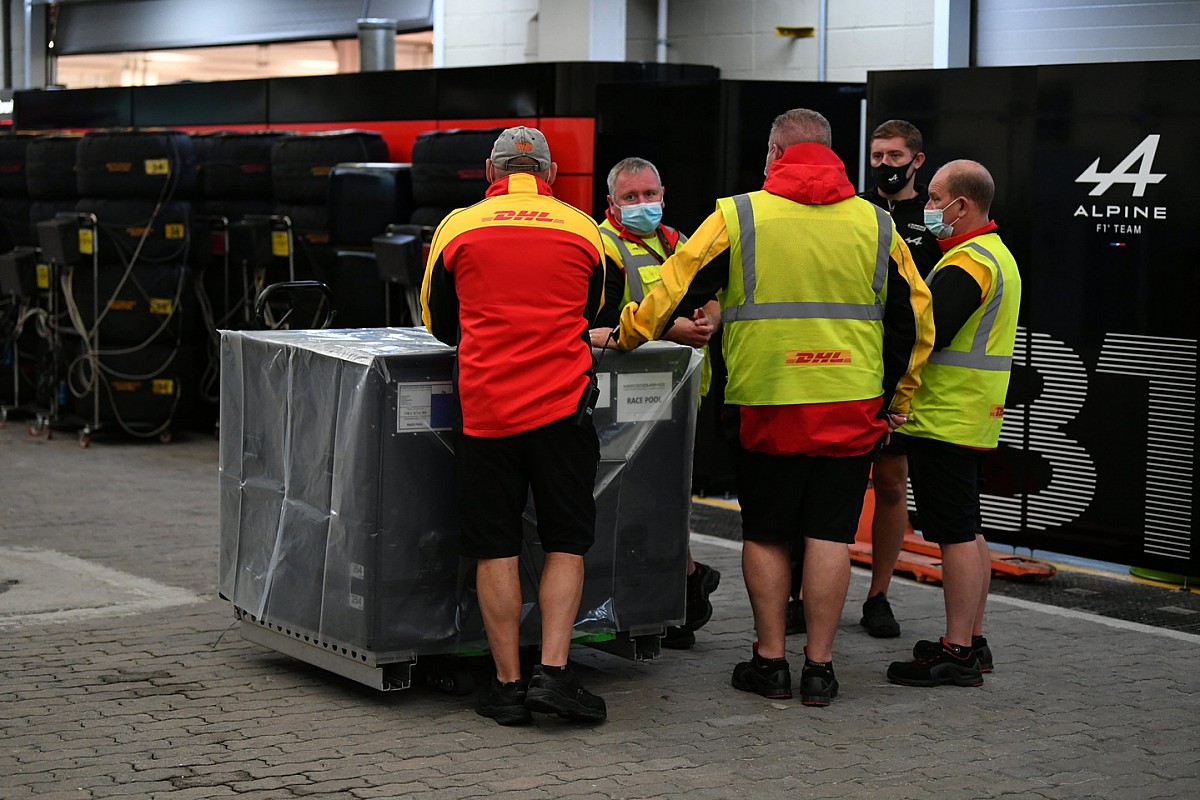
Equipment that arrives in the pit lane
Photo by: Andy Hone / Motorsport Images
“We don’t tell them what to put on their priority cargo, it’s up to them. But we tell them how many pallets they can have and they decide what to put in them. And I’m sure that after this weekend … they will all check what they have in their priority cargo.
“But some teams were badly affected by the secondary flights, mainly engine suppliers who had a lot of engine material in them that got it very late.
“Usually the cargo comes in ruins and drabs. When everything is there, we pass it on to everyone. This time we couldn’t. We had to be pragmatic and tell those who have it.” can begin, and those who don’t will do what we can.
“You can’t have all the planes take off and arrive at the same time, so you have to set priorities. And when you get to an airport, one plane will break down and then another plane and another plane. So unfortunately there is always a priority. Teams know that and they accept that. “
Speaking of the four teams that suffered the most, he said, “They had absolutely less than what they normally would. And that’s why they had to work late last night, so we had to lift the curfew to give them time give.” to catch up.
“And everyone liked to modify it, which is nice. And there were even stories of teams who weren’t as concerned about lending their forklifts and other things to other teams. It was kind of a collective effort and it was nice to see the teams working together to help others recover faster. “
Nielsen emphasized that Formula 1 would examine exactly what could be done differently in the future.
“We will of course do a full autopsy of what happened and try to learn the lessons from it. But it is the boundaries of the real world that cannot be short-circuited.
“It’s not unprecedented, it happened in Melbourne a while ago, the last couple of flights were very late, but it doesn’t happen often.
“Usually our freight department runs smoothly and [its boss] Mike Negline does it all great. But occasionally things happen.
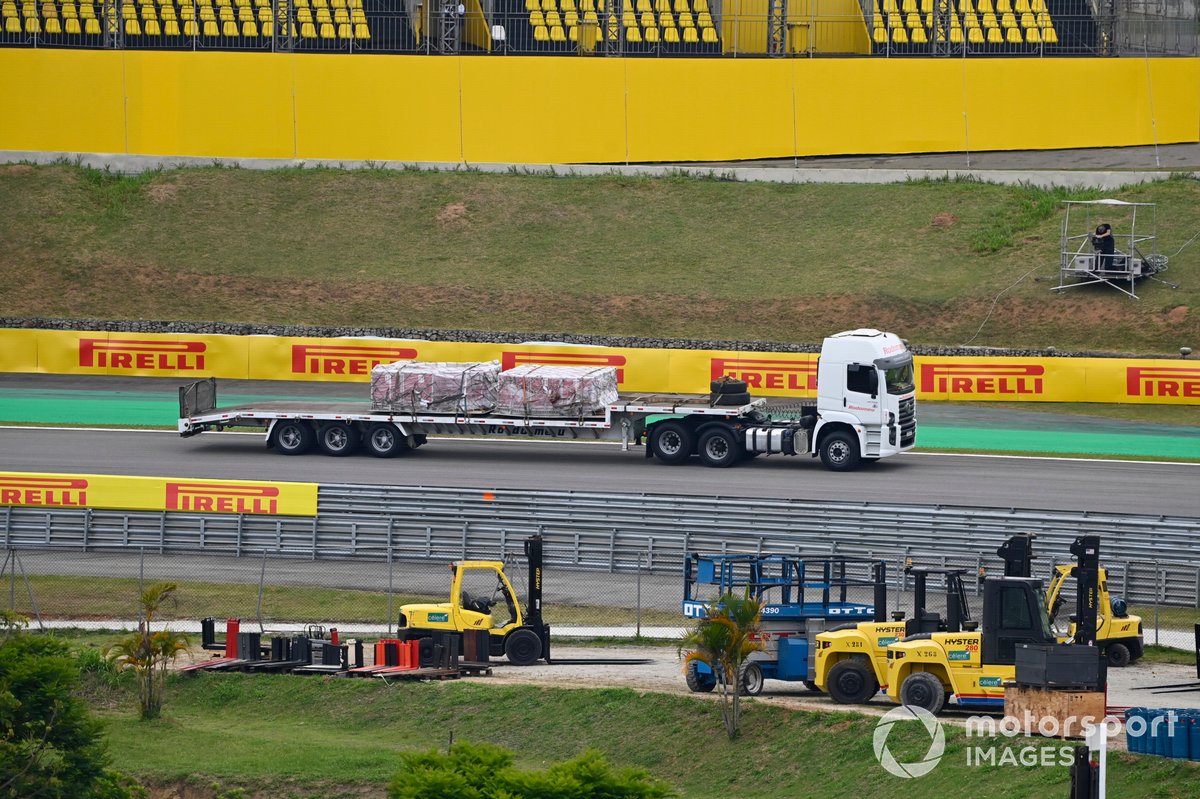
Trucks delivering equipment to the track
Photo by: Mark Sutton / Motorsport Images
“As I said, we’re going to do a full autopsy. Who was affected, how much and why, and see if there are any lessons to be learned.
“It is true that not everyone was affected equally, some much more severely than others, some very slightly or not at all.
“Which is an uncomfortable situation because it’s a sport and you want everything to have the same conditions. But in this particular case that wasn’t possible due to the limits of the real world.”
McLaren boss Andreas Seidl admitted that the delays were difficult for his team.
“On our side, the main cargo was missing, so we didn’t have the cars or the gensets,” he said. “As a result, we could only start converting the cars yesterday afternoon.
“With the freight arriving shortly after noon, luckily, thanks to a big push from the entire team, we were still able to finish pretty much around midnight yesterday.
“That said, I don’t expect it to affect the rest of the weekend. Obviously not an ideal start because you want to use Thursday night normally to recover for everyone before it gets serious on Friday. But again, with the midnight goal, I think it was still a reasonable break. “
The post How freight delays to Brazil affected F1 teams’ preparation first appeared on monter-une-startup.




