
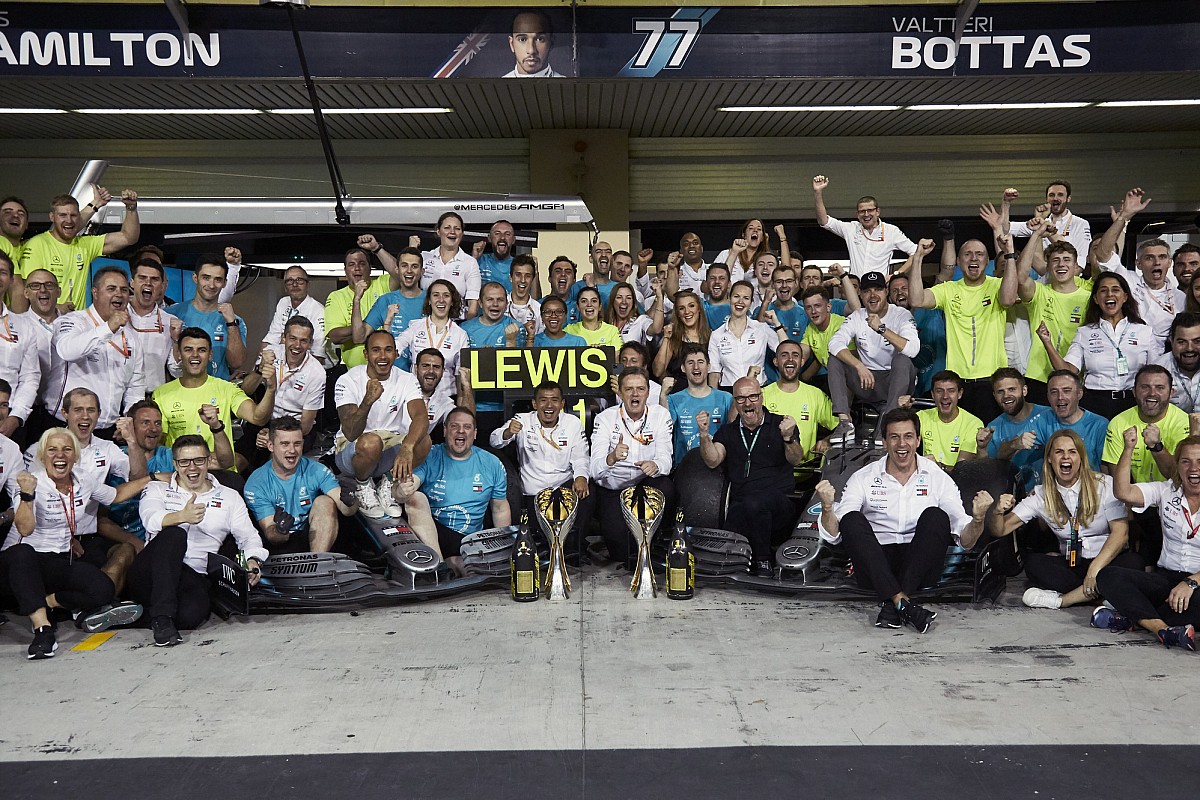
The release of the Hamilton Commission’s report marks the beginning of a future hoped for by Lewis Hamilton in which Formula 1 and other motorsport categories are more diverse.
It is clear to the seven-time champion that he wants to take his findings and recommendations into account at all levels in order to improve the representation of black people in the motorsport industry.
But the current situation, which includes the fact that only one percent of all employees in Formula 1 are black, only hit Hamilton 18 months ago when he celebrated his sixth title.
At the end of 2019, Hamilton looked at the team photos at the end of the season and was amazed at how few black people were shown in the pit lane.
Also read:
As a pioneer in being named the first black driver in Formula 1, he couldn’t quite believe that his presence hadn’t opened the floodgates for others to follow him into the sport.
“As the first F1 driver of color, but growing up in motorsport, I often looked around and wondered why I am one of the very few people with color,” he said.
“And it’s not just about drivers, I’d say it’s more about the great job opportunities that are there, from mechanics to engineers to marketing and accounting.
“Over the years, as I got more successful, I thought that I would open more doors to black talent there and successful and at the top.
Valtteri Bottas, Mercedes-AMG F1, 2nd place, and Lewis Hamilton, Mercedes-AMG F1, 1st place, on the podium
Photo by: Charles Coates / Motorsport Images
“But I remember looking at the team photos after Abu Dhabi in late 2019, and it was a really strong memory as I zoomed in on those pictures of how little progress had been made to make the sport more inclusive. I knew then that I was had to do more and where the idea of the Hamilton Commission came from. “
The Hamilton Commission report took 10 months to complete and drew on a wide range of experts from motorsport, education and industry. It is now being made available to all motorsport teams as well as stakeholders at all levels including Formula 1 to try to bring about change.
F1 CEO Stefano Domenicali has already indicated that his organization will take further action shortly, and Hamilton himself will take the messages further with his Hamilton Foundation and a joint initiative with the Mercedes F1 team.
“There’s a lot more to come later in the month, but that’s really just the beginning,” he said. “And I want to say that I couldn’t be more excited.
“The time for a change is now. And I think what I’ll be most proud of at the end of my career, or even beyond, would be looking back at the UK motorsport industry in five, ten or fifteen.” Years and see it as more representative of our society. “
When you talk to Hamilton, you feel that the work of the Hamilton Commission has been an eye-opening experience for him in understanding where the industry went wrong as it was for companies directly involved.
“Since joining Mercedes, I’ve always asked the team this question: Why doesn’t the team have a lot of diversity?
Toto Wolff, Team Principal Mercedes and Lewis Hamilton, Mercedes
Photo by: Daimler AG
“And I remember that there was just no substantial answer. It just didn’t fit. And of course the answer was that there just aren’t enough people trying to get into engineering. But I think the reason we continued with this was because we were trying to figure out what those barriers are [to entry] are.
“So this is where it really starts. If we learn and gain this understanding, we can fix the problem.
“I think you saw last year when Formula 1 and we all said a lot: for example end the racism that F1 did. And you heard, for example, from Jean Todt and Chase [Carey] say they will invest a million in diversity and inclusion.
“But if you don’t know what the problem is, you can’t fix it. So it’s been an amazing journey and it has been a learning curve for all of us.”
There is no illusion that this is a problem that can be fixed overnight. It is a long-term project that spans the education system to encourage more black students to take STEM subjects and get the best grades for them.
Likewise, it will not be the work of the hour to change some attitudes within motorsport itself – especially when it comes to driving away racism. Because the results of the commission revealed some less than beautiful elements.
Rhys Morgan, Director of the Royal Academy of Engineering said, “The experiences of the engineers we speak to and the students we spoke to in engineering really brought to life some of their lived experiences in motorsport engineering.
“There was micro-aggression and just outright racism, racist comments that they would just live with and that were kind of joked off, but they were pretty terrible racist comments.”
Hamilton says this week’s racist abuse against English footballers after their defeat in the Euro 2020 final showed how far attitudes have yet to change.
“After yesterday we only see the racist abuse of football players on the Internet, which has been devastating. It shows that we as a nation still have a long, long way to go.”
“In my personal opinion, it comes from education. Growing up in a system where you don’t learn where you’re from.
Lewis Hamilton, Mercedes
Photo by: Steve Etherington / Motorsport Images
“I think it’s an educational thing and something that needs to change within the curriculum. And I’m really proud that people today are raising their voices and being more open. We also need more support from social media platforms, they definitely have to do more. “
“We had that before [social media] Blackout early in the year, but it’s not enough, you know. We need to stop the abuse that is happening online. In any case, this Commission is highlighting one of the areas that we can improve. And I hope this will create a ripple effect that will drive further change. “
Hamilton is very excited by the work of the commission and sees an opportunity to transform the industry that has given him so much.
And for a man who is likely to end his Formula 1 career as a record breaker on all fronts, he admits that his work on improving diversity will ultimately be just as important to him as his trophies in the decades to come.
“For years I’ve been asked what should your legacy be?” he said. “I remember that maybe I didn’t really think about it.
“I think when I was younger, being an F1 driver was being the best I could, being considered one of the best F1 drivers. But over time, I’ve had the success and it it was only ever short-lived that this would bring success.
“The universe works in a mysterious way and at the end of 2019 this idea came from the commission to me. We’d started working on it and then it happened to George [Floyd], and this whole movement, and it happened to coincide with what we had already started. So I really felt that I had discovered my purpose.
“For me now, I want to be remembered for much, much more in my life than just winning championships, which of course is an amazing thing in itself, and actually helping people and changing the industry and ways of seeing things.
“We are all the same. We all believe the same and there is just no reason why it is [F1] shouldn’t be as diverse as the world around us.
“So if I’m able to move things around somehow, and all it takes is a little shift of the needle [direction], and over a long distance that can be the size of an entire continent. It could be huge. That’s what I’m working towards. “
Lewis Hamilton, Mercedes-AMG F1, Sebastian Vettel, Ferrari, George Russell, Williams Racing and the other drivers stand and kneel in support of the “End Racism” campaign before the start
Photo by: Mark Sutton / Motorsport Images
The post How F1 team photos were Hamilton’s wake-up call first appeared on monter-une-startup.




