
Companies enter into partnerships with the cutting-edge platform that is Formula 1 for myriad reasons, but primarily to enhance their brand or products, and, where applicable, to benefit from the sport’s unique technologies and attributes, then apply these lessons to their products. The latter could take on many facets, ranging from product development through systems to manufacturing techniques and quality control.
When Pirelli re-entered F1 in 2011, replacing Bridgestone – who became F1’s first officially-appointed sole tyre after Michelin’s 2006 departure – the Italian company did so to tick all the above boxes. Executives spoke of enhanced road tyre technologies, rapid prototyping, streamlined manufacturing processes and enhanced global awareness.
There is, though, a flipside to the appointment: F1 and the teams are effectively Pirelli’s customers, and dictate the terms and parameters of supply – more recently via the so-called ‘target letter’, which outlines the lap time ‘deltas’ (differences) between compounds in order to enhance ‘the show’ via degradation and varying strategies.
Understanding this customer-supplier relationship is absolutely crucial to understanding F1’s tyre dynamic: the supplier (Pirelli) is required to deliver precisely what the customer (F1) demands. This state of affairs was outlined during one of the first in-depth interviews granted by Pirelli’s motorsport director Paul Hembery following their 2011 arrival.
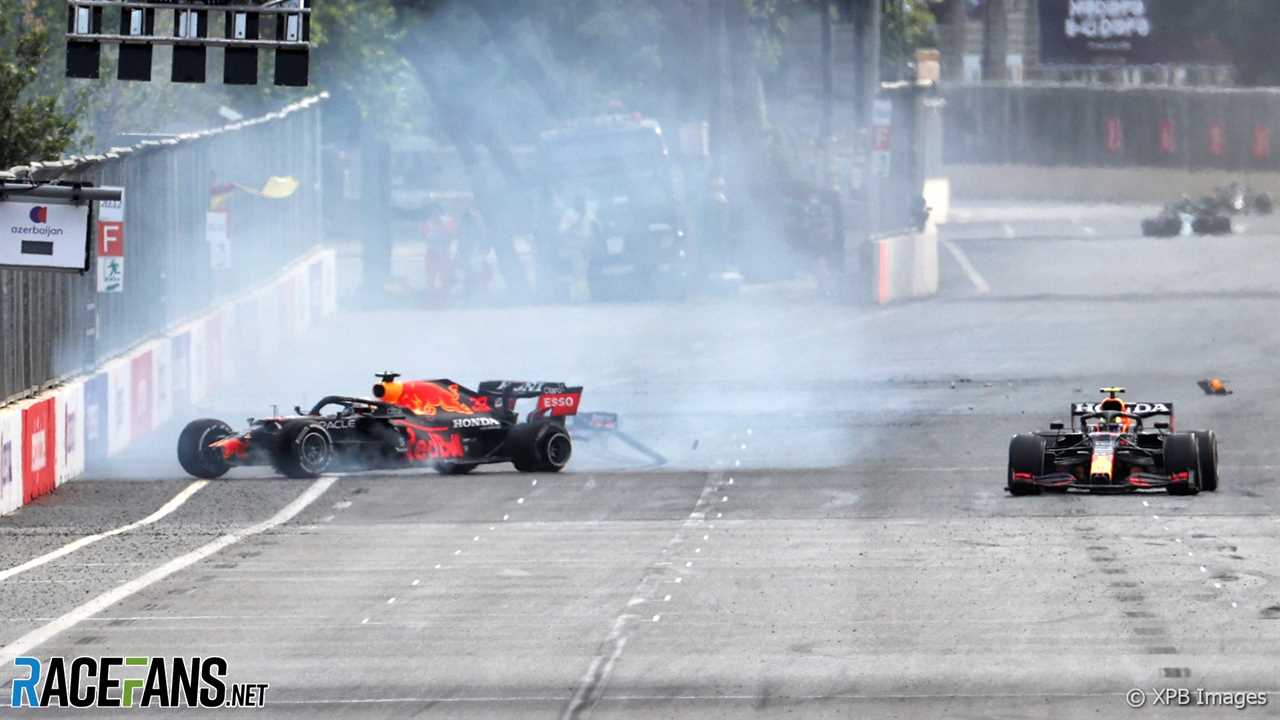
Stroll suffered a tyre failure before Verstappen in BakuSpeaking during a 2012 test at Mugello after criticisms from drivers, most notably Michael Schumacher, surfaced, he explained: “We were asked to come up with a certain approach, and that was agreed with the teams.
“The leader for the teams’ views was actually Ross [Brawn], and he told us that Canada 2010 was the model they wanted, and that is what we worked on.”
At Canada in 2010 – not unlike last weekend at Paul Ricard – teams were caught out by unexpected tyre performance which prompted them to make more pit stops than expected, producing a lively race of uncertainty and lead changes.
Brawn, today F1’s managing director, was at the time Mercedes F1 team principal, but simultaneously acted as technical delegate and spokesperson for the (now defunct) Formula One Teams Association. He was speaking in that capacity – in other words, on behalf of all teams.
Advert | Become a RaceFans supporter and
Hembery then expanded on the thought processes: “What do we want? One car to disappear into the distance? The public turned away from the sport when that happened, so there was a very clear decision made by the sport to address the racing.”
He stressed that Pirelli was required to adapt to F1’s demands. “We can supply tyres that don’t degrade and allow [drivers] to push, as we did [in 2011] when the hard and medium tyres had negative degradation, [when] the loss of performance from the tyre was less than the loss of fuel.
“We would [be open to change] for the sport, but it’s not just the drivers [who decide] – it’s the teams, the promoter (F1). The team principals tend to be quite pragmatic and look at the bigger picture, and I would be very surprised if they asked us to do anything different.
“At the end of the day we do what they want and also the right thing for the sport: it is not us on our own deciding a direction, you have to work together as a partnership.”
Hembery later moved on within the wider Pirelli group, then left the company (and F1) to pursue his entrepreneurial interests, with his role in car racing taken – though not, saliently, at board level – by his former lieutenant, Mario Isola. At the instigation of the FIA in 2019, the Grand Prix Drivers Association – notably via Lewis Hamilton who has often criticised Pirelli’s rubber – has input into the target letter.
That said, the association has been remarkably reticent about coming forward about the spectacular Baku tyre failures unless asked directly for comment, as RaceFans did to GPDA director George Russell during the build-up to the French Grand Prix. The gist of his reply: “Definitely, safety is first and foremost in our sport paramount. I think it is the duty of all of us to try and put an end to all these issues.”
Still, Pirelli holds ultimate responsibility to provide safe products capable of withstanding the 5G forces and sustained energy levels expended by current F1 cars, and to this end it has imposed operating parameters, some of which are now imposed via the race director notes issued on a daily basis by the FIA during race weekends, and technical directives outlining detailed operating procedures, the last of which ran to 12 pages!
All this begs some simple questions: Why would a supplementary 12-page document be required to ensure that highly qualified engineers – all of whom are acutely aware of the safety implications of any missteps – adhere to prescribed tyre pressures and camber angles? Why should a variance of 1 psi make the difference between track or barrier?
Has F1 become overregulated or has Pirelli, in its ongoing quests to provide its customers with what they demand, introduced such complex technologies that increasingly stringent operating procedures need be imposed? Or, as its fiercest critics suggest, is Pirelli incapable of delivering tyres capable of withstanding the considerable performance demands of current F1 cars, undoubtedly the heaviest and overall most powerful in history?
Advert | Become a RaceFans supporter and
Talking the last one first: Pirelli is a world class company with a considerable competition history – it shod the world championship winner in 1950, the Alfa Romeo 158, a car weighing 710kg versus the 740kg of current cars – and there are absolutely no doubts that it has the competencies required to deliver safe, fast and durable tyres.
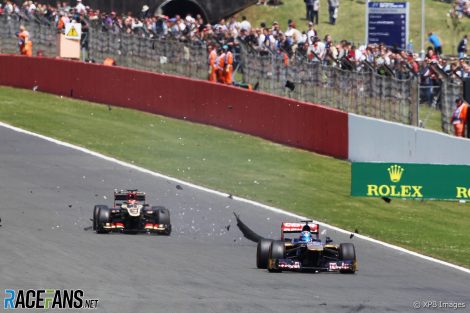
F1 had a spate of tyre failures at Silverstone in 2013…Had there been any doubts whatsoever about Pirelli’s integrity the FIA would not have approved the company as supplier, sole or not. Still, the tyre supplier’s incident record since re-entering a sport in which safety is absolutely paramount is concerning:
Note: the above list is not exhaustive, but excludes incidents where the cause of tyre failure was demonstrably team- or car-related.
Although kerb damage or debris have regularly been blamed for tyre issues, it is noteworthy that that such causes are seldom fingered in other categories which compete on the same circuits and use similar car construction materials.
Component failure can be expected in F1 due to the extreme demands placed on all its technologies – ‘long-lifing’ and simulation techniques have reduced such incidents to the degree that retirements are the exception rather than the rule as they once were – although there is a perception in the paddock that Pirelli has been rather badly served by coincidence when it comes to kerb and debris damage.
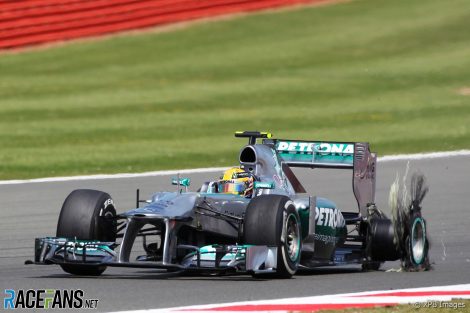
…one of which cost Hamilton a potential winThose perceptions were underscored following the seventh such failure in a 12-month period. Max Verstappen gave voice to them in the wake of the 320kph crash which took robbed him of victory in Baku: “It will be related to debris, it’s like that,” he said. Pirelli identified other, unspecified, causes – indicating Red Bull’s tyres were running outside prescribed pressure parameters.
During Friday’s French Grand Prix Isola stated that all components have operating parameters that need to be respected: “I think tyres are not different to engines, wings, suspensions, just to respect the parameters they are designed to work in with so we have a very clear set of parameters that we need to respect on the tyres, they could be pressure, temperatures, camber, whatever.”
He has a point, of course, but the teams who suffered failures in Baku – Red Bull and Aston Martin – are alleged to have raced with lower than prescribed pressures despite passing stationary checks, the implication being that they somehow circumvented the regulations. But using 100rpm more on an engine is not a safety critical issue, nor is an additional one degree of wing angle. However one psi or two seems to have made all the difference.
An analysis of major tyre incidents suffered by F1 this century recalls just one outside of those listed above, namely during the 2005 United States Grand Prix, where Michelin admitted to having gotten it wrong on the banked portion of the Indianapolis track after it was re-surfaced. No major Bridgestone (1997-2010) incidents spring to mind despite the two brands having been embroiled in intense tyre battles during 1997-98 and 2001-06.
A number of lap and top speed records set during that era endured for 10 or more years; Pirelli is not under pressure from any other brand, so cannot blame the pressures of competition for failures. However, at the height of the ‘war’ the teams tested virtually non-stop – at times seven days per week – with many of their costs underwritten by their respective tyre suppliers. In the process the suppliers gathered mountains of data.
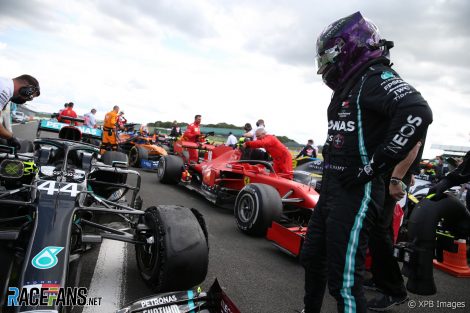
Last year’s Silverstone punctures prompted car changes for 2021Under F1’s current test restrictions – this season teams had just three days to prepare, with in-season testing banned save for tightly-controlled tests of 2022’s 18-inch rubber – Pirelli does not have that luxury; equally, simulation tools and tyre modelling programmes have developed to such a degree that intensive testing is no longer required.
Clearly, though, F1 has not found the correct balance between on-track testing and simulations and Pirelli is carrying the can. Testing costs money – heaps of it – yet the fact that Pirelli undertakes less testing than its predecessors does not mean it spends less on F1 overall.
In fact, a case could well be made that it spends more in a season than did either Bridgestone or Michelin – even on an economics adjusted basis – whose budgets funded research and development and the actual costs of going racing, with little or no contributions paid to F1 for marketing programmes.
In order to obtain the supply contract, the successful tenderer is expected to contribute substantially to F1’s coffers. Although numbers are confidential, Pirelli is believed to spend around half of its $100m annual F1 budget on title sponsorship and ‘bridge and board’ advertising, with the balance spent on development, manufacture and race operations. That’s $50m for marketing and the same on all the rest…
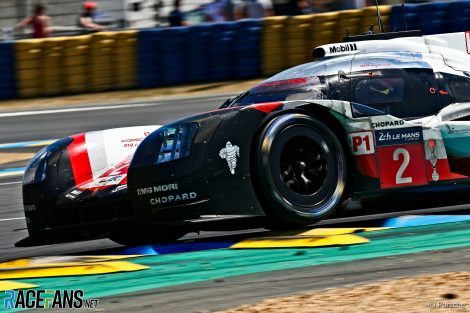
Could F1 tyres take WEC levels of punishment?Perusal of 2006 trackside and podium photographs show not a single visual of either tyre supplier as race or billboard sponsor; shots from the recent past show various races sponsored Pirelli; imagine how much better their tyres could be with another $50m thrown at them annually.
During the 2014 round of tenders a Michelin insider confided that his company was willing to match any spend by the competition subject to the full amount flowing into the F1 programme, with its marketing programme effectively being the brand’s on-track performance. Clearly that would not fly with F1; hence Michelin did not bother to go through with the tender, instead turning (very successfully) to WEC with Porsche.
Consider: the Porsche 919 LMP1 is around 100kg heavier than current F1 cars and similarly powered, yet drivers remarked that they were able to push for the full duration of WEC stints, even ‘double-stinting’ at times. Indeed, a WEC car delivers around 300km – a grand prix distance, give or take a lap or three – on a set of mediums even when driven hard.
True, WEC cars generally have four-wheel-drive which spreads traction and thus tyre wear, so possibly F1 truly has reached the limits of adhesion for 1,000bhp two-wheel-drive cars, a situation under review for 2025-onwards, as F1 technical director Pat Symonds exclusively told RaceFans when he shared his plans for F1’s 2025-onwards future.
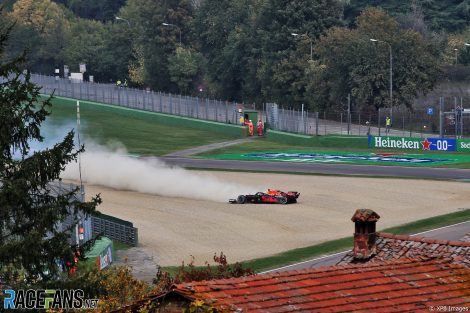
Another failure cost Verstappen second place at Imola last yearThe good news is, however, that 2022’s regulations mandate ‘smart’ tyres with integral sensors to monitor tyre pressures and three critical temperature parameters – air, carcass and rim – which not only enable tyre supplier and governing body to monitor tyres on-track for compliance but provide early warning of potential failure. These 19-inch tyres were scheduled for this year as part of F1’s ‘new era’ package, delayed due to Covid.
Every F1 stakeholder – from drivers and teams through FIA and FI to Pirelli and even circuit designers – is to some degree implicated in the events in Baku, and playing ‘blame games’ with safety critical items and pointing of fingers will not solve the issue. That said, there is no escaping the fact that ultimate responsibility for the integrity of Pirelli’s tyres rests with Pirelli.
F1’s ‘new era’ is likely to prove Pirelli’s last chance in F1, for the mandated sensor technologies will leave the company – or any replacement – with no place to hide if the tyres are not up to scratch.
RacingLines
Browse all RacingLines columns





