
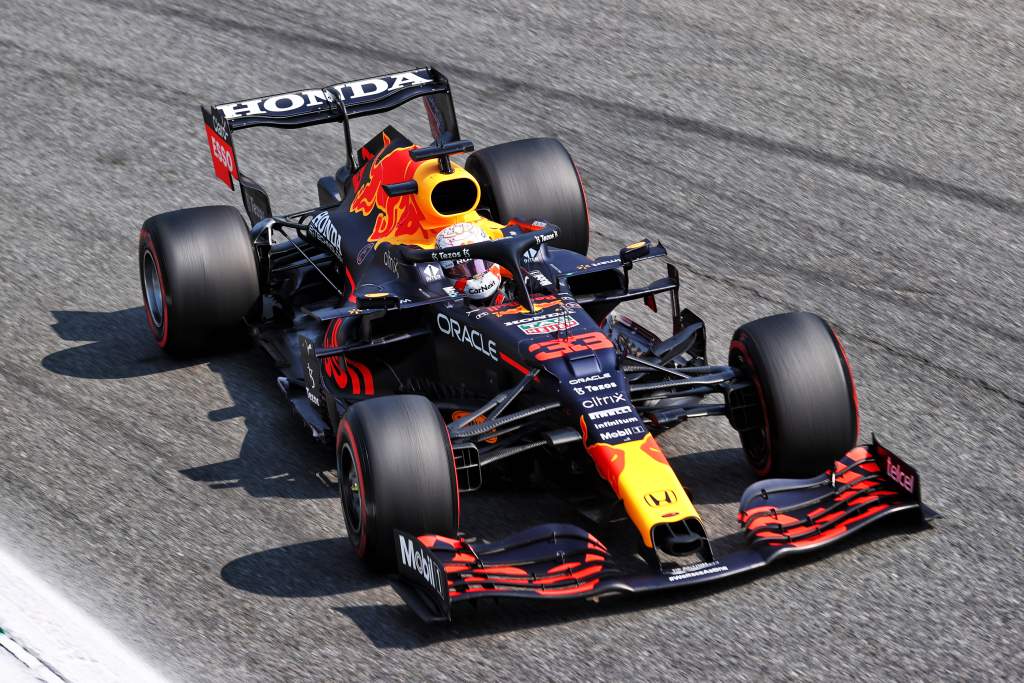
There was a claim by Christian Horner towards the end of the title run-in propaganda war that Max Verstappen was the only thing that brought Red Bull into the title fight, that the car was inferior to the Mercedes.
His tech guru Adrian Newey clearly contradicted this claim, and while recognizing Verstappen’s brilliance, he insisted that throughout the season he believed the Red Bull Honda was the faster car.
In a cold, objective analysis, the Red Bull seemed – with exceptions – to be faster in the first half of the season and – with exceptions – to be slower in the second half. There were all sorts of reasons for this, but the overarching reality is that both the Red Bull technical team and Honda took great pride in the way they embraced and partially defeated the colossus of the hybrid era, Mercedes.
It wasn’t just about the ’21 regulation changes that hurt the low-rake Mercedes concept. Both Red Bull and Honda made big profits. It was the combined result of all of these things that gave us the amazing season we had.
The Red Bull-Honda RB16B was a far more effective car than its closely related 2020 predecessor. Honda had moved what was slated to drive up in 2022 for one final attempt at stardom in its final year of F1 racing.
It was a big step forward. The RA621 was tiny and powerful and was able to fully compete with the long-dominated Mercedes until late into the season. A reorganization of the priorities between combustion and energy recovery has resulted in a number of advances. The enlarged valve angles reduced the cylinder head height and the diameter of the camshafts.
A new material for the block allowed for further shrinkage. The energy recovery was greater and the full power could be used longer – even than with the Mercedes at first. The reduction in size made a tighter body possible, while the reduction in the required cooling capacity also supported the aerodynamics.
Red Bull has cleverly repurposed the existing chassis mounting points for the rear suspension so that the lower wishbone could be reversed – as introduced by Mercedes in 2020 – instead of forward to achieve a very significant downforce Boost by increasing the airflow volume around the diffuser hereabouts. A new gearbox housing was required for this and the two permitted tokens were issued there. In essence, it brought the Red Bull up to date with what Mercedes had unveiled the year before.
It was an extremely aerodynamically efficient car and was able to maintain a very high rake angle despite the regulation restrictions at the rear. This gave it a significantly higher upper output limit than the Mercedes.
On all the tracks where this was the main requirement – Monaco, Mexico in particular – he was devastatingly fast. In other places where aerodynamic efficiency was more important, it was often able to achieve wing levels similar to the Mercedes and therefore comparable straight-ahead speeds in the first half of the season, while still being faster in the corners thanks to its high underbody downforce advantage.
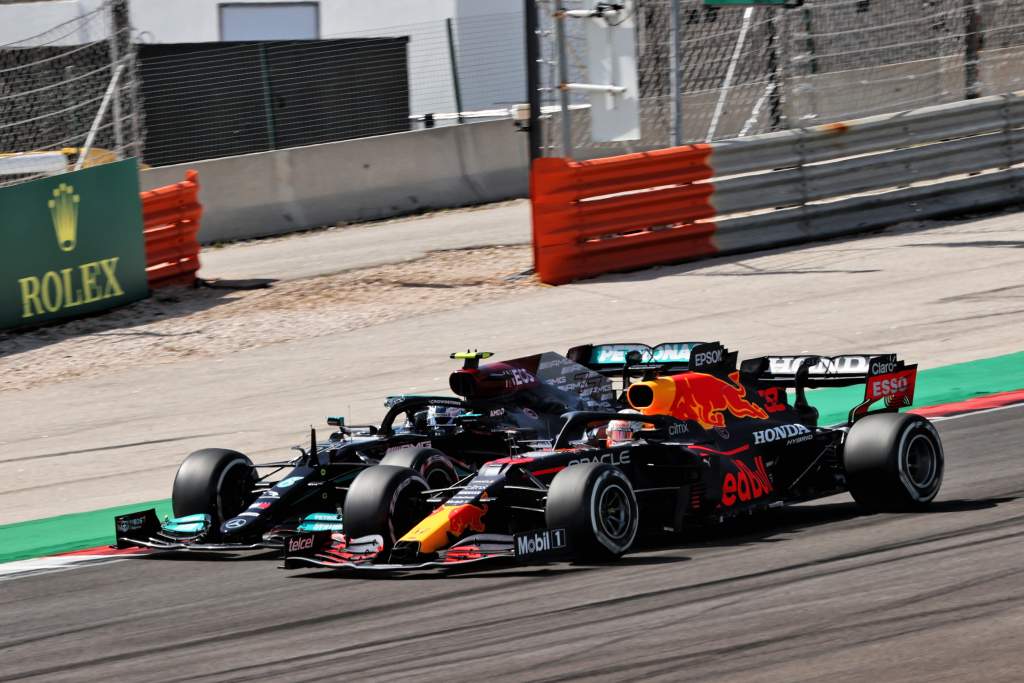
But such properties are only relevant in relation to competition. After Mercedes’ Silverstone upgrade, the Red Bull faced a rival who could now afford to drive bigger wings for competitive cornering speeds and still be faster on the straights.
Red Bull was then in the rear, but Zandvoort’s very crooked Turn 3 gave him the decisive advantage where the long wheelbase of the Mercedes prevented the fastest line from entering.
In a few other races – Hungary, Turkey, Brazil – the Red Bull had an important limitation of its own: it could get caught in a no man’s land at wing level. It created so much downforce at the rear that it was no longer properly adjusted on its larger wings, giving the car the kind of understeer that Verstappen doesn’t like.
In order to get into the lower wing family to achieve the desired balance, too much downforce often had to be given up in order to remain competitive with the Mercedes. All of this also had an impact on tire behavior. The move to the lower wing in Barcelona was a major reason for the increased rear tire grade that Verstappen lost to Hamilton in that race.
If the track layout allowed the Red Bull to be in its happy place at wing level, it was invariably better able to control the rear tire temperatures than the Mercedes. But the Mercedes often had the tire advantage on front-limited routes.
In between was the dynamic of Verstappen and Hamilton and that between the teams. The high-rake Red Bull’s extreme sensitivity to wing level (its narrow window) was absolutely what led Mercedes to campaign for the FIA to look at wing flexibility.
The resulting technical guidelines (from France) cost Red Bull some performance, but less than what they had gained at the time through their strong aero development. When Mercedes was suspected of having found an alternate way to flex the wing later in the season, Red Bull, of course, was extremely choppy and very active in the FIA’s behind the scenes campaign.
In the meantime we had an all-time title fight. Without the great advances made by Red Bull and Honda, it just wouldn’t have happened.





