
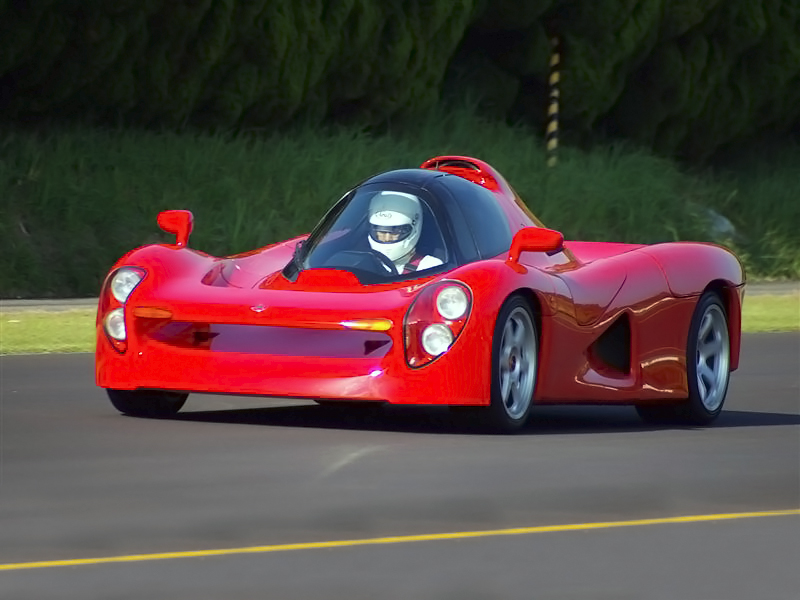
It was inspired by Formula 1 and Group C races
The Yamaha OX99-11 was designed in 1992, but it all started in 1989 when Yamaha entered Formula 1 as an engine supplier. It was then that the idea of a Yamaha supercar with no money was born. In addition, the car had to be based on current F1 technology, even though Yamaha is doing poorly in motorsport.
Named for its engine
In 1991 Yamaha developed a Formula 1 engine called the OX99. It was a 3.5-liter, 72-degree, 60-valve V-12 unit with an output of around 560 horsepower and well over 10,000 rpm in racing trim.
For the road-going Yamaha OX99, the engine developed 400 horsepower (298 kilowatts) at 10,000 rpm and 210 pound-feet (285 Nm). This enabled the 2,535 pound (1,150 kg) Yamaha V-12 to sprint from 0 to 60 mph (97 km / h) and to 217 mph (350 km / h) in just 3.2 seconds. The V-12 engine was paired with a six-speed manual transmission.
Fun fact: some people believed that the V-12 had something in common with the Bugatti EB110 as it had a similar displacement and V-12 layout. The difference, of course, was that the Yamaha unit was normally aspirated, but the one used by Bugatti had a quad turbo setup. Of course, the two engines did not share a single component. In essence, it was a street car powered by a Formula 1-derived engine, similar to the Ferrari F50 and, more recently, the Mercedes AMG One. The difference is that Yamaha’s V-12 was much more restricted in its street shape.
Yamaha was not happy with the original design
Yamaha first turned to a German company to design the body. However, the end result was considered too mainstream as it looked like most other supercars of the era. The Yamaha subsidiary Ypsilon Technology then commissioned IAD (International Automotive Design) with this task. The car ended with an aluminum body designed by Takuya Yura. The whole car was underpinned by a carbon fiber chassis. The suspension was provided with double wishbones all around. The Yamaha OX99-11 had a staggered set of tires that were 245 / 40R17 at the front and 315 / 35R17 at the rear.
It had two tandem seats
Yes, the Yamaha 0X99-11 was a two-seater, but not in the traditional sense.
Yamaha wanted a two-seater but also wanted a little closer to home (they usually make motorcycles) so a second seat was added right behind the rider.
The tandem arrangement was one of the reasons the Yamaha OX99-11 looked like a hybrid between a Formula 1 car and a Group C racer. This allowed the mid-engined Yamaha to keep a central driving position, just like the McLaren F1.
The OX99-11 had no doors
At least not in the traditional sense. Because of the tandem seating, the car was equipped with a convertible top. The whole thing was made of glass, just like in a jet fighter. To get to the interior, you need to open it from the left side.
The end product was rushed
This was mainly due to a disagreement between IAD and Yamaha over the development budget that occurred sometime in late 1991. This led to Yamaha transferring the entire project to its subsidiary Ypsilon Technologies. Yamaha gave them six months to sort things out with the project or it would end.
Very few were made
The Yamaha OX99-11 finally took its final shape in 1992. However, only three units were produced.
In terms of specifications, the cars were completely identical, only differing in the exterior paintwork. One was bright red, another black, and the third dark green. However, since the project was hasty, even these three technically functional prototype vehicles. It is believed that at least two of the three cars were purchased by collectors and have changed hands a few times, while one of them may still be owned by Yamaha.
Yamaha wanted to put a high price tag on it
The Yamaha OX99-11 reportedly had an expected price of around $ 800,000, which is over $ 1.53 million in 2021 – a huge sum considering the manufacturer has no history of making supercars Has. To put things in perspective, the McLaren F1 cost $ 815,000 back then. Not to mention the much cheaper (by comparison) Bugatti EB110 for $ 350,000 or the Lamborghini Diablo for $ 239,000 – all great supercars with a legacy.
In addition, a mid-engined Yamaha V-12 supercar would never have received the same recognition as Lamborghini, Bugatti or McLaren, for example. Oddly enough, it would probably make it today, with many startup makers competing with established manufacturers.
In the end, the Yamaha OX99-11 had bad timing
The Yamaha OX99-11 was a product in the early 1990s. At the time, Japan’s economy was in deep recession. Business investments were down a whopping 22 percent, so people weren’t exactly in a rush to get their hands on an exclusive six-digit V-12 supercar, especially from a manufacturer that doesn’t have a lot of manufacturing experience. The project was delayed until 1994 before Yamaha pulled the plug.
The Yamaha OX99-11 would have been successful in our day, however, as it is much more acceptable for businesses to focus on manufacturing exclusive vehicles these days. In addition, Yamaha has proven itself by developing powerful and great sounding power motors for various automobile manufacturers. In addition, the minimalist but uncompromising performance approach of the OX99-11 could have caused major problems for modern supercars. That being said, the OX99-11 would make a lot more sense today than it did then. Unfortunately, we may never know.
The post The Formula 1 Supecar designed by a motorcycle manufacturer first appeared on monter-une-startup.Did you miss our previous article...
https://formulaone.news/mclaren/nutson-weekly-auto-news-roundup-may-1824-july-2021





