In 1993, the motorsport world had to do without endurance races because the sports car world championship (WSC) season was canceled due to a lack of registrations. Development costs were at an all-time high, so manufacturers chose not to compete and instead focus on other forms of racing.
Fortunately, former Le Mans winners Jürgen Barth, Patrick Peter and Stephane Ratel became the saviors of endurance racing by founding the BPR Global GT Series in 1994. The competition quickly became popular and eventually brought supercars like the Ferrari F40, Lotus Esprit, Jaguar XJ220, De Tomaso Pantera or McLaren F1 GTR. The latter turned out to be too much for the competition, dominating virtually every race it competed in, and winning the 1995 and 1996 seasons.
At the end of 1996, the FIA announced that it would take over the series and rename it to GT Championship. The organization also changed the rules to increase competitiveness and attract more manufacturers. The racing cars
One of the automobile manufacturers who opted for the new competition was Mercedes-Benz. It teamed up with AMG again after a triumphant season in the DTM, and the team’s goal was to end McLaren’s hegemony in the GT1 premier class. The first thing they did was buy an F1 GTR, a move that allowed them to accelerate the development of a brand new car.
The engineers swapped the BMW 6.1-liter V12 for a 600-hp twelve-cylinder engine tuned by AMG and installed several tailor-made body panels on the McLaren test mule. In this way, they extensively tested the engine and refined the overall aerodynamics while the bespoke carbon fiber and aluminum monocoque chassis was still being built. Thus, the first two CLK GTR prototypes were ready to go just 128 days after the start of the development program.
The 1997 season did not start as well as hoped, as the BMW Motorsport McLarens defeated them in the first three races. That changed after the fourth round at the Nürburgring, where they managed a 1-2 finish. After that, the CLK GTR was the first to cross the finish line five more times, Mercedes finally secured the manufacturer’s title, Bernd Schneider the driver’s trophy.
For 1998, the team not only wanted to defend the title, but also to return to Le Mans, the legendary long-distance race in which Mercedes last took part in 1991 with Michael Schumacher among the drivers.
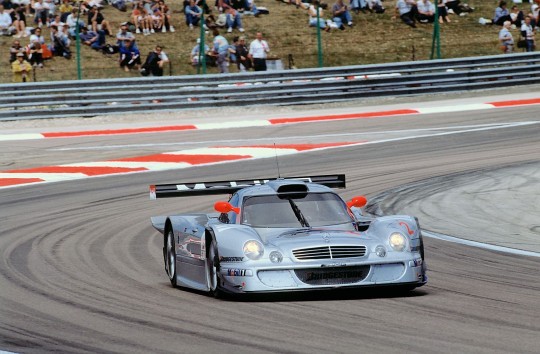
Now called the CLK LM, the car’s body has been extensively redesigned and the engine replaced with a heavily modified version of the M119-derived V8 that powers the Sauber C9 and Mercedes-Benz C11 Le Mans prototypes.
The new unit, code-named GT108B, was rated lighter and more reliable by the engineers in Affalterbach, but in France it suffered serious malfunctions on both vehicles, ending AMG-Mercedes’ dream of winning the famous 24-hour race.
In the FIA GT Championship, however, the team won every single race of the season, with Klaus Ludwig and Ricardo Zonta sharing the driver’s title.
After the humiliation by the rabid Mercs, many competing manufacturers withdrew from the GT1 class for the 1999 season, so that the FIA had to cancel the category. The move ended the hugely successful careers of the CLK GTR and LM, which will forever be remembered as the racing cars that managed to achieve the impossible and made the McLaren GTRs look slow.
Mercedes and AMG would develop the CLR and return to Le Mans this year, but the car could only literally stand out from its competitors. Due to the poor aerodynamics, two cars blew up during qualifying and the actual race, crashed spectacularly and ended the German manufacturer’s involvement in prototype racing. The street cars
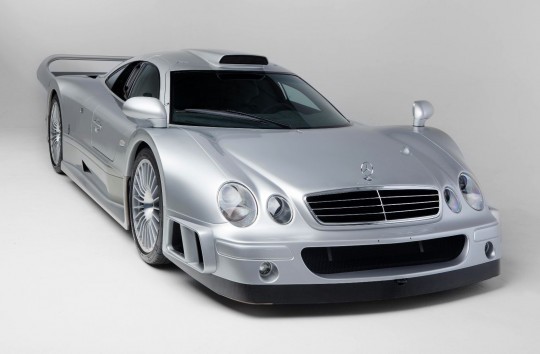
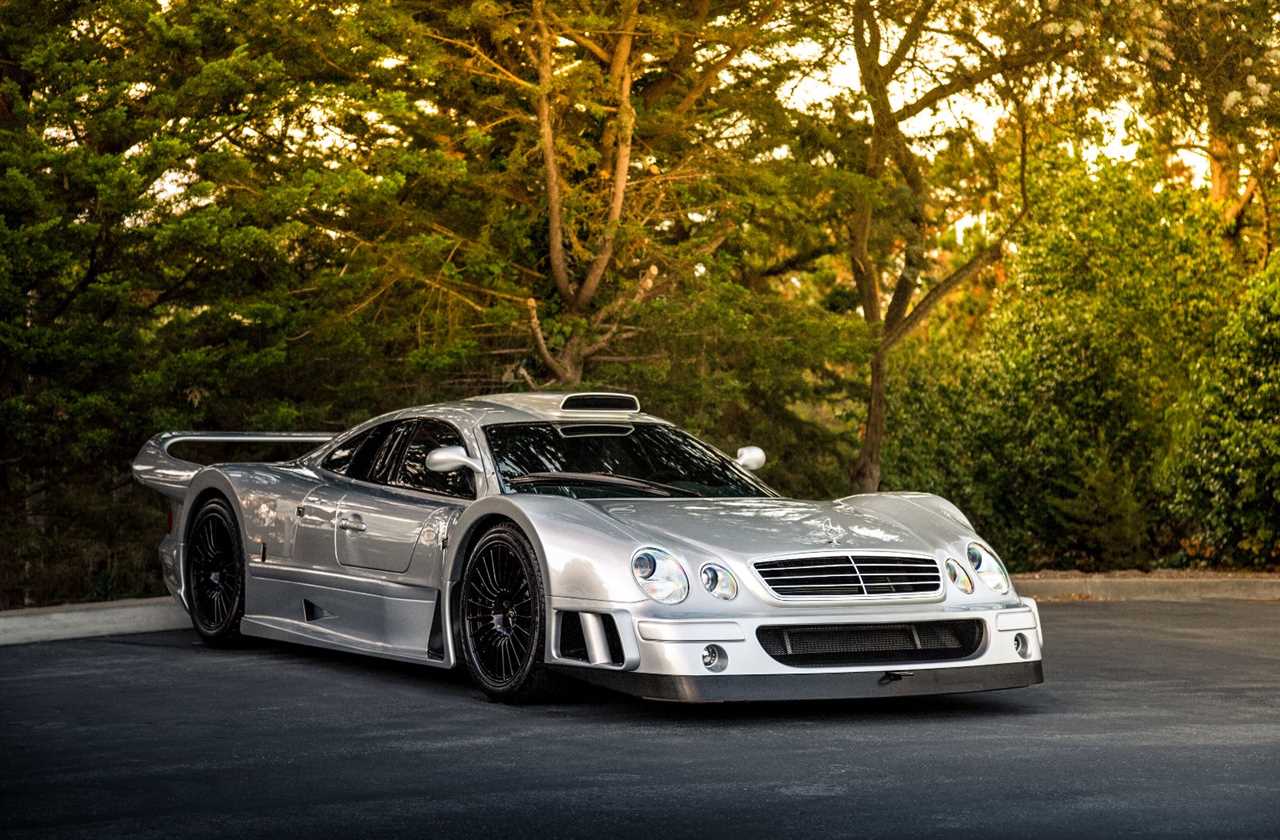
In order to compete in the GT1 class of the FIA GT Championship, every manufacturer had to build at least 25 street versions of their racing cars. The first prototype was built in 1997, the rest came from the Affalterbach plant between winter 1998 and summer 1999.
This epic car, officially known as the CLK GTR street version, was almost identical to the 1997 racer. The carbon fiber and aluminum monocoque, double wishbone suspension, braking system and much of the body were carried over, except for the rear wing completely different.
Although it bore the CLK nameplate, it only shared the headlights and taillights with the production models.
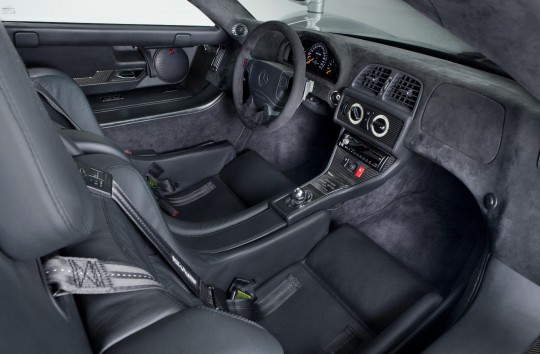
Raising the V-doors revealed a cockpit with two full leather bucket seats, air conditioning, stereo and lots of Alcantara. The steering wheel was also redesigned, and since Mercedes didn’t use paddle shifters at the time, drivers could operate the sequential gearbox with buttons on each horizontal spoke.
The displacement of the V12 engine was increased to 6.9 liters and the air restrictor was removed, resulting in an output of 604 hp (450th) kW) at 6,800 rpm and 572 lb-ft (775 Nm) of torque at 5,250 rpm.
Mercedes claimed the street-legal CLK GTR could accelerate from zero to 60 mph (96 km / h) in 3.7 seconds and reach a top speed of 214 mph (344 km / h). Those numbers made it one of the fastest production cars of the era and also one of the most expensive, with a starting price of around $ 1,550,000.
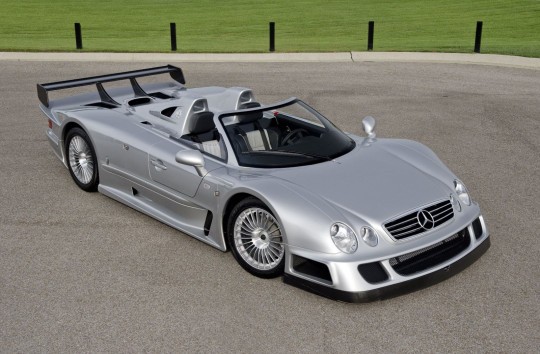
An additional prototype and four other production vehicles were equipped with a newer version of the M297 engine with a displacement of 7.3 liters. Power has been boosted to a whopping 655 hp (488 kW) and 580 lb-ft (786 Nm) of torque – it’s the same unit that powers multiple editions of the Pagani Zonda. These cars, named CLK GTR Super Sport, also received an additional front splitter for better stability at high speeds.
A total of 20 units and two prototypes were built, but that was not enough to meet FIA requirements, so AMG’s newly established HWA department was commissioned to develop six more roadsters. These variants were equipped with a separate rear wing similar to the 1997 Racers and a different front grille, which was highlighted by a large Mercedes logo.
Because of their audacity and rarity, these incredible machines have become the most sought-after supercars of all time. They rarely show up at auctions, but when that happens they charge six-figure prices.
The CLK GTR and GTR LM racing cars, as well as the street legal versions, are still among the most extreme vehicles that have emerged from the longstanding collaboration between Mercedes-Benz and AMG. Posters of these vehicles graced the walls of many children (myself included) in the late 1990s, and those lucky enough to catch a glimpse of one in the wild will never forget this breathtaking experience.
The post Mercedes-Benz CLK GTR: The McLaren F1 GTR Slayer became a street legal super sports car first appeared on monter-une-startup.