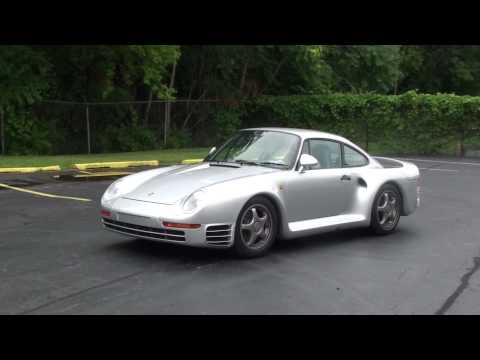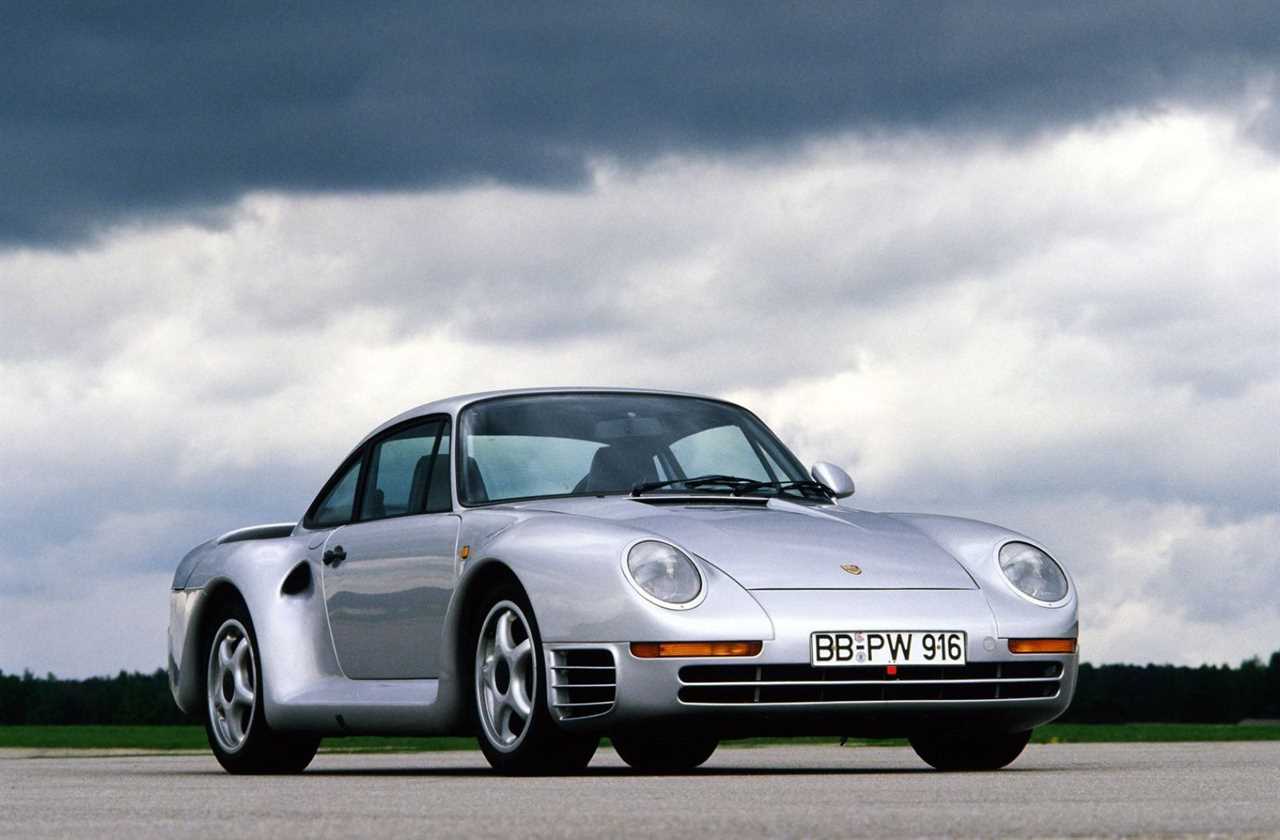
The story begins exactly four decades ago, in 1981, when the car manufacturer from Zuffenhausen appointed Peter Schutz as the new managing director. Back then, Porsche was a mess. The company survived the first year of money loss in its history and planned to discontinue the iconic 911, the only model that sold relatively well. Replacing it with the front-engined 928 that few people bought seemed like a crazy idea, so Schutz decided to abandon those plans and continue developing the 911.
The man who was to breathe new life into the flagship of Porsche was chief engineer Helmuth Bott, who had many great ideas that finally transferred to the Carrera 3.2 from 1984, but also wanted to go outside the box and expand the limits of the 911 by a new, powerful model around it.
He convinced Schutz that developing such a car and competing in the FIA’s famous Group B rally championship would do wonders for the company’s image and assured the new director that he had an ace up his sleeve. Inspired by Audi’s radical Quattro, Bott put a team together and began work on a revolutionary all-wheel drive system that was mounted on a slightly modified 911 chassis.
The system called PSK (Porsche control clutch) was a marvel of engineering and is still considered to be one of the most sophisticated that has ever been created. not as 4WD Systems of the era, the PSK was able to vary the torque split ratio under normal driving conditions (what we now call torque vectoring), while other designs could only achieve this when wheel slip occurred. The default setting delivered 40% of the torque to the front and 60% to the rear, but up to 80% was diverted to the rear wheels when accelerating. In addition, the torque has been evenly distributed between the two axles in slippery conditions to ensure excellent grip.
While the PSK was the highlight of the car, which eventually got the nickname 959, the list of innovations didn’t stop there. The suspension system was another outstanding engineering feat. Developed together with the experts from Bilstein, it has two dampers on each curve, four of which are electronically controlled and allow the ride height and damping force to be adjusted while driving.
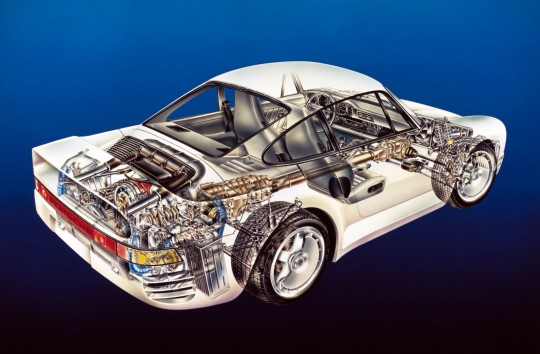
The six-cylinder boxer engine was also something special. Based on a racing engine that powers the Group C prototypes 956 and 962 and is driven to 2.85 liters in accordance with FIA regulations, it features an aluminum alloy head and block, titanium connecting rods, forged pistons and a dry sump lubrication system. It was fueled by a state-of-the-art Bosch Motronic 2.1 injection system and used a couple of small KKK turbochargers that operated in sequence to provide a boost at lower revs. It was connected to a manual transmission that offered five forward gears plus one off-road gear.
The first prototypes were completed in 1983, but 200 production versions had to be built to compete in Group B rallies, and Porsche was far from ready to meet this requirement. In the years that followed, the team managed to refine the engine and complete the body. Although it looked like a souped-up 911, the additional Kevlar composite panels were made through extensive wind tunnel testing and contributed to the car’s incredible 0.31 drag coefficient, a figure that was superior to the Ferrari F40’s 0.34 and was later achieved by the McLaren F1 and Lamborghini Diablo.
The street legal edition was presented at the IAA 1985 as a 1986 model, but had to postpone production for more than a year due to numerous problems.
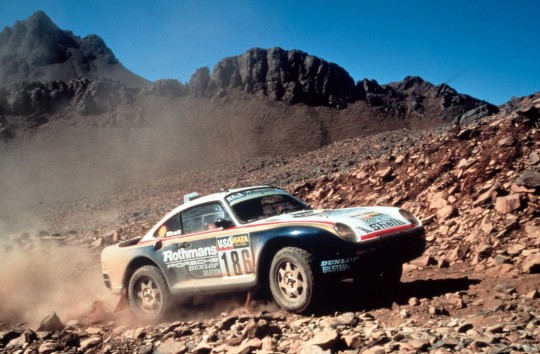
When the car was finally ready for series production and homologated, the FIA unfortunately decided to abandon Group B so that it could never compete in the WRC. Nevertheless, three racing versions took part in the Paris-Dakar Rally in 1986 and finished in first, second and sixth place. It was an incredible feat that proved this was an incredible machine.
Porsche decided on limited production and ended up building a little more than 300 of these wonderful machines. They are available in either Comfort or Sport and were powered by the same six-cylinder engines as the racing cars. It was able to spit out 450 horsepower, which translates into an acceleration time from 0 to 60 mph (97 km / h) of just 3.6 seconds. The sport could reach a top speed of 198 mph (319 km / h), making it the fastest street-legal production in the world at the time.
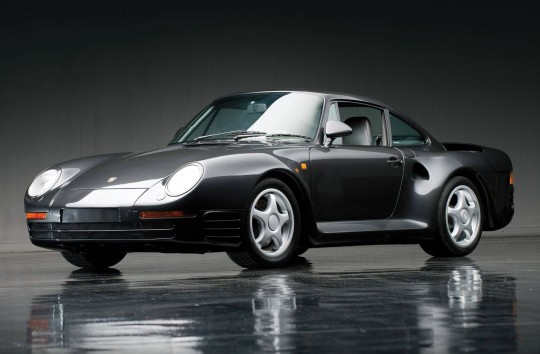
To make things even more interesting, the crazy 959S hit the market in 1988. With the help of larger turbochargers, the power was increased to 508 hp, resulting in an incredible top speed of 211 mph (339 km / h).
Production ended in 1993, and the 959 became one of the most iconic sports cars of all time. It wasn’t as sexy as the Ferrari F40, but it was without a doubt more technologically advanced and influential. It paved the way for the 911 Turbo models as well as many all-wheel drive super sports cars such as the Bugatti EB110 or Veyron, Audi R8, Lamborghini Murciélago, Huracan and Aventador.
You can take a virtual tour of the video below posted on YouTube by DtRockstar1.