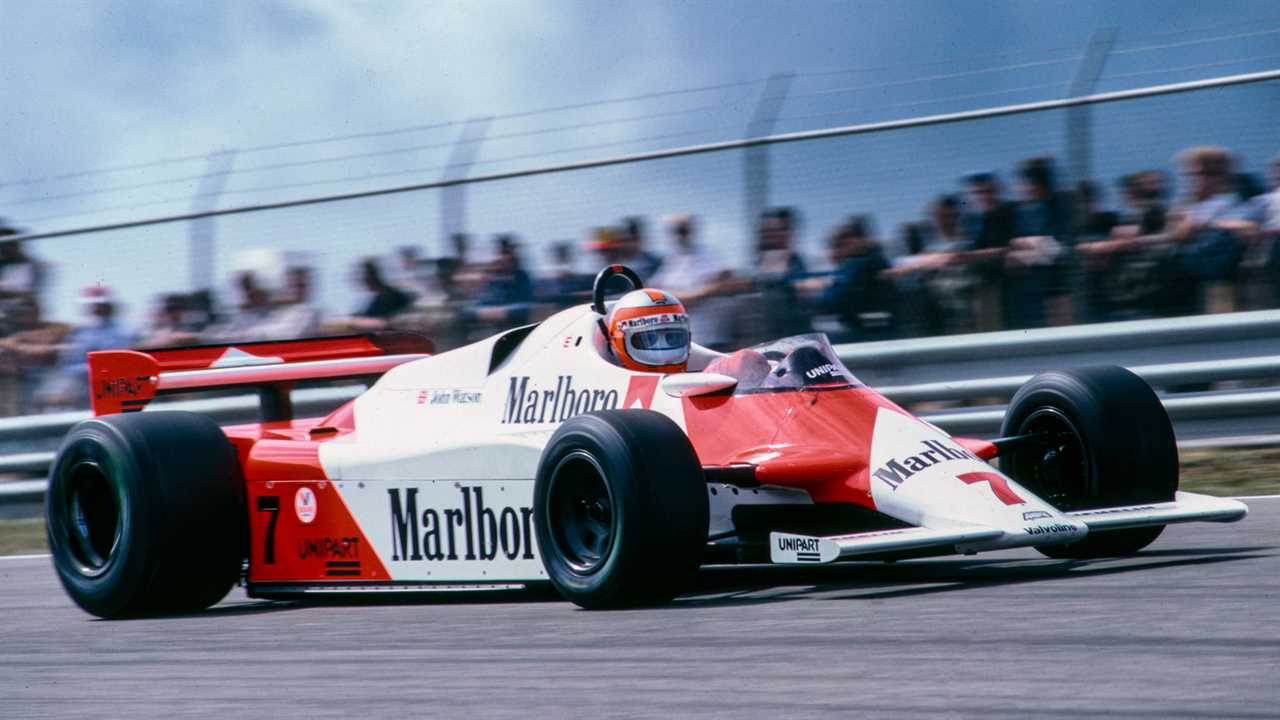
“Most of the drawings I’d done with Alan Jenkins, but because the monocoque had taken so much time and effort, there were a lot of other things to do: suspension, steering knuckle, transmission,” recalls Barnard. “The fact that I came to McLaren meant I immediately had more people to help me finish.”
Since the McLaren competed against the clock in a new look, the MP4 / 1 was hardly tested before it was introduced for the 1981 GP of Argentina – with the inevitable teething problems.
“The exhaust pipe kept breaking,” recalls Barnard, “so we had to keep welding and reinforcing the end. Then it started burning the fiberglass body, which is not particularly temperature-resistant. Once we solved stupid problems like the car burning itself, we could sort it out and get going. “
The trajectory from then on was a bit meteoric, a once headstrong McLaren team suddenly found its way again in the middle of the season with a new car and John Watson at the wheel: a third run in Jarama and a second in Dijon culminated in a famous victory in Silverstone. It was victorious evidence of Barnard’s revolutionary idea and a sign of the times with the new McLaren.
“I think it was very important,” says Barnard. “It is very important for me to return to Formula 1 as technical director. And I think it was especially important to Ron because I think he was telling Marlboro management that we were going to win a race!
“Actually winning a race reinforced everything and said: ‘Hey, this is the right way and we will continue from here’.
This also resulted in a political change in the team. Now the old brooms Mayer and Alexander would leave the team after the season. McLaren International was here to stay a winner – Dennis and Barnard were in charge.
Watson celebrates his turning point win at Silverstone
DPPI
The car’s speed was proven and its strength was later highlighted in Monza in 1981 when Watson walked away from a terrible accident traveling at 140 mph.
“That disproved all of the knockers,” says Barnard. “In the beginning, there were a lot of people who said, ‘Oh, carbon fiber monocoque, you should be very careful, if it hits something, you will go up in a cloud of black dust.’
“It really got that to bed.”
Carbon fiber monocoques would become ubiquitous in the Formula 1 racing field, the fundamental shift initiated entirely by Barnard’s innovation. He now classifies his creation as part of a trinity of original racing ideas.
“When I look back, the Chaparral 2k, the MP4 / 1 and the Ferrari 640/41: those were my three most important steps.”
The designer also credits Dennis with confidence in a car design that has simply never been tried before.
“Ron had to completely take this idea off the wall and make it believable,” he says. “I had to explain why it was better, why it should be better, why we wanted to do it.
“He had to be fully involved and right behind it, otherwise it wouldn’t have happened – we all had to sing from the same song sheet.
“It was a very strong partnership in Formula 1, it was Frank Williams and Patrick Head at Williams, it was Ron Dennis and John Barnard at McLaren.”
The post John Barnard recalls his McLaren MP4 / 1 eureka moment first appeared on monter-une-startup.