
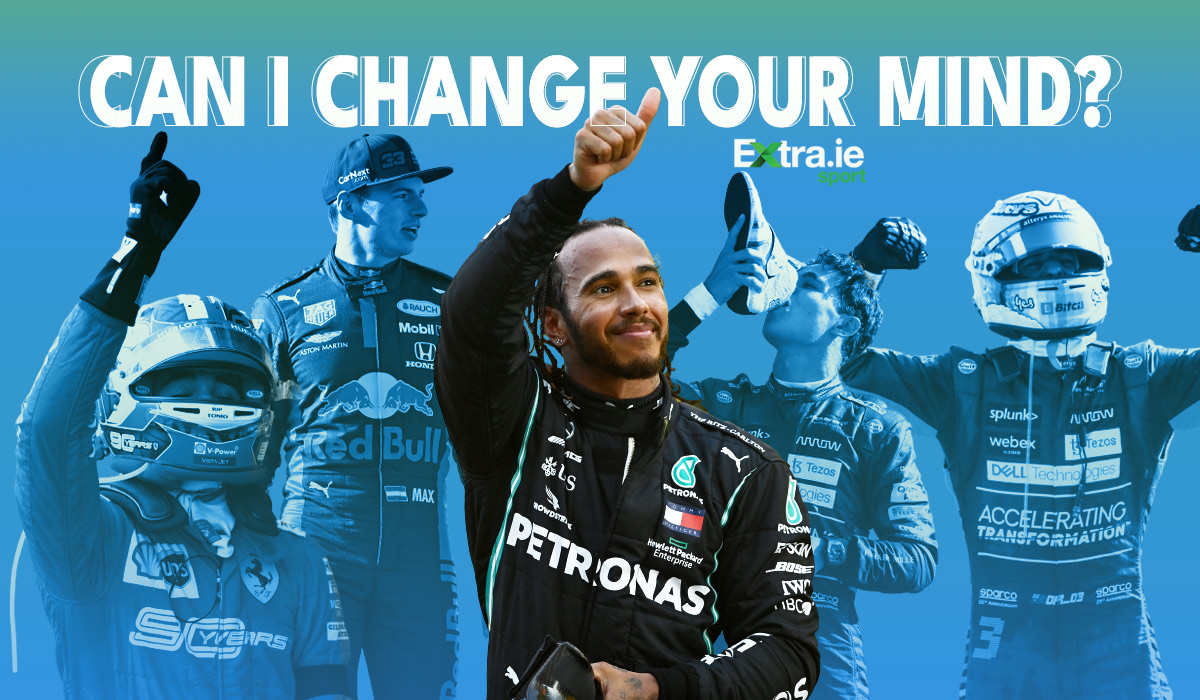
With all the thrills and splashes of an exciting Formula 1 season, the world’s leading motorsport remains a bit spoiled, the B-word or “boring” as it is commonly known.
These six letters hang over a spectacle that has produced some of the most exciting and memorable moments on television for decades.
Yet its critics continue to lazily swing this negative adjective whenever they see fit, be it in Sky Sports News Twitter replies or elsewhere.
Lewis Hamilton from Great Britain in the (44) Mercedes AMG Petronas F1 Team Mercedes W12 leads Max Verstappen from the Netherlands in the (33) Red Bull Racing RB16B Honda. Image: Dan Istitene – Formula 1 / Formula 1 via Getty Images
Unfortunately for the critics, F1 is pretty cool again. Netflix Drive To Survive played a key role in this.
The documentary series opened up the intricacies of a complex and misunderstood sport to fans.
This article intends to do the same. Lights out and let’s go …
Strategy can be as important as speed
 Race winner Daniel Ricciardo from Australia and McLaren F1 celebrates on the podium at the F1 Grand Prix of Italy at the Autodromo di Monza on September 12, 2021 in Monza, Italy. Image: Lars Baron / Getty Images
Grand Prix racing is much more than speed. Strategy is a key factor in a successful weekend.
If sport was all about who is the fastest, we wouldn’t have six different winners this season. The championship fight wouldn’t be that exciting either.
Take the 2021 French Grand Prix, for example. Hamilton looked favorite in its single pit stop strategy before succumbing to a bold “two-stopper” by Verstappen.
 Red Bull Dutch driver Max Verstappen celebrates after crossing the finish line at the Formula 1 French Grand Prix. PICTURED: CHRISTOPHE SIMON / AFP
Logic dictates that Hamilton should have won since his opponent had sacrificed more than 20 seconds to change tires a second time, but – and this is not always the case – the variables at play (tire wear, lower fuel consumption, etc.) allowed Verstappen to secure an unlikely win.
Undercuts – pit stops in front of a rival in the hopes that your out lap will catch up enough time to be in front of them after your own stop – and overcuts – stay out longer but hope for the same outcome – also play a role. Not all overtaking maneuvers take place on the track.
Unpredictability – which plays a huge role – gives battles on the route a chess-like dynamic. But what exactly are the key variables?
variables
 Lewis Hamilton drives the Mercedes AMG Petronas F1 Team Mercedes W12 during the F1 Grand Prix of Belgium at the Circuit de Spa-Francorchamps on August 29, 2021 in Spa, Belgium. Image: Joe Portlock – Formula 1 / Formula 1 via Getty Images
No two Grand Prix are the same, a reality that keeps F1 fans busy. The multitude of variables in sport also keeps drivers and team bosses on high alert.
Tire degradation is the most common problem. This sport is just as much about getting maximum performance out of tiresome tires as it is about anything else.
No circuit is the same as another. Some cars are well suited for certain routes while others tend to have difficulty. McLaren recently defeated Monza but was far from close in Istanbul.
 Race winner Daniel Ricciardo from Australia and McLaren F1 and runner-up Lando Norris from Great Britain and McLaren F1 celebrate in Parc Ferme during the F1 Grand Prix of Italy. Image: Dan Istitene – Formula 1 / Formula 1 via Getty Images
We haven’t even touched on reliability. Many a seemingly assured victory has been cruelly taken by component failure. The 2021 title winner could be determined by an early DNF (Did Not Finish).
The weather can be a cruel mistress. Sudden heavy rain likely cost Lando Norris his first victory in Sochi. It certainly cost Sergio Perez a much-needed podium.
The track development – the sudden increase in grip due to the increased track temperature – causes surprises in qualifying. Teams and drivers can never rest.
politics
 Christian Horner, Toto Wolff and Mattia Binotto team bosses during the qualification session at the Formula 1 Grand Prix de Monaco on May 25, 2019 in Monte Carlo, Monaco. Image: Robert Szaniszló / NurPhoto via Getty Images
It is undisputed that the lucrative Formula 1 circus is “closed”. There are only 20 drivers and 10 team bosses in the sport.
The money involved is massive, as are some of the personalities. Conflict and conflicting opinions are inevitable.
Each season has its allegations of illegality, verbal battles, disputes, FIA investigations and sometimes even scandals.
 Mercedes GP Executive Director Toto Wolff and Red Bull Racing Team Principal Christian Horner speak at the team principal’s press conference. Image: Dan Istitene / Getty Images
Teams have affiliations, incentives, to treat different rivals in different ways, and to make politics on behalf of their own interests.
It is this side of the sport that has undoubtedly brought so many people to Drive To Survive. Some of the performers in the sport are simply larger than life.
There is no doubt that off the track, the handbags can be just as captivating as the on-track action.
Risk reward
 British Mercedes driver Lewis Hamilton (L) gets out of his car after a collision with Dutch Red Bull driver Max Verstappen at the Italian Grand Prix. PICTURED: ANDREJ ISAKOVIC / AFP
F1 drivers race knowing that a simple slip-up in wheel-to-wheel combat can ruin a perfect weekend – even if such incidents are not their fault.
Take Silverstone earlier in the year, when Verstappen beat Hamilton from the start before he was bumped into the guardrails at high speed.
Or Monza, when Verstappen had his own ambition to take the second turn before colliding with his enemy and making their two afternoons null and void.
 British Mercedes driver Lewis Hamilton (L) and Dutch Red Bull driver Max Verstappen collide at the Formula 1 Italian Grand Prix. PICTURED: ANDREJ ISAKOVIC / AFP via Getty Images
The losses in such incidents can be seasonal. In contrast to football, where a rare defeat for a title hope win is a maximum loss of three points, the world of drivers can be turned upside down because of the potential for such significant point shifts.
Verstappen led Hamilton 33 points ahead of the aforementioned British Grand Prix – up just eight when the checkered flag was waved.
Any resulting component replacements – which usually involve trash scraps – can worsen the misery for drivers, as Perez discovered during a torpedo attack by Valtteri Bottas in Hungary.
Exciting title fights
 Lewis Hamilton from Great Britain in the (44) Mercedes AMG Petronas F1 Team Mercedes W12 and Max Verstappen from the Netherlands in the (33) Red Bull Racing RB16B Honda. Image: Bryn Lennon / Getty Images
The potential for big leaps in points keeps the battle for the championship alive, even if it looks like it’s running out.
The top of the table can be regained just as easily over several races as on a single Sunday afternoon. This season was no exception.
Lewis Hamilton led the title fight from the first race of the season until a victorious Verstappen had a four point lead in round five in Monaco.
 Lewis Hamilton of Mercedes-AMG Petronas celebrates on the podium after the Formula 1 Grand Prix of Great Britain at the Silverstone Circuit. Image: Lars Baron / POOL / EPA-EFE / Shutterstock
That lead gradually grew before suddenly shrinking at Silverstone and Hamilton soon regaining the top spot in Hungary.
Max was able to make himself clear again in the Netherlands before Hamilton returned to the summit in Russia.
Verstappen nudged his nose in Turkey last weekend. There are many more twists and turns.
Not all about the championship
 Williams driver George Russell celebrates with his trophy after finishing second in the Belgian Formula 1 Grand Prix on August 29, 2021 on the Spa-Francorchamps circuit in Spa. Image: KENZO TRIBOUILLARD / AFP via Getty Images
The truth is that there is a lot more to the F1 season than the headline-grabbing championship scraps.
Ten teams started with different goals and expectations. Not everyone has the resources to be the best.
George Russell was moved to tears in Hungary when he finished ninth. Not because he was miles away from victory, but because after two and a half years of drudgery he got his first points with the fighter Williams.
 The FULL interview where @ GeorgeRussell63 shed tears of joy after scoring his first points for @WilliamsRacing at the #HungarianGP
 earlier this month

 # F1 # GR63 # TeamGR63pic.twitter.com/6TgOE1zIDu
– Team George Russell (@ TeamGR63) August 22, 2021
This P9 result will likely secure the former Formula 1 giant eighth place in the constructors’ championship after having been at the bottom of the table for years.
Meanwhile, Ferrari and McLaren are embroiled in a battle for a lucrative third place in the same championship as both plan their respective routes back to the top of the grid.
Wherever you look in a race, there is always a fight. Other priorities and such.
It is not without reason that it is the premier class of motorsport.
The post Do you think Formula 1 is boring? Can i change your mind first appeared on monter-une-startup.





