
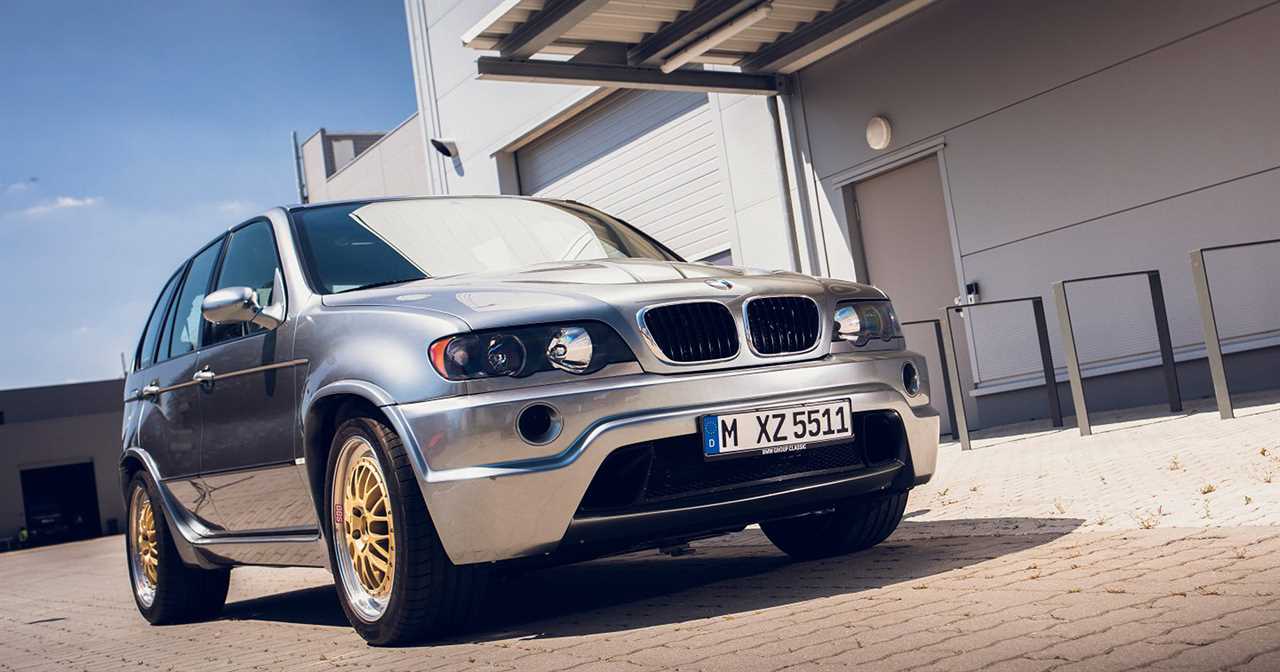
The Bavarian manufacturer recognized the potential of the vehicles that we call SUVs today as early as the mid-1990s. After acquiring Rover Group plc, which also owned the Land Rover brand, the feasibility study began to develop the company’s first company SUV.
With new off-road technologies and technical know-how, the first generation of the X5 was presented in 1998 and production started a year later. It was (and is still) marketed as a Sport Activity Vehicle (SAV), which for the German automaker means it’s sportier than a typical SUV.
During the same period, BMW was heavily involved in motorsport, working with the experts at Williams Engineering on several fronts. After a disappointing Le Mans season in 1998, they returned to France the following season with a thoroughly improved car. The upgraded prototype, named V12 LMR, was the first to cross the finish line and gave BMW its first and only Le Mans title.
To celebrate this success and to promote the newly released SAV at the Geneva Motor Show 2000, the company came up with the idea of building the craziest X5 of all time.
The basis for this project was a production model that was delivered from the plant in North Carolina to Munich, as the X5 was never built in Germany. A team of engineers was already playing around with the idea of creating a ridiculously powerful SAV, and legend has it that the original plan was to use the V10, which was being developed for the upcoming Formula 1 car, the FW22. However, this was found to be too complicated and after the recent triumph in the world’s most famous endurance race, they targeted the P75 unit of the V12 LMR prototype.
As part of the legendary S70 engine family at the heart of the BMW 850CSi or the epic McLaren F1, this glowing 6.0-liter twelve-cylinder was narrower and shorter than the standard 4.4-liter, making replacement quite easy. This also enabled the engineers to use a six-speed manual transmission from the 850CSi, which was connected to the engine via a two-disc racing clutch.
With no restrictions like at Le Mans, the team constructed a carbon fiber intake manifold with two 80 millimeter (3.15 inch) ducts that helped the engine spew out 700 horsepower. That is around 120 hp more than the version that powers the successful racing car.
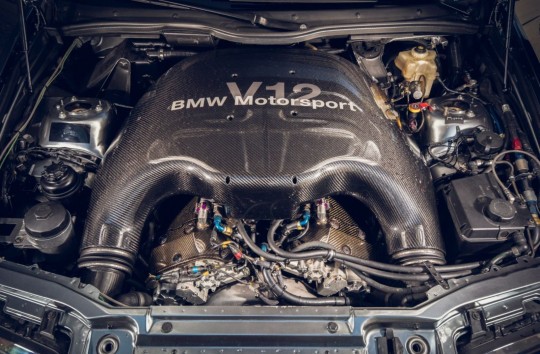
The transfer case was retained and its standard 38/62 torque distribution was left untouched. However, it is Section Module and Range Rover’s downhill descent system were removed to save weight, while the standard exhaust system was replaced with a custom-made straight pipe version that exited from the center of the rear bumper.
Externally, the revamped SAV was very similar to the production version with only minor visual changes. These included curved fenders to make room for wider wheels, redesigned bumpers, and a carbon fiber bonnet with a large cooling vent. Along with the nickname Le Mans, the vent suggested that this was no ordinary X5.
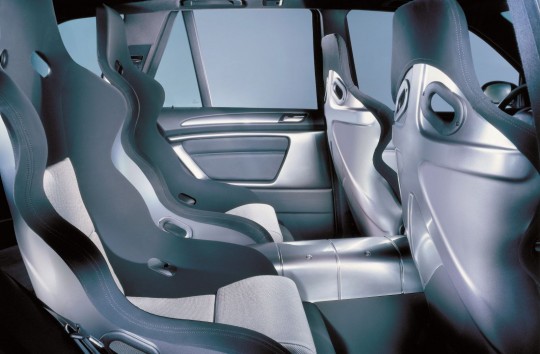
Inside, most of the standard elements such as the dashboard have been retained, but for Geneva the spectacular vehicle has been fitted with a new steering wheel, door panels and four beautiful bucket seats.
The interior was completely redesigned after the show, as BMW wasn’t finished with the X5 Le Mans and was preparing for the Nordschleife. The fancy bucket seats have been removed and replaced with a Recaro racing seat at the front, shielded by a custom roll cage on the driver’s side and a regular fabric seat on the passenger side. In the rear, everything deemed unnecessary, including the seats, has been removed and replaced with seat belt anchors and a fire extinguisher. The show wheels have also been replaced with a set of silver and gold 20-inch BBS LMs.
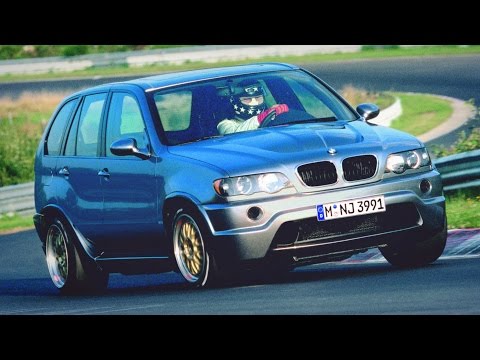
In 2001, the two-time Le Mans winner and DTM champion Hans-Joachim Stuck drove a lap time of 7:49 on the legendary racetrack and is said to have reached 311 km / h on the Kottenborn straight. No other SUV would beat this lap time in the next 19 years until the Audi RS Q8 (2020) and the Porsche Cayenne Turbo GT (2021) achieved it. For comparison: two years after this run, the E46 M3 CSL was almost a second slower. You can see the run of the X5 in a video posted by CarsGarage on YouTube below.
The BMW X5 Le Mans Concept never made it into series production, but is considered by many to be the first true high-performance SUV ever built. It is one of the wildest machines in Bavaria and has proven that crazy ideas can become timeless masterpieces.
Did you miss our previous article...
https://formulaone.news/mclaren/good-fantasy-football-team-names-for-the-20212022-season





