
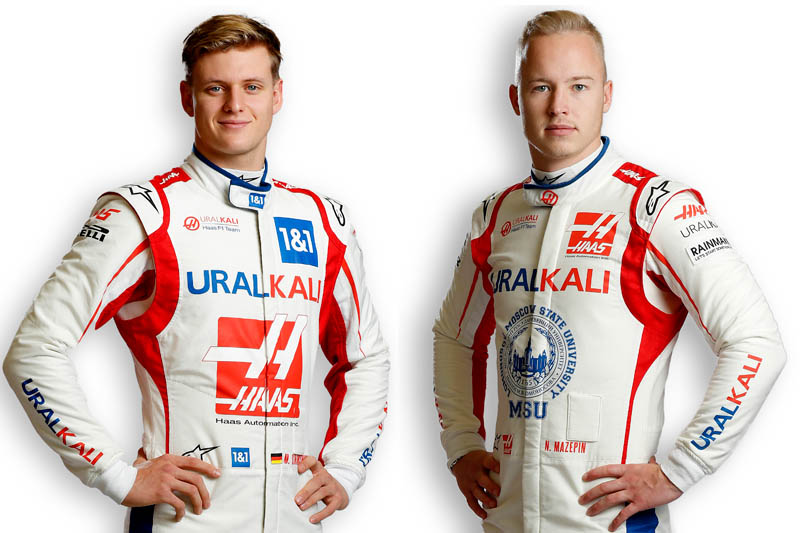
The Uralkali Haas F1 team is traveling to rounds 8 and 9 of the FIA Formula 1 World Championship 2021 on the green pastures of Austria.
Austria entered the Formula 1 calendar in 1964 at Zeltweg Airfield, but the flat and non-functional track proved unpopular, and a new complex was designed in the hills above nearby Spielberg. The fast and flowing Österreichring could be seen from 1970 to 1987, before being renovated and shortened as the A1-Ring from 1997 to 2003. After that, the venue fell into disrepair with no events going on for eight years before it was upgraded to modern standards and heavily renovated by Red Bull.
The Austrian Grand Prix then returned again in 2014, and the green hills echoed again with the sound of the Formula 1 machines. In 2020, Spielberg was the first venue in Formula 1 history to host two races in the same calendar year. The two events marked the opening rounds of the season delayed by the pandemic, as Formula 1 proved it can safely hold its own in a challenging global environment and provided much-needed boost to the motorsport industry.
The 4.3 km circuit has only 10 corners and its short lap time leaves very little room for maneuver, which increases errors, which often leads to tight qualifying sessions and fast-paced races. In 2021 Spielberg will again host two Grand Prix on consecutive weekends, with the first Grand Prix of Styria – based on the local community – and the second being nicknamed the Grand Prix of Austria.
Since Austria will lift the restrictions on July 1st, a full number of visitors is expected in Spielberg for the second event – for the first time since 2019.
Austria brings back welcome memories for the Uralkali Haas F1 Team and its rookie drivers. In 2018 in Spielberg, the Haas F1 Team achieved its best race result of all time with fourth and fifth place and collected 22 points on the way to fifth place overall in the constructors’ championship. In 2017, Nikita Mazepin was twice on the podium in European Formula 3, while Mick Schumacher took a double pole position and two victories on the way to the championship trophy in 2018. Both drivers gained extensive experience in FIA Formula 2 in Spielberg in 2019 and 2020 before they graduated from Formula 1.
It has been almost a year since two races were held at the Red Bull Ring in Austria to restart the 2020 Formula 1 season. The world is certainly a different place now, but how do you remember your thoughts and emotions entering these races after four months of uncertainty after the Australian Grand Prix was canceled in March? At the time, did you expect that a season could be closed realistically or was it just about being happy, somehow starting again?
Günther Steiner: “We were of course happy to get going again and let’s see what we can do with it. I think it’s very good from the Austrian organizers to jump a second race last year, in 2020 and this year too, if we needed it. It’s a good place anyway, but if there’s one place you want to go to two races, one of them would of course be Austria. They do a good job and they’re always there to help. Last year they sparked the Formula 1 revival after everyone thought the season wasn’t going to start. “
What makes the atmosphere at the Red Bull Ring so special?
GS: “I think it’s the people’s great passion. It has always been a race where a lot of people have come from all over the place and now it seems to be taken over by the Dutch fans. We know that they are very loyal to Max are – they love to party and they know how to do it! I think that’s one thing, but in general it’s the scenery – it’s beautiful – and it’s a good circuit and everyone enjoys it. “
Will a second race on the same track just a week apart give you more opportunity to measure Nikita and Mick’s progress at the wheel of the VF-21?
GS: “I wouldn’t say it’s benchmarking. It gives them the chance that if we learn something in the first race, we can try something different in the second race. It’s more of a test that you can think of, when we learn something. ” about it a little longer than on a race weekend and that is our chance. “
Finally, how often do you think back to Austria 2018, when the team with Romain Grosjean and Kevin Magnussen achieved their best result of all time with fourth and fifth place. Are you inspired that on a certain day and under the right circumstances, a team like the Uralkali Haas F1 Team can score big in Formula 1?
GS: “I think back to every time we go to the track this year to stay motivated. I’m sure we can come back, we did it once and we can do it again, but we just need a little bit of time. We “I’ve had a tough couple of years, but what makes you suffer makes you tougher. We’ll be back, it’ll take a little longer, but fourth and fifth place in 2018 was certainly our best result. When you know what is possible and you have experienced it, you know that you can do it again. “
In terms of the results of your time in Formula 2 in 2019 and 2020, the Red Bull Ring was not the friendliest track for you – two top 10 placements achieve your best results in six race starts. What memories do you have of the racetrack from your junior career?
Nikita Mazepin: “The Red Bull Ring wasn’t that bad. I think it’s a track that I can be good at if I’m comfortable in the car. “I’m not very happy with the car. In 2020 it was the first lap of the championship and unfortunately my car went on the first free one Practice broken, so I went out in qualifying and barely missed a top 10 finish, which I think is a very good result after we haven’t driven for six months. Then we had a 25-second pit stop in race two, the got us on the timesheet too, but from that time we were there and I hope that this gradual improvement will continue with luck and performance from then on. “
Can you describe a lap at the Red Bull Ring and what you can expect there at the wheel of a Formula 1 car?
NM: “The route is pretty short if you look at the route map, and if you look at it, you would think that it is very easy. I think it’s a real car track though – if the car is good there the driver will be able There are very few slow corners on the track and it’s dominated by a lot more high speed so I look forward to seeing it how the VF-21 feels out there. “
You experienced successive races at the start of the Formula 2 season in Austria last season. This year you’re doing the double again in Formula 1 at the Red Bull Ring. Do you think a second race on the same track just a week apart will give you more opportunity to measure your progress in the VF-21 and with the team?
NM: “I really think it will be interesting to race one behind the other on the track. As a rookie in Formula 1, you often have the feeling that you don’t have enough time behind the wheel, especially when the free practice sessions are shortened. So I think it will definitely all get a lot closer together with two weeks of racing on the same track and hopefully FP1, 2 and 3 will be a little easier, I’ve never done 90 minute FP1 like other drivers but it’s not my place in short, having three free practice sessions when I’m used to 45 minutes of free practice before qualifying. I think Formula 2 makes you very strict so that you can appreciate it in Formula 1. “
A different tire compound selection will be available for the second race in Austria – from Pirelli’s C2-C3-C4 range for the Styrian Grand Prix to the softer selection of C3-C4-C5 for the Austrian Grand Prix. What are the challenges of riding different compounds on the same track on consecutive weekends and how steep is the learning curve with the new, shortened 60-minute training units this season?
NM: “I don’t think the challenges will be that big. I’m a big fan of soft tires because they end up feeling better with a single push and also take less time to warm up, but that comes at the expense of tires going away faster . For me it’s a bit difficult to predict what it will be now. I just believe that on a track like Austria, which is very slippery, the softest compound available makes it easier to warm up. Tires and possibly a more interesting race for the fans, when the tires go away. “
In terms of the results of your time in Formula 2 in 2019 and 2020, the Red Bull Ring was not the friendliest track for you – a pair of 4th places end your best results with six race starts. What memories do you have of the racetrack from your junior career?
Mick Schumacher: “I’ve always been very happy at the Red Bull Ring, it was a great track for me and I was fast. As for luck, it might not always have been my race, but in general I think we had the pace. In 2019 it was the first race that I had the pace to keep up with the top runners despite being a lap behind, and I was as close as Nyck de Vries was at the time, and he has that this year Championship won. When I look at Formula 3, my speed was good and I clinched several victories there. In general, the Red Bull Ring is a very special circuit – it has a lot of height differences and to be honest, it is a circuit that is fun. “
Can you describe a lap at the Red Bull Ring and what you can expect there at the wheel of a Formula 1 car?
MS: “I’ve never driven a Formula 1 car on the track so it’s hard to describe, but when you look at it there are three very fast corners in T6, T7 and again in T9 and me I’m looking forward to seeing it in a Formula 1. ” Automobile. We also have high braking ranges, which is tough on the car and tough on the brakes. I am very excited about it. It’s going to be a one-two with the team so we can try a lot of things and hopefully we can try to maximize what we have. “
You experienced successive races at the start of the Formula 2 season in Austria last season. This year you’re doing the double again in Formula 1 at the Red Bull Ring. Do you think a second race on the same track just a week apart will give you more opportunity to measure your progress in the VF-21 and with the team?
MS: “It gives me the opportunity to try something on the second weekend during FP1 and FP2 because usually we have to run different programs and try some things that we will do on the first weekend, but then on the second weekend we can do some others Try things out. This will give us a lot of information and hopefully tune the car to the maximum of its potential. “
A different tire compound selection will be available for the second race in Austria – from Pirelli’s C2-C3-C4 range for the Styrian Grand Prix to the softer selection of C3-C4-C5 for the Austrian Grand Prix. What are the challenges of riding different compounds on the same track on consecutive weekends and how steep is the learning curve with the new, shortened 60-minute training units this season?
MS: “You did the same thing as last year when we only changed the tire compound, but Austria is not the biggest consumer of tires in this regard. The first weekend will likely be more on the harder compound and easier to keep tires alive, but it might be a bit difficult to warm them up. It changes a little for the second weekend, but I think the strategies will stay the same and the things we can try will also be the same. I’m just happy that we drive a lot and spend time with the team. “





