
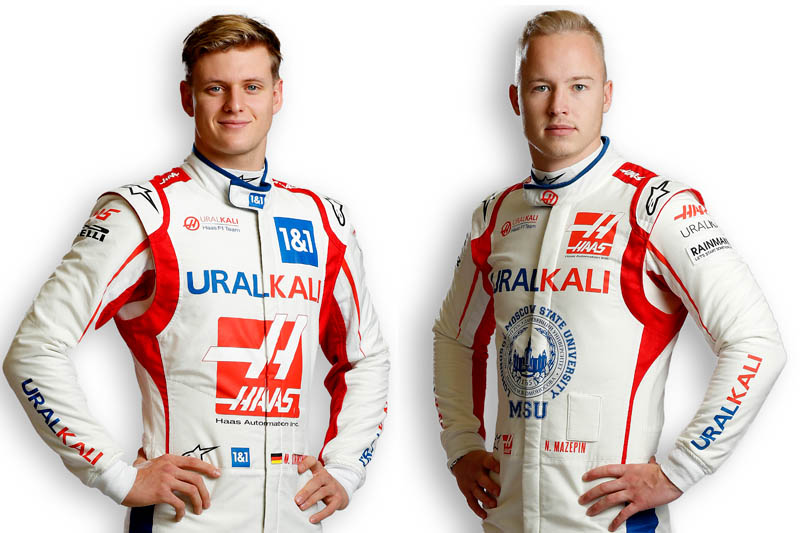
The Uralkali Haas F1 team travels to Italy and to the Autodromo Internazionale Enzo and Dino Ferrari for the second round of the 2021 FIA Formula 1 World Championship, the Emilia Romagna Grand Prix.
The racetrack, commonly referred to as Imola with regard to the adjacent city, reappeared on the pandemic’s schedule in 2020 after a 14-year hiatus. The comeback was well received by Formula 1 stakeholders, teams and drivers alike, and while the hold initially appeared as a longshot, the organizers ultimately secured a spot on the 2021 calendar.
After last year’s presence on a fall date, Imola is returning to its more traditional spring berth this season, having been in that slot from 1981 to 2006 when it was known as the San Marino Grand Prix. Named after the Emilia Romagna region where Imola is located, it will be the fourth round in Italy in just eight months, following last year’s events in Monza, Mugello and Imola.
The 4.9 km long track offers teams and drivers a number of challenges. The presence of several complexes with low and medium speed and high curbs puts emphasis on stability and traction, while the long full throttle run from Rivazza to Tamburello, reaching a high top speed is also important. The narrowness of the old-school circuit and the rare strong braking zones also put qualifying and race strategy at the center, with track position being preferred due to the drivers’ difficulty in being overtaken.
For rookies Nikita Mazepin and Mick Schumacher, it will be their first experience with Imola at the wheel of a Formula 1 car – although both of them had previously driven at the venue. Mazepin took part in the Formula 3 European Championship in 2016, while Schumacher also won the Italian Formula 4 category in Imola in 2016.
Mazepin and Schumacher want to build on the experience they gained from their first Formula 1 race weekends in Bahrain and put some of the first lessons on the historic circuit into practice.
One less race – 22 more. How did you rate the team’s performance at the Bahrain Grand Prix at the start of the season and how did Nikita and Mick work through their debut on the race weekend?
Günther Steiner: “Well, the performance of the team and the car – we know what it will be. So the expectations weren’t high, at least with regard to the results. I think the two drivers did a good job over the course of the year. ” Weekend. Of course, Nikita spun in the race and damaged the car, and Mick spun once too – but the whole weekend was a learning curve for her. We need to do more of it and do as many laps as possible with it. We’ll be fine. It was a weekend from 23. We have to keep getting better, work on doing more laps and keep learning – that’s the mission. “
Do you think people are underestimating the challenge for a team to start over with a brand new driver line-up? What are the specifics of your role to ensure that the drivers are comfortable on the team? How practical are you in this management process?
GS: “It’s a pretty big challenge. Formula 1 is a very difficult sport, but we knew the challenge, so there is no big surprise. We made it up and we have to face it. I’m just trying to do it see.” that the drivers are comfortable – I’m not trying to micromanage them. They have their engineers and have to work with them every day or, more precisely, from hour to hour, not me. Of course, at the beginning I’ll be well informed and try to see where I might have to intervene. I don’t do the job myself, I have good people who work for the team who know how to do the job better than me. I’m just watching what happens. When there is a problem, I am there to ask what it is and then I see if I need to do anything. “
When you think about what you saw through testing in Bahrain and then on the track through to the race weekend – is there anything that sets you apart in terms of the competition, or has the grid turned out as you expected?
GS: “A very short answer. The grid looked exactly as I expected after the test. I think we will see a battle between Red Bull and Mercedes for victories this season.”
Looking at Imola – on the last visit the team had no historical reference point on the racetrack as Formula 1 had not driven there before in the short history of the Uralkali Haas F1 team. A little over five months later we return to the circuit. Is it more useful to have this current track knowledge as a benchmark to evaluate the drivers on their learning curve or from a technical point of view in terms of vehicle set-up – or is it both?
GS: “It’s mostly useful in vehicle set-up. Even if the cars haven’t changed much, they have changed with the aero regulations, so there is a difference. It’s always good to have been to a racetrack. Everything you know and what you have learned is all useful. The more you have been, the better it is. Sure, it will help the team and our rookie drivers. “
After you’ve had time to digest and think about your Formula 1 debut weekend in Bahrain – what’s especially important if you can learn from this event and apply in the future?
Nikita Mazepin: “I think the most important thing I have to get used to is learning the schedule. The weekend is much more intense with all that is going on and the sessions on the right track. It’s about that Maintaining focus and learning the schedule – that’s the biggest thing. “
With the intensity of pre-season testing, which was almost immediately followed by the Bahrain Grand Prix, there was now a longer than usual break of two weeks between races. How did you use this time, both professionally and personally, to recharge before Imola?
NM: “For me personally it was very important to use these two weeks to go away and think about the weekend, to see the things that I need to improve – and of course there are a lot of things that are a beginner. Besides, was it’s very nice to go home and see my family. As we knew that the year was going to be a very busy schedule, these two weeks were very important. “
What are your memories of races in Imola in your junior career?
NM: “I drove in Formula 3 in Imola in 2016. It’s a very old racetrack and it was very special to drive there with the memories of Ayrton Senna. When I go to Formula 1, there will obviously be a lot of changes give, but I look forward to being out there again. “
What preparations did you make before driving a Formula 1 car in Imola for the first time?
NM: “Some of the simulator drives were very important as I haven’t raced the track for five years. It’s a track where the qualifying lap is very important because there are very few opportunities to overtake. So to get that one boost – so good.” The qualifying round is key. Being there from the first minute is the key factor for the race weekend. “
After you’ve had time to digest and think about your Formula 1 debut weekend in Bahrain – what’s especially important if you can learn from this event and apply in the future?
Mick Schumacher: “I think I’ve learned a lot of new things in general and we’ve seen this come through in all the meetings we’ve had. It’s always different to talk about it and feel it. It. It There’s a lot of things I’ve learned about tires, that’s probably the biggest new thing for me. Even when it comes to how much downforce we lose at the start of the race, it’s like the moment you do turn, switch from 100 percent downforce to 20 percent downforce I felt like I had a lot more knowledge and a lot more comfort, but I was also very surprised at how quickly the weekend was over. It all happened in an instant – it was a In the case of little time and much to learn, let’s put it this way. “
With the intensity of pre-season testing, which was almost immediately followed by the Bahrain Grand Prix, there was now a longer than usual break of two weeks between races. How did you use this time, both professionally and personally, to recharge before Imola?
MS: “As usual, we had a couple of team meetings after the weekend, obviously to put a point on what we had learned and to put everything together before Imola. I prepared myself physically and also recovered a bit.” I was really just 100 percent focused on going to Imola. “
What are your memories of races in Imola in your junior career?
MS: “I only have fond memories there, to be honest. I drove in F4 in Imola and did a few tests in F3. To be honest, all the experiences I’ve had there are great. We had there once did a track run and saw five peacocks which was new to me. The track is amazing to drive. In terms of racing it can be quite difficult with very few overtaking spots. Once you are in a flow and do a nice lap, it is amazing, especially the way one corner after the other follows. There are fast corners, technical corners, the curbs that you have to drive on. There is definitely a lot to look forward to in a Formula 1 car. “
Describe the specific characteristics of the Imola circuit and what you need from a car to get there. What preparations did you make before you drove there in a Formula 1 car for the first time?
MS: “Obviously Imola is known for a lot of curbing. You have the two corners in the chicane where you have to take a lot of curbs. We have some long corners that follow long straights. Everything is basically very twisted. In all junior categories, I’ve driven there, it’s always been a lot of fun and a track that I love to drive on. I’m pretty sure things get a lot better in a Formula 1 car. It’s amazing, a Formula 1 Driving a car, so doing it on a super cool track, will be even more special. I’m definitely looking forward to it. In terms of preparation, I talked everything through with the team and looked through the notes I made there when I was young. “





