
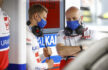
Mick Schumacher, Haas F1, with Simone Resta, (Photo by Andy Hone / LAT Images)
KANNAPOLIS, North Carolina (September 1, 2021) – Following the relaunch of the Formula 1 regulations to be used by the teams from 2022 onwards, the Uralkali Haas F1 Team will be introducing a series of content and updates to develop the VF-22 and the team behind a new era of racing for the American F1 team. In the first of two conversations, we talked to Technical Director Simone Resta, who introduced the team behind the VF-22, priorities and how building a new car is about both people and machines …
Ciao, Simone! You joined the Uralkali Haas F1 team in January 2021. What made you decide to join the American Formula 1 team?
“Joining Haas was a new challenge and I decided to take it when it was offered. It is a very interesting professional opportunity to be part of a young and ambitious growing team. “
If there is a big rule change that affects numerous areas of the car, when does work on the current car stop and the team look ahead? How is the VF-22 brought to life, since the genesis of a Formula 1 car is rarely shared …
“This major rule change was originally planned for 2021, when the COVID pandemic hit our sport, it was decided to postpone the introduction of the new rules to 2022 with several changes. At the same time, aerodynamic development on this platform was frozen for the rest of 2020.
“When that decision was made, Haas was at a point where only some small development work was done, so in 2021 it was basically a restart of those regulations.
“As mentioned, I joined the team in January of this year and worked with the team almost from scratch on the new technical organization, being quite involved in the technical organization recruitment process, role review and decision making was. while doing the minimal work required to legalize the VF-21.
A lot of people are involved in the development of a new car – can you give us a few details about the groups and key figures?
“I feel very fortunate to be able to work with a group of very talented engineers, some of whom even joined the team with me. If you look at my first line of report, there is Andrea Da Zordo (Chief Designer), Matteo Piraccini (Head of Chassis Engineering), Arron Melvin (Head of Aerodynamics), Maurizio Bocchi (Performance Development Manager), then we have Ayao Komatsu, ( Director of Engineering) and Ben Agathangelou (Head of Engineering Operations).
“That’s the line-up of the group, I am physically in Italy with most of the technical group, while Ayao, who travels to all the races, sits with his department in Banbury.
“In addition to our core Haas team, we have an important component from Dallara based in Italy. The scope of the collaboration has been reduced slightly compared to 2019, but this collaboration remains strategic for us, thanks to the support in design, aero and wind tunnel engineering-related activities.
“The technical group is spread over four main offices, two in Maranello (Ferrari area), one in Varano (Dallara) and another in Banbury.”
How do you prioritize? If something comes up that you think needs more time to be spent on, does it have to be something else?
“It’s always a compromise because we work with finite resources, and with the introduction of the budget cap in our sport, more and more of those compromises will come into play. The decisions for the chassis project are mainly made between Andrea and Matteo, with assistance from Ben in terms of legality and planning. The responsibility to drive the aerodynamic development program is part of Arron Melvin’s mission. In his day-to-day business, he is supported by two main aerodynamicists, Juan Molina and Rhodri Moseley, who lead several aero team leaders who are responsible for all areas of the car.
“Vehicle performance is a day-to-day business for the entire technical organization, but Maurizio and Ayao are worth mentioning as two key players.
“If we think of aerodynamic development, for example, we can always imagine that two separate groups are developing the new car and the current year in parallel. In 2021 this is an exception as the Haas team made the strategic decision to focus almost entirely on developing the new car in 2022.
“After all, we at Haas firmly believe in empowerment. Each engineer is responsible for his own area or component, and the structural role is to ensure that the colleagues working in each area execute and adhere to the plan. This is our business. “
Does it sound as much like a people management business as it does a technical business?
“It’s like technical management. There is a lot of management, process, organization and personnel work – together with a mixture of complex technical decisions, tool development, planning and, last but not least, pure racing. “
You have been involved in many car design and regulatory changes throughout your career. What kindles the fire in you and what is addictive to the Formula 1 business?
“I believe that the introduction of new regulations is a unique opportunity for the team to develop ideas from scratch as there are no references to existing cars. You can see the fire and ambition in every engineer’s eyes to prove that they can come up with the best design or concept. In a way, there are many common elements and situations between new car projects, but it is also true that they are all different as the conditions are not the same. With a new set of rules you try to develop something that doesn’t yet exist – that’s very exciting – and having learned from previous experience is a key element in facing new challenges in order to maximize the team result.
-UralkaliHaasF1Team-
Did you miss our previous article...
https://formulaone.news/haas/callum-ilott-joins-juncos-hollinger-racing-for-portland





