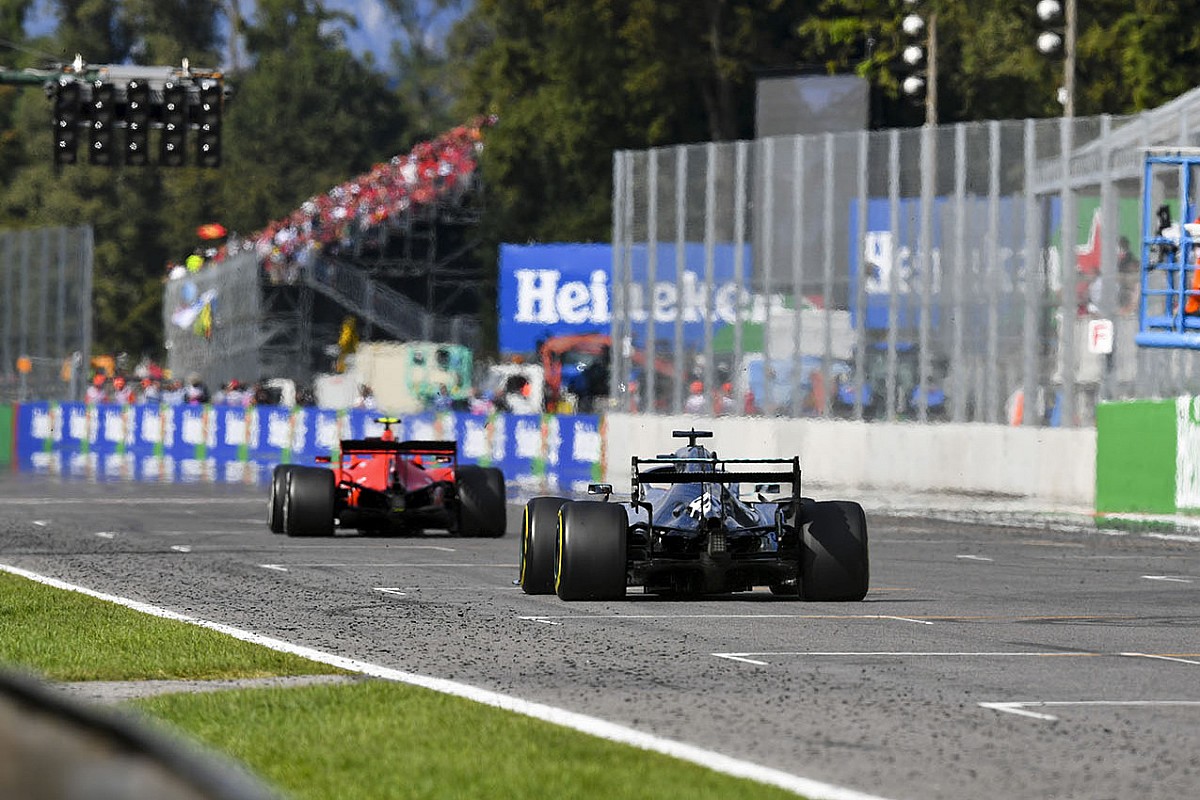
The German manufacturer faces ongoing concerns about its engine this season as both Lewis Hamilton and Valtteri Bottas have faced a number of start penalties since the summer break.
Hamilton, who is being determined for a DRS violation in qualifying, has acquired a new internal combustion engine for the Brazilian Grand Prix this weekend and will be serving a starting penalty of five places on Sunday.
The Mercedes situation is a surprise considering how few problems it had with reliability during the turbo-hybrid era. Honda’s F1 technical chief Toyoharu Tanabe noted that he “can’t believe” why his rival has fought so hard.
Team boss Toto Wolff believes, however, that the current difficulties are a result of Mercedes having achieved too much in the chase during the 2019 season – when Ferrari had an advantage of power.
This season proved controversial as Ferrari’s engine was subjected to an FIA investigation into potential behavior that circumvented F1’s strict fuel flow limits.
While the FIA could not prove that Ferrari had broken the regulations, the retrofitting of an additional fuel flow sensor caused the Italian team’s performance to decline.
At the time, Mercedes was upset because it felt that its employees were being pushed to their limits in order to achieve the Ferrari performance that they believed was the result of the Italian team breaking the limits of the rules.
Now Wolff is suggesting that the measures he took back then to catch up in 2020 reappear now.
“We were challenged a lot in 2019 and in 2020 we came up with a unit that was there, but maybe it was too much of a strain on us,” explains Wolff.
“When you’re constantly striving for performance, reliability sometimes falls behind. And I think that happened. “
Lewis Hamilton, Mercedes W12
Photo by: Steve Etherington / Motorsport Images
While Mercedes has understood a lot more about its reliability issues over the past few weeks, the decision to switch Hamilton’s engine for Brazil came out of concerns about the degraded performance.
Since the team had to reduce the power at the end of the life of each engine, it made the most sense to give Hamilton a boost with a new unit.
Wolff added: “We are not yet 100 percent comfortable on our part with regard to reliability and degradation. What we know for sure is that the more we do this, the more we lose power.
“That’s why we don’t want to continue operating this current engine and end up in Saudi Arabia or Abu Dhabi with little more if we’re still in the championship.”
Although the reliability of the engine is currently not completely under control, Wolff says that Mercedes cannot let up with its performance boost before an impending development stop.
“You have to push hard,” he said.
“We’re fighting an extremely powerful and reliable Honda engine and these guys have put all the resources you can possibly use into this last season. Because of me.
“And that will continue to be, in a certain way frozen, the engine for the next few years.
“So we just have to make sure next year that we start with an engine that is performing as well as it is now, but that can actually survive the season without risking engine penalties.”
Did you miss our previous article...
https://formulaone.news/ferrari/raikkonen-reacts-when-alonso-amp-vettel-propose-a-devious-plan-to-defeat-him-at-the-2021-crypto-overtake-award