
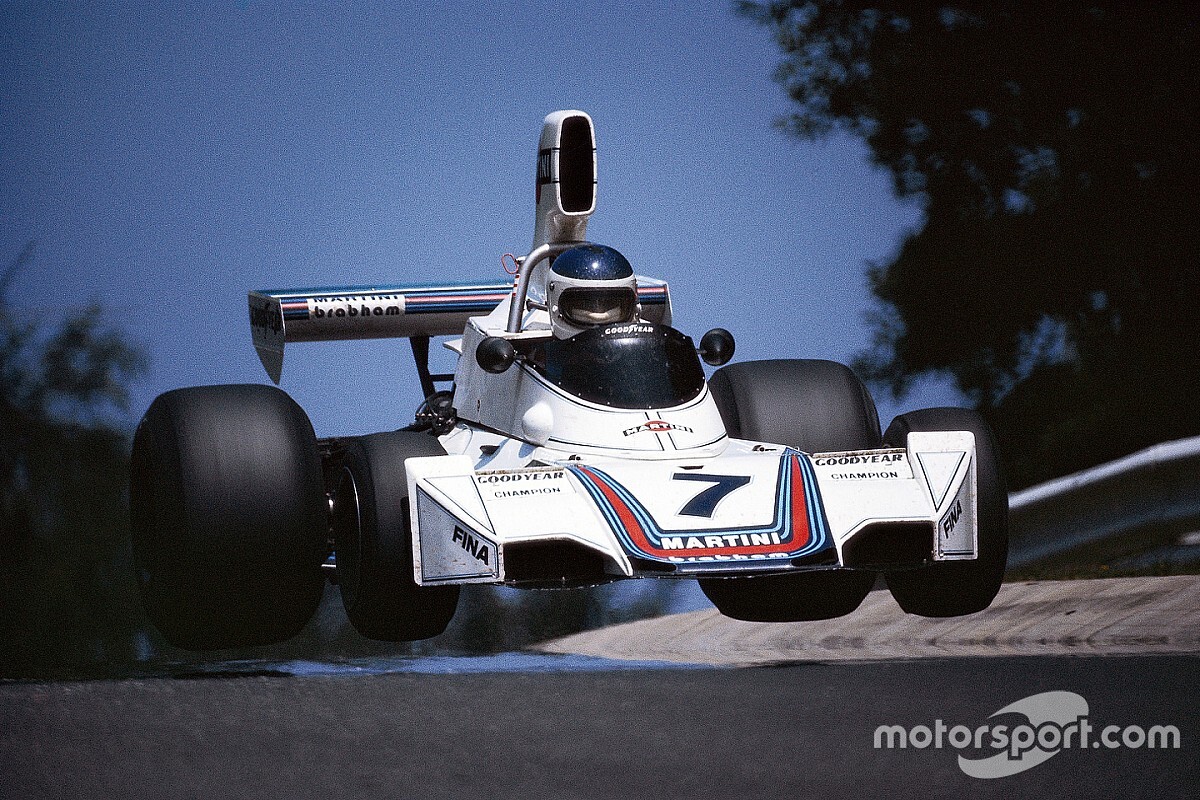
In 1974, the Argentine Reutemann celebrated his first Grand Prix victory in Kyalami, South Africa. It was not only the first Formula 1 world championship triumph for a Brabham since 1970, but also the first victory of an F1 car designed by Gordon Murray – by a happy coincidence in Murray’s original homeland.
The fact that Reutemann was to be successful at this level early in his third season was not a shock for the Formula 1 establishment. Most of his rivals had expected this since Carlos was signed by Brabham’s new owner Bernie Ecclestone in 1972 – and landed pole position on his Grand Prix debut.
Race of my life: Carlos Reutemann, South Africa GP 1974
Though the remainder of Reutemann’s rookie season was wasted on the mediocre Brabham BT37, it began to show promise when Murray’s BT42 hit the tracks in 1973. At a time when only the six first placed points scored, Reutemann was rewarded six times in the last nine races of the season, including two podium places. When Murray wrote the striking BT44 in 1974, Brabham again looked like a team worthy of its founder, Sir Jack Brabham, and Reutemann scored three wins that year.
The pretty BT44B update for 1975 faced Lauda’s faster and more reliable Ferrari 312T, and now Reutemann had the opposite problem to the previous year. Murray had ironed out the flaws of the original so the car was nearly bulletproof in terms of reliability, but now lacked a crucial speed advantage so Reutemann blew his Goodyears and tried to keep up with the red cars on race day.
With one win – a lucky triumph at the Nürburgring – and five more podium places, he would be third in the championship. But for arguably the first time in his career he encountered a tough teammate, Carlos Pace, and he was lacking in qualifying speed, a trend that continued through 1976.
Given the sensation Reutemann would later prove, Pace – who was killed in a plane crash in 1977 – was perhaps one of F1’s greatest unfulfilled talents. Or, as some speculated, Reutemann hung his head. Reutemann was a sensitive man, emphatically not stubborn, and when he discovered a closer connection between the Brabham team leaders and Pace, it was not inconceivable that this worried him to an unusual degree.
Not that there were any winners at Brabham in 1976, as Ecclestone replaced Cosworth V8s with Alfa Romeo Flat-12s. The gorgeous Martini-painted machines were neither fast nor reliable, and Reutemann got the short end of the stick and failed to finish nine of the 12 races he started for the team that year.
Engine smoke from the rear of Carlos Reutemann’s Brabham BT44B Ford leads to his retirement
Photo by: Motorsport Images
Enzo Ferrari pushed for an open door when he approached the Argentine to replace Clay Regazzoni in 1977. The change came early when Lauda suffered life-threatening injuries at the Nürburgring in 1976. But just like Ferrari confirmed Reutemann for the Italian GP, Monza, the burned defending champion, announced his hardly credible return and obliged Scuderia to field three cars. In both qualifying and the race at Monza, Lauda outperformed his future team-mate full-time, which made the additional entry unnecessary, which meant that Reutemann had to suspend the remaining three races after leaving Brabham.
In the 1977 season, Lauda and Reutemann were more or less even in qualifying, but the ice-cold Austrian, who had little time for his team-mate, would take three wins and the world title, while Reutemann caught up with a single win and fourth place in the points classification a season in which you sometimes looked brilliant, sometimes mediocre.
When Lauda left the squad before the end of the season, Reutemann was pushed into the team leadership, with rookie Gilles Villeneuve as a teammate. Reutemann reacted great. While Lotus recorded eight victories in 1978 and top driver Mario Andretti won the world title, the Reutemann Ferrari 312T3 was without ground effect, but Reutemann’s Michelin-shod Ferrari 312T3, which came closest to a constant threat, four wins and a third in the championship.
So his inventory was high when he switched to Lotus in 1979, but the move came at an inopportune time: the new Lotus 80 did not work well on most routes. Andretti would take third place on the beautiful machine’s debut, but he would only use it twice more while Reutemann refused to drive it entirely. Instead, he decided to return to the Lotus 79, which was no longer fast enough to seriously threaten victory.
The strong car in the second half of the season was the Williams FW07, and Reutemann took the opportunity to switch to Frank Williams’ team in 1980 and drive the new B-model – even if it meant signing a contract with him as No. 2 Williams incumbent Alan Jones. This deal should soon become insignificant, as the Australian won five races and the world championship, right up to Reutemann’s individual victory in Monaco and third place in the points table, Brabham’s Nelson Piquet separated them in the overall standings.
Reutemann seemed to turn the tables in ’81 with the FW07C and increase his qualifying pace (10-5 against Jones), but he would cause tensions within the Williams team, which despite Jones’ title still had not lifted the restriction as Reutemann # 2. The Argentine was mistaken by Jones in leading the season opener at Long Beach, but in Brazil, Reutemann ignored team orders, didn’t switch for Jones and drove to victory. Jones and the team weren’t impressed.
Reutemann won again in Zolder, and that was an emotional triumph, because an Osella mechanic got in the way of the Williams # 2 in the pit lane during training and died of his injuries. Carlos’ distress was not reflected in his perfect drive, but was clearly visible on the podium. He later flew to Italy to meet the young mechanic’s parents.
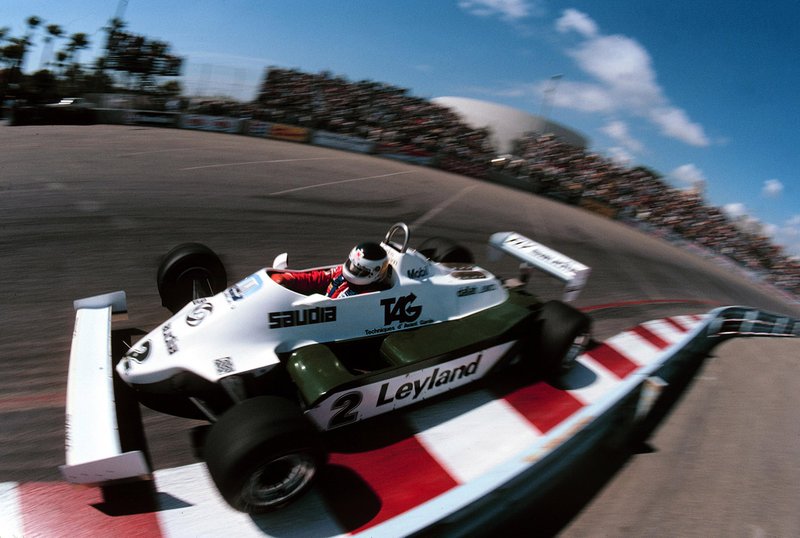
Carlos Reutemann, Williams FW07C
Photo by: David Phipps
After round nine of 15, Reutemann led the championship by 17 points. However, in the remaining six laps he only finished in the top six twice, and for the last three races of the year he drove as if he didn’t really want the title, performing his only real protagonist, Piquet (who took the crown) and Jones. Reutemann decided a few days after the season finale to leave Formula 1. He later reversed the decision and competed in the first two GPs of 1982 for Williams, scooping a podium before giving up again, this time for good.
When he entered political life as governor of Santa Fe, the motorsport world had to ponder the mystery Reutemann. Was he too sensitive? Did he need more attention to do his best more consistently? Was he consciously or unconsciously averse to the attention that championship would have brought? Did he just think about it? How can a man who is mentally strong enough to overcome the tragedy in the Zolder pit lane in 1981 in order to take pole and win not show the same steadfastness in dealing with teammates as Lauda or Jones?
Nobody – maybe not even the man himself – had all the answers. But most would agree that, at best, Reutemann was almost inviolable.
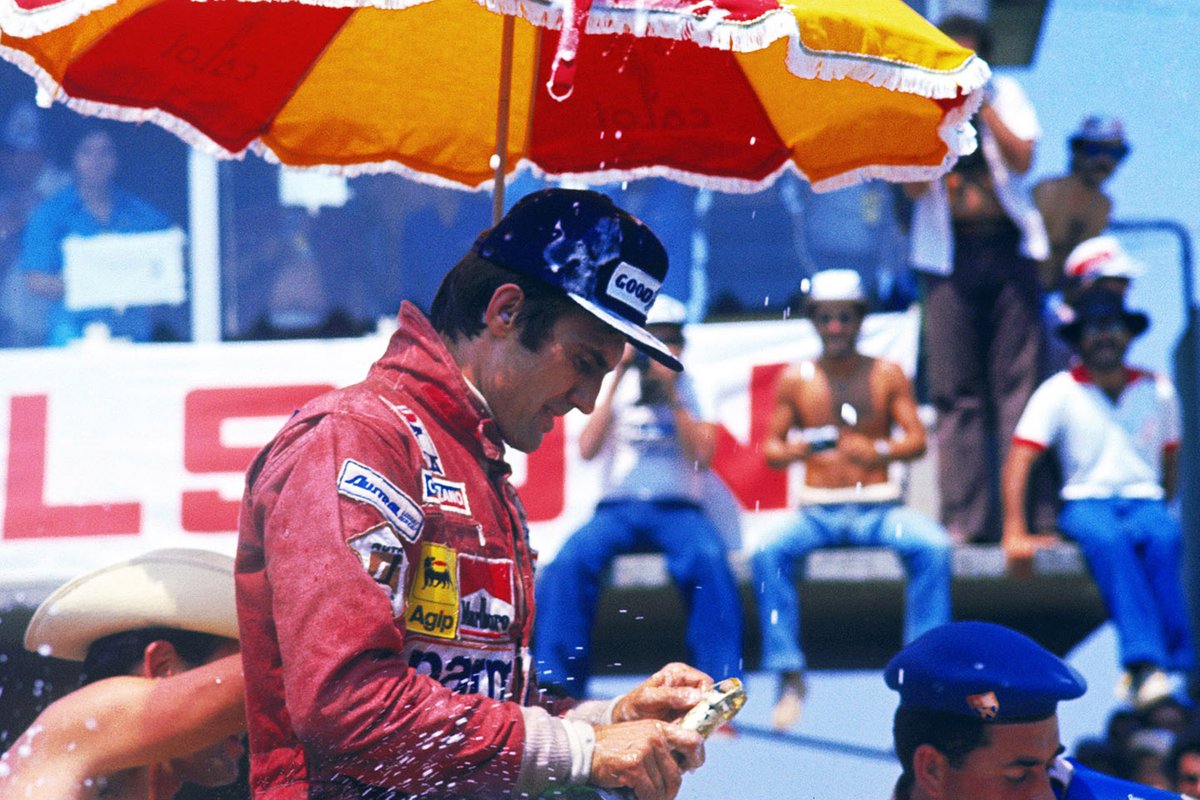
Carlos Reutemann, Ferrari celebrates its victory on the podium while trying to open its bottle of champagne
Photo by: David Phipps
The post 12-time Formula 1 racing winner Carlos Reutemann: 1942-2021 first appeared on monter-une-startup.




